Turkish TV Series as a Soft Power Tool1
Şerif Arslan (a), & Aytekin İşman (b)
(a) Ondokuz Mayıs University. Samsun, Turkey. Email: serif.arslan[at]omu.edu.tr ORCID https://orcid.org/0000-0003-4369-8982
(b) Sakarya University. Sakarya, Turkey. Email: isman[at]sakarya.edu.tr ORCID https://orcid.org/0000-0003-0420-7976
Received: 13 July 2024 | Revised: 22 October 2024 | Accepted: 30 October 2024
Abstract
The concept of soft power, developed by Joseph Nye in the 1990s, refers to a country’s ability to influence others in pursuit of its interests through cultural, political values, and foreign policy, rather than military or economic coercion. Turkey has adopted this strategy by transforming cultural and media elements into tools of foreign policy. Particularly since the 2000s, the significant leap in the television series industry has positioned Turkey as one of the leading countries in television exports globally. This study examines the impact of Turkish television series, a crucial tool of Turkey’s cultural diplomacy, on the international stage through content analysis of the series “Gümüş” and “İstanbullu Gelin”. The analysis reveals that these series idealize and present Turkey’s cultural values and lifestyle while simultaneously reflecting and transforming Turkish culture and society in various ways. This phenomenon is notably supported by visual representations that highlight Istanbul as a center of attraction. Furthermore, it has been determined that foreign audiences develop a positive perspective towards Turkey and Turkish culture through these series, indicating that they play a significant role in strengthening Turkey’s soft power. In conclusion, it is emphasized that Turkish television series enhance the country’s cultural influence on a global scale and support its soft power strategies, thereby strengthening Turkey’s position in international relations.
Keywords
Turkish Television Series; Soft Power; Cultural Diplomacy; “Gümüş”; “İstanbullu Gelin”; Media and Culture; Turkey’s Image; International Relations; Soft Power Strategies; Cultural Representation
1This study is derived from the doctoral thesis titled “Perception of Soft Power in Turkish Television Series,” which was accepted in 2022 at Sakarya University’s Institute of Social Sciences, Department of Communication Sciences.
Турецкие телесериалы как инструмент мягкой силы1
Арслан Шериф (a), Ишман Айтекин (b)
(a) Университет Ондокуз Майыс. Самсун, Турция. Email: serif.arslan[at]omu.edu.tr ORCID https://orcid.org/0000-0003-4369-8982
(b) Университет Сакарьи. Сакарья, Турция. Email: isman[at]sakarya.edu.tr ORCID https://orcid.org/0000-0003-0420-7976
Рукопись получена: 13 июля 2024 | Пересмотрена: 22 октября 2024 | Принята: 30 октября 2024
Аннотация
Концепция мягкой силы, разработанная Джозефом Найем в 1990-х годах, описывает способность страны влиять на другие государства в достижении своих интересов посредством культуры, политических ценностей и внешней политики, а не военных или экономических методов принуждения. Турция успешно использует эту стратегию, превращая культурные и медийные элементы в инструменты внешней политики. Особенно с 2000-х годов стремительное развитие индустрии телесериалов позволило Турции занять одну из ведущих позиций в мире по экспорту телевизионного контента. В данной работе исследуется влияние турецких телесериалов, являющихся важным инструментом культурной дипломатии Турции, на международной арене на основе контент-анализа сериалов «Гюмюш» и «Стамбульская невеста». Анализ показывает, что эти сериалы идеализируют и представляют культурные ценности и образ жизни Турции, одновременно отражая и трансформируя турецкую культуру и общество. Это явление особенно поддерживается визуальными образами, подчеркивающими Стамбул как центр притяжения. Кроме того, было установлено, что зарубежные зрители формируют позитивное отношение к Турции и её культуре через данные сериалы, что подтверждает их важную роль в укреплении мягкой силы страны. В заключении отмечается, что турецкие телесериалы усиливают культурное влияние Турции на глобальной арене и поддерживают её стратегии мягкой силы, укрепляя позицию страны в международных отношениях.
Ключевые слова
турецкие телесериалы; мягкая сила; культурная дипломатия; «Гюмюш»; «Стамбульская невеста»; медиа и культура; образ Турции; международные отношения; стратегии мягкой силы; культурная репрезентация
1Данное исследование основано на докторской диссертации под названием «Восприятие мягкой силы в турецких телевизионных сериалах», которая была принята в 2022 году в Институте социальных наук Университета Сакарьи на кафедре коммуникационных наук.
Introduction
Public diplomacy is defined as a communication process through which a government conveys the ideals, ideas, institutions, and culture of its nation, as well as its national goals and existing policies, to foreign public opinion. A literature review indicates that while there are various views regarding the emergence and definitions of the concept, it is generally accepted that the term “public diplomacy” was first used by Edmund Gullion, the dean of the Fletcher School of Law and Diplomacy at Tufts University, in 1965.
Historically, the classical understanding of diplomacy, which was conducted solely between states, has evolved into new diplomatic practices, particularly since the 19th century, with the advancement of communication technologies. This shift has led to the emergence of approaches such as Liberalism, Behavioralism, Neorealism, Neoliberalism, World-Systems Theory, Critical Theory, and Postmodernism, which argue that international relations and foreign policy are not solely the domain of the state as a single actor. Instead, they contend that civil society organizations, media, think tanks, and other non-state actors also play significant roles. One of the fundamental factors contributing to the development and strengthening of these approaches is the historical context where international relations and foreign policy were primarily based on “security” concerns, and the only counterparts for states were the states on the other side. However, in contemporary world politics, not only states but also public opinion within states, media, civil society organizations, and economic groups constitute the counterparts of states. Therefore, while traditional diplomatic methods promoted a one-sided communication model, new forms of diplomacy practiced since the mid-20th century, referred to in some sources as “soft power” and in others as “public diplomacy,” incorporate a bilateral and effective communication model. One of the essential characteristics of this new diplomacy is that states regard war as a last resort (or, according to many theorists, not even a remedy) and seek to resolve conflicts that arise in international politics through peaceful means.
In this regard, an examination of the literature reveals that the subject is primarily discussed within the discipline of international relations. The topic is often approached in relation to international politics, international actors, power balances, conflicts, and collaborations. As noted earlier, the necessity for a bilateral and effective communication model has also prompted discussions and studies within the discipline of communication sciences. The studies conducted in communication sciences regarding this issue primarily focus on examining the activities of Turkey’s soft power/public diplomacy tools (such as TIKA, YTB, the Public Diplomacy Coordination Office, and the Yunus Emre Institute), revealing that the aspect of “influence” has not been thoroughly examined, which is another significant finding from the literature review.
As the ability to influence international public opinion and agenda has gained increasing importance, public diplomacy has become indispensable to foreign policy. Governments aim to create impact on their foreign target audience through public diplomacy and bring about desired changes in behavior. Consequently, the influence of the represented country on its target audience is heightened in public diplomacy. States engage in public diplomacy efforts, utilizing media to foster sympathy in foreign publics, eliminate misunderstandings, and manage perceptions in desired directions, aligning with foreign policy objectives. Public diplomacy, which signifies soft power for states, has evolved from the traditional understanding of diplomacy, where the hard power (focused on military and economic coercion) of countries takes precedence, into a tool that resonates with people’s minds and hearts through values and culture. In this context, the media undoubtedly plays a crucial role for states in influencing and persuading foreign target audiences, as well as in the transmission of culture and ideology.
As a media element, television series also play a significant role in promoting a country and transmitting cultural values to other societies. In this regard, Turkey has notably emphasized its television series sector since the 2000s, transitioning from a country that did not produce series and relied on imports to one that exports series. Research indicates that Turkey is the second-largest exporter of television series after the United States (Cereci, 2014, p. 2-4). The television series exported by Turkey reach various regions, from the Middle East to the Balkans, Asia to Europe, Africa, Latin America, and East Asian countries. The revenue generated from these series was approximately $100,000, which increased to around $400 million by 2018. The target for the television series sector in 2023 is expressed to be approximately $1 billion (aksam.com.tr; Haberturk.com; sozcu.com.tr, 2018).
While discussing all these developments and effects of the media, it is highlighted in the literature that Nye (2020, p. 24) introduced the concept of soft power. Although the concept emerged from the ashes of the discipline of international relations and has been extensively researched in this field, a significant portion of its application area is found within media and communication studies. Soft power refers to a country’s ability to enhance its appeal and attractiveness to other countries without resorting to hard power (Nye, 2020, p. 24). After the introduction of the soft power concept, scholars began discussing it and attempting to construct its theoretical framework. Following various criticisms, Nye produced new studies to explain the concept in more detail and to lay out its theoretical foundations. In these studies, he posited that there are three different sources of soft power: culture, political values, and foreign policies, and if effectively utilized, states could influence other countries without resorting to hard power (military intervention, war, economic sanctions, etc.) (Nye, 2004, p. 20-24).
With the initiation of discussions on the soft power concept, public diplomacy practices involving factors external to the state began to give way to soft power practices. In other words, states have started to compete not only in military, economic, and technological domains with other countries but also in the realm of soft power. In this competition, the United States has produced numerous films since the 2000s that showcase the levels it has reached in technology and convey messages about its role as a global protector (Medin & Koyuncu, 2017, p. 7). The leadership that the U.S. has achieved in this area continues to be reflected in contemporary cinematic works. Following the U.S., countries such as China, Russia, Japan, and India have also produced films that highlight both their own cultures and the other sources of attraction from their countries.
Since the 2000s, Turkey has also begun to participate in both foreign policy strategies and soft power efforts. In this context, two fundamental media pillars of Turkey, TRT and AA, have been transformed. The number of representatives of AA abroad has been increased. Similarly, TRT has implemented comparable practices, launching channels such as TRT 6, TRT World, and TRT Arabic (Aydemir, 2016, p. 325-330).
Within the framework of public diplomacy and soft power, not only the media but also civil society organizations have begun to be utilized effectively. Additionally, organizations such as TIKA have been restructured, and new institutions such as the Public Diplomacy Coordination Office and YTB have been established, along with the implementation of exchange programs and scholarships for international students (Ekşi, 2018, p. 178-200).
These initiatives aimed at the outside world also include Turkish television series. Until the 2000s, Turkey was a country that imported series; however, from this period onward, it began producing its own series. Particularly after 2008, the network of Turkish series began to expand. Following these developments, Turkey has become a country that exports television series. As emphasized in the literature, Turkey is the second-largest exporter of series after the United States. The successful reception of Turkish series in many countries has increased interest in Turkey. Notable series such as “Magnificent Century,” “Valley of the Wolves,” and “Gümüş” have garnered considerable viewership in various countries. In fact, the final episode of “Gümüş” was viewed by approximately 80 million viewers in the Middle East (Deniz, 2010). This situation has been reflected in academic studies, and in recent years, there have been scientific investigations both in Turkey and abroad regarding this aspect of Turkish series. Furthermore, a “Workshop on Turkish Series as a Tool of Public Diplomacy” was held in 2019.
The figures reached by Turkish series in the last decade are seen as a problem worthy of investigation. Following research and literature evaluation, this study aims to answer the following question(s):
-
What is the role and impact of Turkish series in Turkey’s soft power?
-
How is Turkey represented in Turkish series?
-
What are the positive aspects of Turkey depicted in Turkish series?
-
What are the negative aspects of Turkey depicted in Turkish series?
-
How are Turkey’s cultural elements represented in Turkish series?
-
What are the soft power elements symbolizing Turkey in Turkish series?
From Theory to Practice: Soft Power
In order to achieve the desired successes in international politics and to justify themselves in the eyes of societies, a country activates certain elements under the umbrella of soft power. Soft power is defined as the ability of a state to get the other party to consent to the desired behavior without using force or hard power, by using elements such as charm and attraction (Nye, 2004, p. 76; 2011, p. 43). In this context, a country’s soft power resources include culture, political values and foreign policies. In these times when hard power has lost its importance, states have started to attach importance to soft power elements in order to show their image as strong and to influence foreign public opinion. In this respect, deepening the concept of soft power is important for the content of this thesis.
Before moving on to the concept of soft power, the concept of power should be mentioned. It is one of the most important issues in international relations. The concept of power is often compared and evaluated with the concept of hard power in the process of foreign policy and diplomacy. The traditional view of power that prevails among international politics scholars has been a realist vision. Realists have tended to adopt a hard power concept that focuses on the idea of nations using ‘material resources’ to influence other nations (Barnett & Duvall, 2005, p. 40; Schmidt, 2007, p. 49-50). According to the classical realist perspective, power has been considered in the context of the relationship of interest and the understanding that ‘each state protects its own interest to the maximum extent’ has constituted the dominant view in this movement. Realists centered on ‘power’ in their approach and argued that international politics consists only of states. From this point of view, it was emphasized that clashes of interest were at the root of the wars and disputes seen in ancient times (Gallarotti, 2011, p. 27). Mearsheimer (2001, p. 55) stresses that avidity for power is based on ‘certain material capabilities possessed by a state’. These material capabilities are essentially the ‘tangible assets’ that determine the ‘military’ power of a nation. Waltz (1979, p. 131) shows a similar hard tendency in defining power by capabilities, consisting respectively of ‘population and territorial size, resource endowment, economic ability, military power, political stability and competence’.
Morgenthau (1970) is one of the names that attach importance to power in international relations and has almost become a source of reference in this field (p. 1-5) He states that what is meant by power is interest and that no national or international policy can be produced without power in international politics. According to him, international politics is ultimately a quest for power. However, although the ultimate goals of states may differ, at the end of the day, their most important goal is power or the attainment of power (as cited in H. Özdemir, 2008, p. 118).
This perspective, which is briefly summarized above and referred to as ‘Realist’ in political science, has been discussed over time and has lost its validity. The search for concepts seen in every field in the post-modern period has also shown its effect in this field. The resulting Liberal/Neoliberal understanding rejected the Realist understanding of power. The liberal approach adopted the understanding of a system of social relations instead of the system of states seen in the realist understanding. Moreover, in the liberal perspective, non-state actors in international relations are also given great importance.
One of the most important contributions to the concept of power in the International Relations literature was made with the concept of ‘soft power’. It has been a popular topic in the disciplines of international relations and communication sciences introduced to the literature by Nye in 1990. Nye (2004, p. 15-17) instigated the concept of soft power in response to claims that American power was weakening and declining, and further developed the concept in response to criticism.
Nye (2004, p. 26) stated that there has been a shift in international relations and world politics in terms of power, and in this sense, he emphasized the importance of not only forcing others to change through the threat of military force or economic sanctions, but also setting the agenda in world politics and attracting others. From this point of view, Nye (2004, p. 24) defined soft power as persuasion and attraction rather than coercion and pressure to achieve desired outcomes. According to him, power is becoming less malleable; the influence of coercion on power behavior is losing its importance and being replaced by cooperative power, which tends to emerge from sources such as cultural and ideological attraction. According to him, it is less costly to lead a society if it represents values that others want to adopt.
Soft power is the capacity of a country to exert influence over other countries without exerting military or economic pressure, but rather through cultural appeal, ideals and diplomacy. Unlike hard power in international relations, this concept aims to enable a country to influence another country without using force. This non-coercive, persuasive approach is shaped primarily by cultural values, political principles and foreign policy practices (Nye, 2004; 2011). While hard power uses methods such as military interventions, sanctions or economic pressures, soft power seeks to achieve voluntary cooperation by emphasizing a country’s own cultural appeal, political values and policies (Barnett & Duvall, 2005; Mearsheimer, 2001).
Soft power is one of the most important strategies that a country develops to increase its reputation and influence in the world. According to Joseph Nye, this power is shaped by the values, cultural products and political ideals that a country presents to the world and encourages other countries to voluntarily get closer to that country (Nye, 2011). In other words, the goal of soft power is to persuade the people or leaders of other countries to cooperate voluntarily and thus create a global environment favorable to the interests of the country. Unlike hard power, soft power does not coerce others; it attracts them to act voluntarily. A country’s soft power capacity is directly related to its cultural appeal and the success of its foreign policy.
A country’s cultural influence is one of the cornerstones of soft power. Culture includes a society’s way of life, beliefs, values and aesthetics. Cinema, literature, art, music, fashion and other cultural elements can shape a country’s perception in the world. These cultural elements can create a positive image of a country by transmitting its way of life and values to other countries (Nye, 2004). For example, Hollywood movies have helped American culture to spread globally and leave a positive impression on people around the world. Similarly, Japan’s anime and manga culture has strengthened Japan’s soft power by spreading the country’s cultural influence around the world. Culture also reflects national identity and provides a way to connect with other societies. By promoting its cultural products around the world, a country can not only share its own values but also build sympathy and admiration for itself across the globe. This is one of the fundamental principles of soft power.
Soft power is not limited to cultural activities; it is also directly related to political ideals and foreign policy practices. A country’s political principles and practices can make it a powerful actor in the international arena. Universal values such as democracy, respect for human rights, and adherence to the rule of law can cause a country to be admired by other countries. For example, the United States’ defense of democracy and freedom for many years has made it an attractive model for many countries. In this context, a country’s democratic structure and liberal policies can bring it prestige in the international arena and give it an advantage in its relations with other countries.
On the other hand, a country’s foreign policy strategies are also an important part of soft power. The search for diplomatic solutions, peaceful approaches and humanitarian aid operations can help a country to be perceived positively on the international stage (Nye, 2011). A country’s peaceful and solution-oriented attitudes in international crises can increase its soft power and foster more positive relations with other countries.
Foreign policy is considered one of the most important instruments of soft power. A country’s influence on the world depends on the strategies it pursues in foreign policy and the successful implementation of these strategies. Pursuing peaceful policies, respecting international law and offering diplomatic solutions in crisis situations increase a country’s soft power capacity. For example, the European Union’s prioritization of seeking peaceful solutions in its foreign policy has contributed to its perception as a peacemaker in the international arena, thereby increasing its soft power (Nye, 2011). Moreover, a country’s humanitarian aid activities can also be an important indicator of soft power. Aid during natural disasters, humanitarian crises or wars can positively affect the international community’s perception of a country. Such humanitarian aid can increase a country’s prestige in the international arena, thus giving it soft power.
For soft power to be effective, a coherent and sustainable foreign policy is necessary. The harmony between a country’s foreign policy and its domestic policy determines how successful that country will be in the international arena. A country that does not respect human rights and is not committed to democracy in its domestic policy cannot be credible in its foreign policy. Therefore, in order for soft power strategies to succeed, a country needs to show consistency in its domestic and foreign policies. Moreover, effective use of media and communication tools is also crucial to strengthen a country’s international image and enhance its soft power capacity. With globalization, media and communication tools have started to play an important role in international relations. How a country is presented to the world and how it is covered in the media directly affects its international image (Nye, 2004). Therefore, effectively promoting a country’s cultural, political and humanitarian values through the media is an important way to increase its soft power.
Soft power offers a space where not only states, but also non-governmental organizations, international organizations and individuals can exert influence. Non‑governmental organizations can carry out various humanitarian projects to enhance a country’s reputation in the world. International organizations can play an important role in finding solutions to global problems. For example, the United Nations is globally respected for its work in maintaining international peace and security. Individuals can also contribute to soft power strategies. Famous artists, athletes and writers can have a positive impact on the international arena by promoting the cultural values of their countries to the world. For example, Nobel Prize- winning scientist Aziz Sancar, by representing Turkey’s achievements in the field of science, has increased Turkey’s soft power and positively affected Turkey’s reputation around the world. The achievements of such individuals contribute to improving the perception not only in their own fields, but also in the international perception of their countries.
The effectiveness of soft power strategies is also directly related to international cooperation and solidarity. Inter-country cooperation, joint projects and international events play an important role in enhancing soft power. For example, cultural festivals, art exhibitions and sporting events organized jointly by many countries allow different cultures to come together and get to know each other. Such events reinforce a country’s soft power and increase its influence in the international arena. In addition, such cooperation increases trust between countries, helping to foster long-term relations.
Soft power should not only be seen as having a positive impact. This is because a mismanaged soft power strategy can lead to the opposite of what is expected. If a country’s efforts to spread its cultural elements around the world are not sincere, but only interest-driven, they may be met with a negative international backlash. For example, a country’s efforts to increase its cultural influence may create resistance to that culture, which may weaken its soft power. Similarly, inconsistencies in foreign policy can undermine a country’s soft power. Therefore, the effectiveness of soft power depends on adopting the right strategies and a sustainable and sincere approach.
The role of soft power in international relations has gained more importance especially in recent years. The acceleration of globalization, increased access to information and the widespread use of communication tools such as social media have enabled countries to use their soft power effectively. Social media has the capacity to rapidly disseminate a country’s cultural elements, policies and values. In this context, social media platforms offer new opportunities for countries to build their international image and increase their soft power (Nye, 2011). For example, a country’s social media posts have become an effective tool for promoting its culture, traditions and policies. Therefore, social media strategies are recognized as an important part of soft power strategies.
In general, soft power is an important strategy for increasing a country’s influence in international relations. Cultural appeal, political ideals and effective foreign policy practices are the main components of soft power. The effectiveness of a country’s soft power depends on the coherence between its domestic and foreign policy, the effective use of media and communication tools, and the contributions of civil society and individuals. Soft power offers a space where not only states, but also international organizations and individuals can contribute. However, the effective implementation of these strategies requires a sincere and sustainable approach. While soft power enhances a country’s reputation in the international arena, it also contributes to the development of peace, cooperation and understanding across the globe. In this context, the effective use of soft power by countries is critical to their success in international relations.
The Impact of Turkish TV Series on Turkey’s Soft Power
Turkish TV series have recently been effective in increasing Turkey’s soft power. Turkey, which imported TV series until the 2000s, has been on the rise in the sector since 2005 and has become a TV series exporting country. Turkish TV series and the TV series sector, which have recently come to the forefront in the international market with quality productions, have achieved significant success in many regions and countries from the Middle East to the Balkans, Asia to South America. According to 2019 data, Turkey has also brought more than 150 TV series to more than 700 million viewers in 146 countries in Europe, the Middle East, Central Asia, Africa, North and South America (Uştuk, 2019).
It is worth mentioning a few points about the success of Turkish TV series. First of all, this success of the series is considered as the success of the sector. In addition, there are also opinions that this success of Turkish TV series does not increase Turkey’s soft power, on the contrary, it decreases it (Aydemir, 2016, p. 368; Yörük & Vatikiotis, 2013, p. 2362). However, two aspects of soft power need to be considered here. The first one is the foreign policy-oriented part of soft power. Nowadays, it is almost impossible for private television channels to produce TV series that are entirely based on the foreign policy of any country. This is because the primary target of the series is the domestic audience. Depending on the success and ratings in the domestic audience, these series are sold to other countries. The second dimension of soft power is the element of attraction. Today, Turkish TV series are known to significantly contribute to Turkey's soft power by influencing viewers' perceptions of the country through their depiction of locations, objects, socio-cultural dynamics, and the economic status of characters (Bilis & Bilis, 2018, p. 407-408).
Another element that needs to be mentioned in relation to the series is that although the series are put on the market by the producers, marketing companies are in charge of exporting them. Turkish TV series are mostly exported through marketing companies. However, this does not mean that this is always the case. In the same way, a production company can also market its own products. For example, major Hollywood studios like Universal Pictures, Warner Bros., Disney, Fox, MGM, and Sony are often perceived as production companies, but they typically do not create their own content. For example, The Matrix is produced by Joel Silver, but Warner Bros. is the company that sells it to the world (calinos.com, 2011). The majority of soap opera exports in Turkey (around 80%) are carried out by companies such as Calinos Entertainment and Global Agency. Calinos Entertainment is the first Turkish company to market and sell television programs such as films, television series, documentaries and soap operas to local and international markets (Karlıdağ & Bulut, 2014, p. 79-80).
Turkish TV series have an important role in Turkey’s soft power. Turkish culture, Turkey’s historical and natural beauties, its secular and democratic structure, family lifestyles, local clothes and products, local games, etc. are conveyed to the world through TV series. This rising success of Turkish TV series was also recognized at the state level and in March 2019, the “Turkish TV Series Workshop as a Public Diplomacy Tool” was organized in cooperation with the Presidential Communications Directorate and Istanbul University (IU) Faculty of Communication. In his message to the workshop, Prof. Dr. Fahrettin Altun, Presidential Communications Director Prof. Dr. Fahrettin Altun mentioned the successes achieved by the sector and stated that Turkish TV series tell the historical texture of Turkey together with its modern face and meet with more than 500 million viewers from 156 countries. Mr. Altun also stated that the Turkish TV series sector, with an export volume of over 350 million dollars, ranked second after the US in this field, and that he believes that the Turkish TV series sector will reach an annual export figure of 1 billion dollars in 2023, especially with new efforts to be made for the Western European market (iletisim.gov.tr, 2019).
It is known that Turkish TV series are watched with interest especially in the Arab region. In this sense, Turkey is seen as a role model in Arab countries both in terms of its form of government and lifestyle. An assessment made on a news website on the subject is noteworthy. In the evaluation, as stated above, Turkey’s style of governance and the way of life of the Turkish society are seen as a role model by the Arab peoples in terms of how a balance between East and West can be achieved (porttakal.com, 2019). According to the website, one of the reasons why Turkish TV series are so popular and followed with interest is that Arabs see in them “a society that balances tradition and modernization”. In this respect, according to many thinkers, the “modern life that does not reject tradition” in Turkish TV series appeals to Arabs. It is also stated that there are many elements in Turkish TV series that are new but not alien to Arabs, and this creates a sense of ‘they are like us’ in Arabs. Thus, in Turkish TV series, this lifestyle, which Arabs desire but cannot yet have, is shown to the audience and made attractive. In other words, in general, the feeling of ‘identification’ that Turkish TV series create in the Arab public can be stated as the main reason for this success (porttakal.com, 2019).
The main appeal of Turkish television series is the ‘modern’ lifestyle they present to the viewer. From an Arab perspective, modernity is particularly inherent in certain types of gender relations and gender equality. In general, the image of women in Turkish TV series (with exceptions) is portrayed as ‘modern’, with economic independence, able to hold and rise through the ranks, make decisions and express opinions within the family. In this respect, women in Turkish TV series have a freer stance in society, are involved in professional life and have fairly liberal relationships with men compared to most of their Middle Eastern counterparts. Arab women have also expressed a strong appreciation for the romantic male characters featured on their social media accounts. Another contributing factor to the appeal of Turkish TV series is that they are presented in an environment of opulence and luxury, inhabited in the mansions of the Bosphorus (Yigit, 2013, p. 292).
Deniz (2010, p. 63), who examines the role of Turkish TV series in Arab communities with the example of “Gümüş” (“Gümüş” Series), evaluates the secularization of the society and the issues of women’s social role and freedom as the main reasons for the interest of Turkish TV series in the Arab society, in particular “Gümüş” (Nur). In addition, Turkish TV series have captured an important audience potential as they convey to the audience issues that are seen as social problems in Arab countries but cannot be voiced in public spaces (Deniz, 2010, p. 63). The finale of the series, which aired in Turkey under the name “Gümüş”, was watched by approximately 85 million people in the Arab world. The Arab public’s interest in Turkish TV series has also been echoed in the Western media. New York Times writer Michael Kimmelman (2010) in his article, argues that Turkey effectively markets its cultural value through TV series and uses soft power, and that the Turkish TV series wave, led by the series “Gümüş” (Nur in Arabic), has made its way to Arab television with series such as Yaprak Dökümü, Kurtlar Vadisi, Asmalı Konak, Ihlamurlar Altında, Aşk-ı Memnu, from crime thrillers to conspiracy thrillers, and has used a kind of soft power. According to Kimmelman (2010), from the small screen to the dining tables, living rooms and bedrooms of Arabs from Morocco to Iraq, Turkey has begun to exert an influence that the United States can only dream of. He also argues that Turkey’s cultural exports are not accidental, but have been enhanced by its political moves, such as sending an aid flotilla to Gaza, challenging US sanctions against Iran, talking tough to its former ally Israel, and giving an Islamic color to Kemal Ataturk’s constitutional secular state.
Today, TV series such as Diriliş Ertuğrul, Payitaht Abdülhamid, Muhteşem Yüzyıl, Kurtlar Vadisi, Kara Sevda, Kara Para Aşk, İstanbullu Gelin, Binbir Gece are watched with great interest in Arab countries, but this interest has also brought some criticisms. At the heart of the criticism is the claim that some of the values in the series are not in line with Arab-Islamic values. Scenes of alcohol consumption, extramarital affairs, having children and abortion are some of the points that Turkish TV series have been criticized in Arab countries.
Berg (2017, p. 49) found that Turkish TV series contributed significantly to the rise of Turkey’s soft power, Turkish TV series played a decisive role in the formation of a positive image of Turkey among Arab students, and students saw Turkey as a friend of Arabs and a successful model. Berg also found that (2017, p. 50-52) students admire Ottoman history because it is perceived as a period when Muslims, not Arabs, were collectively important, rather than seeing Turkey’s imperial past as a period of Arab oppression. Another remarkable result of Berg’s (2017) study is the statements of female participants. The study emphasizes that the views of female respondents have changed in recent years and that their desire to visit Turkey is driven by the beautiful landscapes they see in Turkish TV series, which provides a significant boost to the country’s tourism sector. In addition, Turkey is perceived as a model country that Arab countries aspire to be, as its society represents an ideal fusion of Eastern and Western values, which contributes greatly to the overall positive view of the country.
One of the TV series recently exported abroad is “İstanbullu Gelin”. Özcan Deniz, who plays a rich businessman from Bursa under the name ‘Faruk Boran’ as the lead actor in the series, plays a romantic and understanding character, which has been shown as an example by Israeli women. However, the fact that Israeli women constantly cited Faruk (Özcan Deniz) as an example for their own wives caused some men to react harshly on social media. So much so that an Israeli man finally couldn’t take it anymore and rebelled on social media. In the video shot by an Israeli man, he said, “People like Faruk Boran do not exist in reality, if you want someone like Faruk, go to Faruk. Go to Turkey. Leave me alone!” (internethaber.com, 2019a).
Through Turkish TV series, Turkey’s historical, touristic and natural beauties are conveyed to foreign audiences and, as Berg says, can attract foreign communities. In particular, those who followed the series from Arab countries wanted to visit Turkey. For example, a travel agency in Jordan reported a 20-25 percent increase in bookings when they added the mansion where the TV series “Gümüş” was filmed to their tour (Kurt, 2019, p. 231).
Turkish TV series are watched not only in Arab countries and Arab societies, but also in different regions and countries of the world. One of these regions is the Balkans, where there are common historical and cultural ties. The fact that many societies have become accustomed to Turkish TV series is considered a plus in terms of ratings. In this respect, Varol (2016) attributes the success of the series, which are exported to different geographies such as the Balkans, the Middle East and South America, to the human-centered stories in the series, the naturalness of the relationships and the differences between East and West. For Albania, most of these productions are derived from literature and traditional stories from the Middle East and the Balkans. This assessment provides an opportunity to comment not only on the results for Albania, but also on the Balkans in general. The success of Turkish TV series in the Balkans is attributed to the fact that Turkish TV series favor the patriarchal family structure over the Western family model.
To illustrate the above with a few examples, in the summer of 2005, the TV series Yabancı Groomat (The Foreign Groom), which was broadcast on weekdays in Greece, attracted great attention and subsequently different series started to be broadcast on different Greek TV channels. In 2010, Bulgaria imported 27 different Turkish TV series such as Binbir Gece and Yaprak Dökümü, making it Turkey’s second largest exporter of TV series. The data from these years alone shows that the Balkans is a good market for Turkish TV series (Ağırseven & Örki, 2017, p. 848). In this sense, we can define the Balkans as the golden age of Turkish TV series in the 2010s.
Atay (2016) treats on the success of Turkish TV series around the world and on ‘modernity in doses’, ‘religiosity in doses’. According to Atay, Turkish TV series that are able to project the secular Islamic formula onto the screen of imagination, accompanied by competent storytelling and talented acting, are watched with ‘envious’ interest by Muslim societies, especially by women. In his column on Turkish TV series, Atay (2016) states that the power of Turkish TV series, especially in the ‘Eastern-Islamic’ geography, lies in the ‘image of life’ they present, and that this is achieved through the image of ‘modernity in moderation – religiosity in moderation’.
Apart from these, it is also stated that Turkish TV series contribute to the tendency of foreign viewers to buy clothes, hairpins, etc. that they see in TV series. (Kurt, 2019, p. 230). Aljammazi’s (2017: 156) research is important in this sense. In his research measuring the impact of Turkish TV series on the consumer behavior of Saudi viewers, he found that there is a significant relationship between watching TV series and consuming products.
The fact that Turkish TV series are watched with great acclaim globally increases the interest in the characters of the series. For example, Kıvanç Tatlıtuğ and Tuba Büyüküstün, who play the lead roles in Turkish TV series, have broken sales records in the Middle East with their eponymous perfumes (Kurt, 2019, p. 231). In another example, the famous actor Can Yaman was welcomed with great interest in Italy and this situation became an agenda in Turkey as well (onedio.com, 2019).
Turkish TV series have become a part of daily life in the countries and regions where they are broadcast. Turkish TV series not only contribute to the transmission of Turkish traditions, customs and culture, but also to the spread of Turkish language and the formation of a large fan base. Just as Turkish viewers incorporate the jargon and characters from TV series into their daily lives, foreign audiences do the same, as supported by research conducted by Euronews. In an interview with tourists from the Middle East, it was stated that people who could not identify with Brazilian or Argentine TV series felt affinity towards Turkish TV series (Ökmen & Göksu, 2019, p. 261). This shows that foreign viewers establish para-social interaction with Turkish TV series, which is the identification of a person with an actor or a character from a TV series, by comparing the problems he/she sees in the TV series with his/her own problems. In this sense, we can say that Turkish TV series, especially in the last 10-15 years, have achieved significant success in terms of script and storyline. While Turkish TV series broadcasted in the late 90s and early 2000s generally progressed with plots such as honor, murder, rich girl-poor boy (or vice versa), today’s series convey universal stories to the audience.
Turkish TV series are effective instruments of soft power in different geographies and countries dominated by the Ottomans and Turkey. From this perspective, TV series act in Turkey’s favor as a media tool. In addition to direct financial contribution, TV series play an important role in contributing to many sectors, attitudes towards Turkey and its vision. One of the clear reasons for the success of Turkish television series in the Middle East and the Balkans is that Turkish plots appeal culturally to viewers who have a stake in Ottoman/Muslim history as well as to viewers who can identify with it. In the series, some political issues are integrated into the Turkish way of life, while some forms of modernity are still of great interest in many geographies and countries. What Bahrain’s Minister of Culture Mai Bin Mohammed al Khalifa said about this issue in an interview is quite meaningful. Mai Bin Mohammed al Khalifa said that contemporary Turkish TV series offer an image of stability where contemporary practices and Western lifestyles can coexist with Islamic and Arab identities and culture. Al Khalifa also notes that the image that Turkish TV series project of Turkey is one of an open and engaging culture with both Eastern and Western appeal among the different traditions and practices of today’s world (Rousselin, 2013, p. 19).
One of the regions where Turkish TV series have a significant potential is South America, where countries such as Brazil, Argentina, Venezuela and Colombia are located. After years of importing TV series especially from Brazil, Turkey started to sell TV series to these countries in the 2010s. Turkish TV series have been widely watched in this region and have been among the top-rated productions. According to 2016 data, in Chile, Peru, Panama and Uruguay, there are at least four Turkish TV series among the top 15 programs in all categories. Furthermore, a study conducted in Argentina found that viewers of Turkish TV series find familiar indicators of their own culture in the series (Göksun, 2018, p. 74-75). As mentioned above, the fact that Turkish TV series tell universal stories and take as their theme events that can be seen and experienced all over the world shows that there is a para-social interaction between the viewers and the characters of the series.
In this regard, the BBC’s report on the viewers of Turkish TV series in South America is noteworthy. Tali (2016), in “An unlikely story: Why do South Americans love Turkish TV?” reveals why Turkish TV series are popular and widely watched in South America, despite the fact that the country is many kilometers away. Marcela Mera, a 42-year-old Chilean living in the capital Santiago, is, in her own words, a devoted viewer of Turkish TV series. Mera says it is easier for her to relate to the series than US TV shows, and she likes that Turkish shows focus on old-fashioned romance rather than what she sees as the over-sexualization of Hollywood. In her interview, Marcela noted the cultural similarity in the series despite the distance between them, emphasizing the high quality of Turkish productions (Tali, 2016).
In addition to these successes of Turkish TV series, it is necessary to briefly mention the productions “Diriliş Ertuğrul” and “Payitaht: Abdülhamid” broadcast on TRT. TRT, which continues its broadcasting activities with the understanding of public broadcasting, has started to focus on series productions since 2005. In this process, series productions with universal themes on local, regional and international issues met with the audience one after another. The most important of these series are undoubtedly “Diriliş Ertuğrul” and “Payitaht: Abdülhamid”. Both series are watched by millions of people both in Turkey and abroad. One common feature of both series is their adaptation of the past to the present while reflecting current political, social, and economic developments in global politics (Devran, Göksun & Okumuş, 2018, p. 86-87). Both series are likewise viewed as soft power tools for conveying the government’s domestic and foreign policy messages and strategies to audiences at home and abroad (Devran, Göksun & İhtiyar, 2018, p. 66, 105‑107; Ökmen and Göksu, 2019, p. 285-286).
The “Diriliş Ertuğrul” series, which brings to the screens the life of Ertuğrul Gazi, who laid the foundations of the Ottoman Empire, and the struggle of the Kayı Tribe, which he led, has been exported to 71 countries. The highly acclaimed series was watched by more than 21 million people in all countries where it was broadcast in early 2020, as the world struggling with the coronavirus turned to digitally broadcast series (yenisafak.com, 2020). The interest in the series has been widely reported in both the Turkish and foreign press. One of these news stories is an article by Aina Khan in The Guardian titled “Ertuğrul: how an epic TV series became the “Muslim Game of Thrones”. As the title suggests, the series is portrayed as a ‘Muslim Game of Thrones’ and its global success is mentioned. According to the report, its global appeal to the Muslim diaspora stems from its positive portrayal of Islamic rituals and writings, including words of wisdom from one of the greatest Muslim philosophers, Ibn' Arabi of Andalusia (Khan, 2020).
In light of the above-mentioned data, it is clear that Turkish TV series have a global appeal. In this sense, the number of studies on the effects of Turkish TV series on Turkey’s soft power is increasing day by day. Today, soft power is important in terms of explaining, promoting and attracting countries. Especially in recent times, when regional conflicts and political discourses have hardened, the use of soft power is an important argument.
Purpose and Importance of the Research
The study aims to contribute to the field by filling the literature gap briefly summarized above. In addition, it is known that TV series can positively affect/influence the image of a country. Therefore, the study is important for guiding the sector on how to use TV series more effectively to enhance Turkey's image abroad, which elements to incorporate, and which comprehensive steps to take.
Within the scope of the study, answers to the following research questions were sought:
RQ1: How is Turkey represented in Turkish TV series?
RQ2: How are Turkish people represented in Turkish TV series?
RQ3: What are the social problems highlighted in Turkish TV series?
RQ4: What are the effects of these series on Turkey’s image?
RQ5: What are the elements of Turkey that are shown as positive/positive in Turkish TV series?
RQ6: What are the elements of Turkey portrayed as negative/negative in Turkish TV series?
RQ7: What are the cultural elements emphasized in Turkish TV series?
RQ8: How are the cultural elements of Turkey represented in Turkish TV series?
RQ9: What are the soft power elements that symbolize Turkey in Turkish TV series?
Method
Television series is a field that can be studied using different methods. Semiotics, reception analysis, surveys, discourse analysis, etc. are some of the methods used in studies on television series in the discipline of communication sciences. In this study, content analysis method was used to reveal how Turkey, Turkish people and Turkish culture are represented in Turkish TV series exported abroad.
In this context, the population of the study consists of Turkish TV series exported abroad between 2008-2018 and all foreign students studying in Turkey.
For the case study analysis, a universe consisting of Turkish TV series exported abroad between 2008-2018 was determined. Table 1 shows the Turkish TV series exported abroad in the specified date range. Interviews were conducted with different individuals and institutions in the creation of the table. The data in this table was obtained from Global Agency, one of the organizations exporting Turkish TV series abroad, through a personal interview. News websites were also used (www.gunes.com, 2019; www.ensonhaber.com, 2019; listelist.com, 2019; www.hurriyet.com.tr, 2018; www.milliyet.com.tr, 2019; www.sabah.com.tr, 2019).
Table 1. Turkish TV Series Exported Abroad between 2008-2018 (Created by the author)
|
Series |
Countries Monitored |
Number of Sections |
Period |
|
What's Fatma Gül's Crime? |
Middle East, Africa, Balkans, Turkic Republic Countries (Iraq, Iran, Kuwait, United Arab Emirates, Saudi Arabia. North African countries, Egypt, Tunisia, Algeria, Morocco, Libya) |
80 |
2010 -2012 |
|
Black Money Love |
Middle East, Balkans, Europe, Turkic Republics |
54 |
2014-2015 |
|
20 minutes |
Middle East, Africa, Balkans, Turkic Republic Countries (Iraq, Iran, Kuwait, United Arab Emirates, Saudi Arabia. North African countries, Egypt, Tunisia, Algeria, Morocco, Libya) |
25 |
2013 |
|
Sıla |
Middle Eastern Countries, Africa, Greece, Bulgaria, Bulgaria, Romania, Serbia, Croatia, Slovenia and Macedonia, Iraq, Iran, Kuwait, United Arab Emirates, Saudi Arabia. North African countries, Egypt, Tunisia, Algeria, Morocco, Libya |
79 |
2006 - 2008 |
|
Ezel |
Middle East Countries, Africa, Greece, Bulgaria, Bulgaria, Romania, Serbia, Croatia, Slovenia and Macedonia |
71 |
2009 - 2011 |
|
Unforgettable |
Middle East Countries, Africa, Greece, Bulgaria, Bulgaria, Romania, Serbia, Croatia, Slovenia and Macedonia |
90 |
2009 - 2011 |
|
Magnificent Century |
Middle Eastern Countries, Africa, Greece, Bulgaria, Bulgaria, Romania, Serbia, Croatia, Slovenia and Macedonia, Iraq, Iran, Kuwait, United Arab Emirates, Saudi Arabia. North African countries, Egypt, Tunisia, Algeria, Morocco, Libya |
139 |
2011 - 2014 |
|
One Thousand and One Nights |
Argentina, Azerbaijan, Bosnia and Herzegovina, Brazil, Bulgaria, Chile, Colombia, Colombia, Greece, Hungary, Peru, Venezuela, Indonesia, Uruguay, Peru, Venezuela, Ukraine, |
90 |
2006 - 2009 |
|
Silver |
Middle East, North Africa |
100 |
2005 - 2007 |
|
Black Love |
Mainly Middle Eastern countries, Greece, Peru, Argentina, Uruguay |
74 |
2015 - 2017 |
|
Diriliş Ertuğrul |
Approximately 70 Countries (Middle East and surrounding areas) |
150 |
2014 - 2019 |
|
The Brave and the Beautiful |
Europe and the Balkans |
32 |
2016 - 2017 |
|
My Homeland You |
Sold to 50 countries in Chapter 13 |
59 |
2016 - 2018 |
|
Istanbul Bride |
Albania, Romania, Croatia, Bulgaria, Bosnia and Herzegovina, Greece, Georgia, Kazakhstan, Montenegro, Israel, Argentina, Chile, Peru, Uruguay, Brazil, Panama, Mexico and Costa Rica |
87 |
2016 - 2019 |
As can be seen in the table above, a large number of TV series were exported abroad between 2008-2018. This situation necessitates the narrowing of the sample population. In the study, the following TV series were selected as the sample using the purposive sampling method, which is a non-probability based sampling method. The reason for the selection of these TV series in particular is that they were both exported to many countries in the above-mentioned date range. As an interim note about the series in the table, the series “Gümüş” was broadcast in Turkey between 2005 and 2007. However, since the series started to be exported abroad in 2008, it was included in the study.
Table 2. TV Series Selected as Sample in the Study (Created by the author)
|
Series |
Season aired in Turkey |
Number of Episodes |
|
İstanbullu Gelin |
2017-2019 |
87 |
|
Silver |
2005-2007 |
100 |
|
|
Total |
187 |
Table 2 refers to the main mass/universe of the study in the case study analysis. In this respect, the main mass of the study consists of 187 episodes, which is the total number of episodes of the two series selected as the sample.
The selection of these TV series as a sample is based on the fact that they were broadcast in different historical periods in Turkey and that each series was exported abroad in different historical periods. Thus, it is possible to see how Turkey is represented in these series in different historical periods. Another criterion for selecting these series as a sample is that they were exported to different parts of the world.
In content analysis, different techniques are used according to the subject being studied. Frequency analysis, categorical analysis, evaluative analysis, contingency or relationship analysis and other analysis techniques constitute the most commonly used data collection techniques in content analysis (Bilgin, 2006, p. 18‑25). In this context, categorical analysis, one of the content analysis techniques, is used in this study. Categorical analysis is the division of a message into units and then the classification of these units into categories according to certain criteria. In this context, the series taken as a sample above were previewed. After the first previews, the main categories were identified by the researcher (Karadaş, 2017; Gökçe, 2001; Yıldırım, 2015; Bekiroğlu & Çakın, 2016). These categories are as follows:
• Representation of Cultural Elements,
• Representation of Spiritual Elements,
• Representation of Social Elements and
• Representation of Spaces.
These categories were determined as the basic units of analysis to reveal the way Turkey conveys its cultural and social values to international audiences and the role of these series in soft power strategy. The contents of these themes can be explained as follows:
Representation of Cultural Elements
The representation of cultural elements aims to reveal how Turkey’s traditional values, customs and cultural heritage are portrayed in the series. This category focuses on examining elements such as traditional rituals, Turkish hospitality, feasting, local food, music and dance. In the content analysis, the frequency of cultural elements and the positive or negative expression of these elements were evaluated. How cultural values are represented in the TV series is analyzed as an important element that reinforces Turkey’s soft power.
Representation of Spiritual Elements
The representation of spiritual elements examines how spiritual and ethical concepts such as family ties, loyalty, sacrifice, moral values and religious rituals are portrayed in TV series. This category aims to reveal how spiritual values, which have a deep place in Turkey’s social structure, are conveyed to the audience in the TV series. In the content analysis, the frequency of spiritual elements and the way they are portrayed were analyzed in detail. How these elements affect Turkey’s image and soft power strategies in the international arena is evaluated.
Representation of Social Elements
The representation of social issues focuses on the ways in which social themes such as social problems, generational conflict, violence against women, rich-poor relations and family conflicts are portrayed in the series. This category focuses on how social issues are reflected in the series and how this reflection conveys Turkey’s understanding of social justice and human rights to international audiences. The analysis evaluates the frequency of these social themes, the way they are presented to the audience and their potential to contribute to Turkey’s soft power.
Representation of Spaces
The representation of places focuses on examining the narrative of the spaces and places used in the series. This category analyzes how the Bosphorus Strait, historical buildings, tourist attractions, rural and urban areas are portrayed in the series and how Turkey’s natural and historical beauties are conveyed to the audience. In the content analysis, the frequency and representation of places are evaluated through their role in promoting Turkey’s cultural heritage and aesthetic values at the international level.
Content analysis based on these categories provides a systematic method to understand how the TV series “Gümüş” and “İstanbullu Gelin” represent Turkey’s cultural and social values and how these representations contribute to Turkey’s soft power strategies. All data were evaluated through thematic coding and frequency analysis, aiming to reveal how the series are used as soft power tools.
Findings
In this section, the findings regarding Turkey’s representation in the international arena through the series “Gümüş” and “İstanbullu Gelin” are evaluated. Both series possess strong narrative elements that reflect Turkey’s cultural, spiritual, and social values, successfully showcasing the traditions, family structures, and social dynamics of Turkish society. In this context, analyzing the content of the series will provide important insights into how Turkey’s soft power is constructed and how the country’s cultural identity is conveyed to international audiences through this power. First, the focus will be on how themes are developed in these series and the frequencies of thematic content, followed by an examination of the role these contents play in Turkey’s representation.
Representation of Turkey in the TV Series “Bride of Istanbul” and “Gümüş”
In this study, how Turkey’s cultural, spiritual, and social values are represented through the series “Gümüş” and “İstanbullu Gelin” has been examined. Both series stand out as significant narrative tools that reinforce Turkey’s soft power by presenting the traditional family structure, cultural rituals, and social dynamics of Turkish society to a broad audience. By focusing on the scripts and character structures of the series, a detailed analysis has been conducted on how these values are conveyed to the international audience. In this context, findings regarding how Turkey’s cultural and social structure is reflected, taking into account the frequencies and ratios of the thematic content of the series, are detailed in Table 1.
Table 3. Distribution of Key Concepts Related to Themes in the Series
|
Themes |
Gümüş Series |
İstanbullu Gelin Series |
Total |
|||
|
F |
% |
F |
% |
|||
|
Representation of Cultural Elements |
146 |
26 |
215 |
27 |
361 |
|
|
Representation of Spiritual Elements |
178 |
32 |
196 |
25 |
374 |
|
|
Representation of Social Elements |
95 |
17 |
163 |
21 |
258 |
|
|
Representation of Places |
134 |
24 |
221 |
28 |
355 |
|
|
Total |
553 |
100 |
795 |
100 |
1348 |
|
Table 3 provides a detailed distribution of the themes present in the TV series “Gümüş” and “İstanbullu Gelin”. The series “Gümüş” is represented by 146 examples (26%), while “İstanbullu Gelin” features 215 examples (27%) in terms of cultural elements. These proportions indicate that both series emphasize cultural elements significantly, but “İstanbullu Gelin” addresses these elements more effectively. Particularly in “İstanbullu Gelin”, family ties, traditions, and local elements are highlighted, contributing to a sense of Turkey’s cultural diversity and allowing viewers to experience this richness. To provide a concrete example from the series, the dominant character in “Gümüş” is Mehmet Fikri Bey, the head of the Şadoğlu family. Since other characters in the family genuinely understand each other’s temperaments and personalities, he assumes the role of the ‘main man’ through his interventions during tensions and critical moments among the family members. This aspect of Mehmet Fikri Bey reflects the traditional Turkish family structure. Whether in the traditional family life of rural areas or in modern family structures, the ‘man/father’ holds a significant function in Turkish family life and lifestyle. In Turkish family structures, the father or the head of the household is the final decision-maker. Generally, discussions and conflicts that arise within the family culminate in the father having the last word on any action to be taken. In this sense, Mehmet Fikri Bey, as the leader of the family in “Gümüş”, plays a key role in resolving issues by asserting his authority on various matters. Furthermore, one of the significant themes representing Turkey’s cultural, social, and moral values in “Gümüş” is the necessity of family members gathering together for meals and breakfasts. Traditional rituals, such as iftar dinners during the month of Ramadan, are depicted in later episodes of the series. In Turkey, evening meals have become a ritual where all family members participate, whether in traditional or modern family structures. For all individuals, evening meals are viewed as a singular gathering time when important matters can be discussed. The Şadoğlu family generally represents a family that is connected to its cultural values. However, the portrayal also emphasizes a family that experiences oscillations between this traditional structure and what is referred to as a Western-style modernity. Family members sometimes consume alcohol on special occasions. The traditions and customs conveyed to the audience in the series include the engagement ceremony depicted in the first episode. Additionally, the cultural value of family elders greeting one another during festive days can also be expressed as another cultural element portrayed in the series. The Şadoğlu family represents a family with a wide circle of relatives. Therefore, guests frequently visit both the holding and the mansion. Elements such as greeting guests while standing, providing refreshments, and seeing guests off as they leave are other cultural elements depicted in the series.
In “İstanbullu Gelin”, similar themes are evident regarding Turkey’s cultural values. One of the cultural values conveyed to the audience in the series is the important practices of animal sacrifice and distributing food, which are significant elements of Islam and Turkish culture. The Boran Family has gone through many disasters. First, due to Adem’s secret plan, the Boran family’s major companies became involved in smuggling and their stock market shares plummeted. Moreover, in order to manage the compensation lawsuits they faced and to pay their debts to the banks, the Boran Family sells all their valuable possessions, including their historic mansion. During this process, Faruk begins working at a friend’s company in Istanbul to cleanse the family’s reputation and restart life anew. In the following episodes, they overcome all these challenges by reaching an agreement with Adem. Meanwhile, Faruk has a daughter. Upon their return to the mansion, Esma Hanım sacrifices an animal as a vow, prepares food for distribution, and donates clothes and money to those in need in Bursa. The most important element primarily conveyed to the audience in the series is the Boran family’s deep-rooted history and the reflection of the feelings stemming from this past in the present. An important aspect here is the determination of not only Esma Hanım but all family members to preserve the traditional structure of the Boran family. The traditional arranged marriage seen in the patriarchal structure and traditional Turkish culture is portrayed to the audience.
From the perspective of spiritual elements, the series “Gümüş” stands out with 178 examples (32%), while “İstanbullu Gelin” follows with 196 examples (25%). This indicates that “Gümüş” focuses more on spiritual themes and addresses these elements through the inner conflicts of its characters. This approach allows the audience to establish an emotional connection with the characters, which significantly contributes to Turkey’s soft power. On the other hand, in “İstanbullu Gelin”, spiritual elements are examined in a more social context, emphasizing the characters’ relationships with society and their cultural roots. Thus, this series also conveys strong messages about social values to the audience.
To provide examples of the representation of spiritual elements in the series, a review of the “Gümüş” script reveals that Turkey’s traditional family structure and family ties are effectively represented. In this context, the Şadoğlu family is portrayed as wealthy and upper-class while preserving traditional ties, with the hierarchical structure within the family predominantly. The father figure, Mehmet Fikri Bey, delivers significant messages to viewers through his explanations in many episodes regarding spiritual elements. In these messages, he emphasizes topics such as unity, cooperation, and solidarity, highlighting that the Turkish nation survives with these values. His speech at an award ceremony serves as a notable example:
“… of course, I accept this award not on my behalf but on behalf of the Şadoğlu family, which is the most important entity in my life. When the family is united, the homeland is united, and the nation is united and strong…”
In terms of social elements, “İstanbullu Gelin” offers a more pronounced thematic structure with 163 examples (21%) compared to “Gümüş”, which has 95 examples (17%). This suggests that “İstanbullu Gelin” delves deeper into the social dynamics among characters, family structures, and societal relationships. The emphasis on social rituals such as holiday greetings and gift exchanges enhances the cultural richness of the series and creates a positive image of Turkey’s social values. These social elements not only strengthen the emotional ties established with the audience but also provide significant support for Turkey’s soft power.
There are numerous examples of social elements in the series. For instance, the social problems depicted throughout the “Gümüş” storyline include generational conflict, rich-poor conflict, family intrigues, and disagreements between brides and mothers-in-law. Such problems are prevalent in almost all series, giving the impression that they are issues that can be encountered in any family, anywhere. Particularly, there is an emphasis that the lifestyles and experiences of the wealthy are “not as they appear from the outside.” Furthermore, these problems are made increasingly complex in the later episodes to keep the audience engaged with the storyline. One of the social problems presented in the series is the rich-poor division/conflict. As seen in the dialogue above, the series is structured around the relationship between a wealthy man and a poor girl. The Şadoğlu family, in general, finds Gümüş and her mother strange in the early episodes of the series. For example, when Gümüş and her mother arrive in Istanbul, they all have dinner together. When Gümüş’s mother crumbles bread into the soup, everyone looks at each other in surprise, reacting negatively to this behavior.
The series “İstanbullu Gelin” also addresses some social problems in Turkey. In this context, the social issues conveyed to the audience in the series include violence against women, generational conflict, and infidelity. While these issues are encountered in other countries as well, they are also a significant wound for Turkey. Although the depiction of these subjects in the series may somewhat weaken Turkey’s image, the message conveyed reflects a global collaboration against violence towards women and children. Violence against women is presented in the first episode of the series. Faruk has made a significant deal with a foreign businessman, Rado, for his company. Later, Rado expresses his desire to stay in Istanbul for a few nights and proposes going to a nightclub to celebrate the deal. Despite having promised his mother to come home for dinner, Faruk cannot resist Rado’s persistent insistence and they go to a nightclub. In the nightclub they visit, Süreyya performs on stage with the leading artist. At the same time, in the first episode, Faruk and Süreyya meet unexpectedly. Seeing Süreyya there excites Faruk. Rado, who is heavily intoxicated, mistakenly believes Süreyya is a prostitute working at the bar and expresses his desire to be with her to Akif. Akif tells him that the place is not that kind of venue and warns him sternly. When the leading artist and Süreyya leave the stage, the drunk Rado immediately goes after Süreyya. Just as he is about to assault her and force her into his car, Faruk and Akif intervene. They quickly take Süreyya from Rado’s grasp and apologize to her. The incident here conveys the issue of women being perceived merely as sexual objects. Although this behavior is scripted, the fact that it is exhibited by a foreign businessman refers to the previously highlighted theme of global collaboration.
In the representation of locations, “İstanbullu Gelin” stands out significantly with 221 instances (28%) compared to the 134 instances (24%) in “Gümüş.” “İstanbullu Gelin” incorporates the historical and cultural richness of Bursa, integrating the locations with the characters’ stories, which facilitates the audience’s connection to local culture. While spatial elements enhance the depth of the story, they also reflect Turkey’s cultural identity, becoming a part of its soft power. Although spatial elements also hold significant importance in “Gümüş,” the more effective and meaningful use of locations in “İstanbullu Gelin” enhances the impact of the series on the audience. The abundance of locations in “İstanbullu Gelin” positively contributes to Turkey’s soft power. While a large portion of the series takes place in Istanbul and Bursa, Faruk and other family members, along with the actors, occasionally organize tourist trips to different regions of Turkey. The locations featured in the Istanbul episodes of the series are presented to the audience as attractions. The Maiden’s Tower, the Bosphorus bridges, and venues with Bosphorus views, Galata Tower, the Golden Horn Bridge, and waterfront mansions and locations have been represented as elements reflecting Istanbul’s charm and allure. Additionally, the places Faruk and Süreyya visit in Istanbul to escape from work and family issues are also shown to the audience. Faruk often surprises Süreyya by taking her to Istanbul. The environments where Faruk and Süreyya experience life in these Istanbul locations are depicted as places that enhance Turkey’s soft power and allure. In the episodes set in Bursa, various locations have been used. The historical mansion where the Boran family lives, Bursa Bus Station, Uludağ, the daycare where Süreyya and Dilara work together, İpek’s family house, Bursa market, and Bursa Grand Mosque are among the most frequently shown locations in the series. In particular, Bursa market and Bursa Grand Mosque are often featured as promotional elements and backgrounds during scene transitions. Bursa Castle is also included among the locations shown in this context. These places stand out as locations that play a role in promoting Bursa and increasing Turkey’s attractiveness. Moreover, when people think of Bursa, the first place that undoubtedly comes to mind is Uludağ. Since “İstanbullu Gelin” began during the mid-season, Uludağ, one of Turkey’s largest ski resorts, was frequently featured in the early episodes. A similar situation is observed in “Gümüş.” The series predominantly takes place in Istanbul, but different episodes have been filmed in other cities outside Istanbul. For example, as mentioned in the script, the Şadoğlu family traveled to Afyon, their hometown, for the engagement. Some parts of the series also take place there due to the family’s roots. In the Istanbul scenes, the series generally spans 3-4 different locations. The Şadoğlu family’s home and the Şadoğlu Company are primarily where the series unfolds. Particularly in Istanbul, views of the sea and the Bosphorus are frequently presented to the audience.
The allure of the Istanbul Bosphorus is well-known to everyone. The geographical structure of Istanbul, which connects two continents, attracts the interest of both Turks and foreigners. In the analyzed episodes of the series, the historical and touristic locations in Istanbul are presented as elements of attraction. Places such as Hagia Sophia, the Maiden’s Tower, Galata Tower, and the Golden Horn are conveyed to the audience as iconic sites associated with Istanbul.
In conclusion, the table clearly illustrates the differences and similarities in the distribution of themes within the contents of “Gümüş” and “İstanbullu Gelin.” Both series contribute to Turkey’s soft power by presenting cultural, spiritual, social, and spatial elements within a rich narrative; they introduce the audience to Turkey’s social structure, values, and cultural identity. The deep themes offered by these series not only strengthen Turkey’s cultural presence on an international level but also reinforce social ties and cultural interactions, thereby enhancing Turkey’s soft power.
The Construction of Turkey’s Cultural Identity in Series within the Context of Soft Power
In this section of the study, we focus on the representation of cultural, spiritual, and social values highlighted in the series “Gümüş” and “İstanbullu Gelin” under the headings of The Treatment of Key Concepts Related to Themes in the Series and The Construction of Themes in the Series. These series serve as significant narrative tools that reinforce Turkey’s soft power and have the potential to present the richness of Turkish culture and societal values to a wide audience.
First, a detailed analysis is provided regarding how the concepts mentioned in the first table are processed in both series, as well as the frequency and diversity of their treatment. This analysis reveals how the series reflect Turkey’s cultural identity and the impact of this identity on the international audience.
Subsequently, the findings concerning the construction of themes in the series are evaluated in the second table. In this process, the strengthening of social bonds through characters, settings, and plot structure will be examined, as well as how Turkey’s soft power is represented.
Table 4. The Treatment of Key Concepts Relatedto Themes in the Series
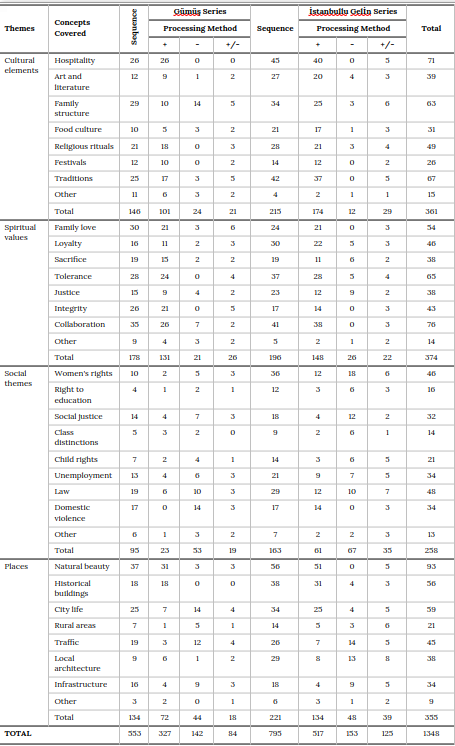
Table 4 presents a detailed analysis of the ways in which themes are treated in the series “Gümüş” and “İstanbullu Gelin”. Through this table, it is possible to comprehensively evaluate the cultural, spiritual, social, and spatial dimensions of the content offered by the series by considering each data point with its percentage values.
In the Cultural Elements section, the theme of hospitality is addressed at a rate of 26% in “Gümüş”, while “İstanbullu Gelin” processes this theme at a rate of 40%. This situation indicates that “İstanbullu Gelin” emphasizes hospitality, one of the prominent values of Turkish culture, more intensively. The emphasis both series place on the theme of hospitality provides an important example of the social structure of Turkish culture. The theme of family structure is addressed at 29% (29 positive examples) in “Gümüş” and 34% (34 positive examples) in “İstanbullu Gelin”. The importance given to family structure in both series demonstrates the prominence of family values and relationships in Turkish society. Family relationships play a crucial role in strengthening social bonds and ensuring social solidarity.
The theme of food culture is processed at a rate of 10% (10 positive examples) in “Gümüş” and 21% (21 positive examples) in “İstanbullu Gelin”; this reveals that food culture holds significant importance in both series, with “İstanbullu Gelin” providing more content on this topic. Food, as part of Turkish culture, aids in strengthening social bonds while also offering a cultural experience to the audience.
Religious rituals are depicted at a rate of 21% (21 positive examples) in “Gümüş” and at 28% (28 positive examples) in “İstanbullu Gelin”, highlighting these themes’ effectiveness in conveying Turkey’s religious and cultural richness to the audience. Religion and culture play a significant role in shaping the values of society.
In the Spiritual Values section, the theme of helping one another stands out at 35% (35 positive examples) in “Gümüş”, while it is processed more extensively at 41% (41 positive examples) in “İstanbullu Gelin”. This indicates that the concepts of helping and solidarity are significantly present in both series, emphasizing their importance in the social structure of Turkey. Helping and solidarity serve as one of the cornerstones of Turkish society, playing a vital role in maintaining social cohesion.
The theme of tolerance is addressed at 28% (28 positive examples) in “Gümüş” and at 37% (37 positive examples) in “İstanbullu Gelin”. We can say that these themes reflect the tolerant nature of Turkish society. Tolerance is a crucial element in ensuring cultural diversity and social unity. The theme of familial love is depicted at a rate of 30% (30 positive examples) in “Gümüş” and 24% (24 positive examples) in “İstanbullu Gelin”. The theme of familial love emphasizes the importance of family ties and affection in Turkish society; family plays a significant role in shaping individuals’ identities and values.
In terms of Social Themes, women’s rights are addressed to a lesser extent at 10% (10 positive examples) in “Gümüş”, while they hold significant importance at 36% (36 positive examples) in “İstanbullu Gelin”. This indicates that “İstanbullu Gelin” focuses more on gender equality and women’s rights issues. The right to education is also given limited attention at 4% (4 positive examples) in “Gümüş” and is explored more at 12% (12 positive examples) in “İstanbullu Gelin”. This suggests that the right to education is important in both series; education plays a key role in determining individuals’ social and economic positions. The theme of social justice is represented at 14% (14 positive examples) in “Gümüş” and at 18% (18 positive examples) in “İstanbullu Gelin”, indicating that social justice holds a significant place in both series. The themes of children’s rights and domestic violence are also treated at varying rates in both series; this illustrates that social issues in Turkey are addressed in both narratives.
Concrete examples of how social themes are constructed in the series can be observed. One of the social problems depicted is the class distinction/conflict between the rich and the poor. As seen in the dialogue above, the plot is centered around the relationship between a rich man and a poor girl.
In the section on Representation of Spaces, “Gümüş” draws attention with natural beauties at a rate of 37% (37 positive examples), while “İstanbullu Gelin” stands out with 56% (56 positive examples). This indicates that “İstanbullu Gelin” emphasizes Turkey’s natural beauty more. Highlighting natural beauty serves as an important tool in promoting Turkish culture and lifestyle. Historical buildings are addressed at 18% (18 positive examples) in “Gümüş” and at 38% (38 positive examples) in “İstanbullu Gelin”, demonstrating that both series draw attention to Turkey’s historical and cultural heritage; this heritage forms a society’s identity and cultural memory. Urban life is represented at 25% (25 positive examples) in “Gümüş” and at 34% (34 positive examples) in “İstanbullu Gelin”, showcasing Turkey’s urban life and social dynamics to the audience. Rural areas are depicted at 7% (7 positive examples) in “Gümüş” and at 14% (14 positive examples) in “İstanbullu Gelin”, addressing the significance of rural life; rural living plays a crucial role in preserving social values and traditions.
In conclusion, this table illustrates how the themes of “Gümüş” and “İstanbullu Gelin” are processed and the percentage rates at which these themes are reflected, demonstrating a strong engagement with Turkey’s cultural richness, spiritual values, and social issues, thereby contributing to Turkey’s soft power. Both series effectively present the values and cultural identity of Turkish society to an international audience, influencing how Turkish culture is perceived abroad. In this context, the series significantly contribute to the promotion and dissemination of cultural values as part of Turkey’s soft power strategies on the international stage.
Table 5. How Themes are Constructed in Sequences
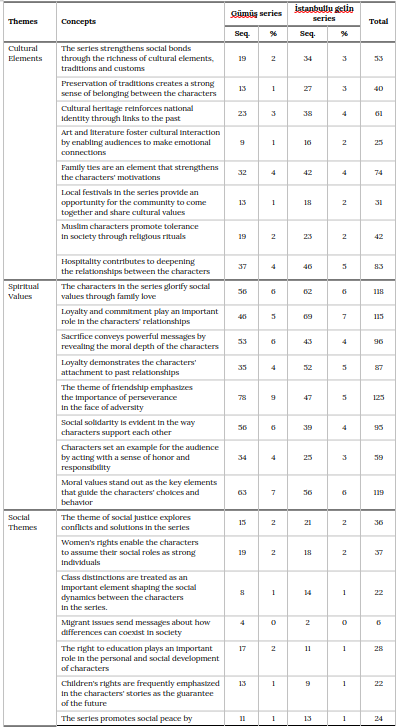
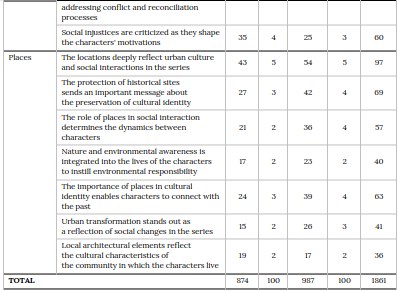
Table 5 presents an opportunity to analyze the societal and cultural impacts of both “Gümüş” and “İstanbullu Gelin” by illustrating how themes are constructed and their percentage distributions. This table is particularly valuable for understanding how the concepts within the series are represented and how these structures contribute to Turkey’s soft power strategies.
Cultural elements emerge as significant components that strengthen social ties in the series. For instance, hospitality is represented at a rate of 37% (37 sequences) in “Gümüş” and at 46% (46 sequences) in “İstanbullu Gelin”. This indicates that “İstanbullu Gelin” develops social connections among its characters more robustly. Hospitality, as a fundamental aspect of Turkish culture, emphasizes the importance of social solidarity and sharing, thus contributing to the soft power strategies of both series.
Additionally, the assertion that cultural heritage reinforces national identity through connections to the past is reflected at 23% (23 sequences) in “Gümüş” and at 38% (38 sequences) in “İstanbullu Gelin”. This suggests that “İstanbullu Gelin” engages more deeply with cultural elements, allowing viewers to establish connections with their cultural identities more effectively. Family ties also hold significant importance in both series, with 32% (32 sequences) in “Gümüş” and 42% (42 sequences) in “İstanbullu Gelin”. The theme of family serves as a powerful element reflecting social solidarity in Turkish society, offering messages about the preservation of cultural values to the audience.
Among the spiritual values, family love is represented at a rate of 56% (56 sequences) in “Gümüş” and at 62% (62 sequences) in “İstanbullu Gelin”. This indicates that both series aim to exalt social values, but “İstanbullu Gelin” emphasizes this theme more prominently. Additionally, the theme of friendship is highlighted at a rate of 78% (78 sequences) in “Gümüş”, while it has a lower representation at 47% (47 sequences) in “İstanbullu Gelin”. The high rate in “Gümüş” underscores the importance of solidarity and mutual assistance, providing moral support and courage to viewers, thereby contributing to the strengthening of social ties.
Among social themes, social justice is addressed at 15% (15 sequences) in “Gümüş” and at 21% (21 sequences) in “İstanbullu Gelin”. This shows that both series tackle social injustices and strive to promote social peace. Women’s rights are represented at 19% (19 sequences) in “Gümüş” and at 18% (18 sequences) in “İstanbullu Gelin”. This result indicates that the empowerment of women and the emphasis on their social roles are significant aspects in both series. Moreover, social solidarity is clearly visible in how characters support one another, with “Gümüş” at 56% (56 sequences) and “İstanbullu Gelin” at 39% (39 sequences).
The role of settings in the series deeply reflects urban culture and social interactions. In “Gümüş”, settings are represented at 43% (43 sequences) and at 54% (54 sequences) in “İstanbullu Gelin”. This suggests that “İstanbullu Gelin” places greater emphasis on the importance of settings, deepening the social interactions of its characters. Furthermore, the preservation of historical sites emerges as an important message in both series, with “Gümüş” at 27% (27 sequences) and “İstanbullu Gelin” at 42% (42 sequences). This conveys a strong call for the need to protect cultural heritage.
Both “Gümüş” and “İstanbullu Gelin” contribute to the social dynamics and cultural identity of society by deeply exploring Turkish culture and values. These series play a significant role in enhancing social values while also contributing to Turkey’s soft power strategies, helping viewers find their own identities and strengthen their cultural ties. The contents of both series have become important tools for reinforcing social bonds, elevating cultural values, and consolidating national identity. In this context, it is evident that the messages conveyed by the series are essential elements to consider regarding social change and cultural transformation.
Conclusion and Evaluation
Soft power has become one of the cornerstones of contemporary international relations and diplomacy. In the post-Cold War era, the concept of soft power has gained prominence as states have changed their approaches to the use of power. In this context, cultural and social values have begun to play an important role alongside military and economic power in the foreign policies of countries. Studies examining how media, particularly television series, function as tools of soft power are crucial for understanding the international impact of Turkish series. This study investigates how Turkish series are received abroad, the strategies employed by Turkey to reinforce its soft power, and how these series represent Turkish culture, values, and social dynamics.
The international popularity of Turkish series not only serves as an entertainment element but also significantly influences the shaping of Turkey’s image. Turkish series are widely viewed on television channels in many countries, thereby increasing the visibility of Turkey’s cultural elements, lifestyles, and social values around the world. The fact that most Turkish series are filmed in Istanbul has contributed to the city’s positioning as an international attraction, sharing its natural beauty, historical structures, and cultural richness with the world through these series. Symbolic locations, such as the views of the Bosphorus, the Golden Horn Bridge, and Hagia Sophia, leave a profound impact on the viewers of the series and enhance curiosity about Turkey.
Firstly, a deep analysis of the cultural elements in these series reveals that they play a crucial role in reinforcing social cohesion and national identity within Turkish society. Cultural themes such as family ties, hospitality, and the preservation of traditions are skillfully woven into the narratives of “Gümüş” and “İstanbullu Gelin”. The representation of hospitality, forming one of the cornerstones of Turkish culture, serves not only as a narrative element but also as a means of showcasing solidarity and social cohesion within Turkey’s societal structure. In this context, the emphasis on family relationships and cultural heritage demonstrates that the series do not only entertain but also foster a sense of belonging and a social identity among viewers. Celebrating traditional values and practices fosters a shared cultural consciousness among local and international audiences, strengthening Turkey's cultural heritage.
The characters in the series are often portrayed as wealthy and affluent individuals, allowing for the reflection of a lifestyle related to Turkish culture. This representation positively shapes viewers' perceptions of Turkey abroad, reinforcing its image as a modern and dynamic nation. However, the wealth and luxury depicted in the series are also presented with a critical perspective; there is a noticeable effort to balance traditional lifestyles with modern ways of living. In this context, Turkish series illustrate how traditional values intertwine with modern lifestyles, providing viewers with a broader perspective.
Most female characters in the series emerge in strong and independent roles, such as businesswomen or executives, contributing to discussions about gender equality. Emphasizing women’s presence in the workforce carries a positive message regarding the empowerment of women in Turkish society while also strengthening impressions of Turkey’s modernization process in the international arena. Such representation can serve as an inspiring example for female viewers in other countries. Additionally, the analysis of the roles of women and men presented through the characters shows how gender norms are constructed and reproduced. The female characters in “Gümüş” and “İstanbullu Gelin” are depicted as strong and independent individuals, transcending traditional images of femininity. This dynamic plays a crucial role in discussions on gender equality in Turkey and fosters the redefinition of women's roles in society. The fact that female characters step beyond traditional homemaker roles can also be viewed as a reflection of social change and women’s empowerment. In this context, the representation of women in these series strengthens Turkey’s stance on women’s rights on international platforms and supports the country’s modernization process.
Family relationships and social bonds hold significant importance in the content of Turkish series, highlighting themes such as family values, unity, and togetherness. Viewers are conveyed the message that the family is one of the cornerstones of the social structure. The complex relationships and intrigues among the characters attract viewers’ attention and increase interest in the series. This situation demonstrates that Turkish series serve an important function beyond being mere entertainment tools; they also play a role in transmitting social values and norms. The emphasis on moral values in the series highlights the ethical frameworks that guide human relationships in Turkish society. Values such as loyalty, honesty, and sacrifice are frequently portrayed through the characters’ behaviors, reflecting societal norms. This situation reveals that the series not only tell a story but also provide a framework for viewers to understand the moral fabric of Turkish society and the dynamics of social relationships.
The frequent presence of religious rituals, especially funeral ceremonies and mevlits in the series offers viewers a glimpse into the depths of Turkish culture and reflects Turkey’s spiritual values. These elements create a familiar and meaningful connection for Turkish viewers while sparking curiosity among foreign audiences and enhancing cultural interaction. The cultural elements presented in Turkish series promote Turkey’s rich cultural heritage and strengthen foreign viewers’ interest in the country.
The conflict between traditional and modern lifestyles is also a significant theme explored in the series. In this context, topics such as the bride-mother-in-law relationship, how the wealthy wield their power and riches, justice, and social inequality are addressed; this provides viewers with an opportunity to contemplate social issues. The critical approach to such topics in the series contributes to the audience’s understanding of the social structure and cultural dynamics in Turkey.
When considering the impact of these series on international audiences as part of Turkey’s soft power strategy, they present an important window for cultural diplomacy. “Gümüş” and “İstanbullu Gelin” promote Turkish culture, values, and lifestyle worldwide, offering viewers opportunities to learn more about Turkey. These series, which have reached a large audience, particularly in Arab and Middle Eastern countries, positively influence Turkey’s international perception and enhance the country’s cultural impact. This situation demonstrates how cultural products function as tools of soft power in international relations.
In conclusion, Turkish series possess significant potential beyond mere entertainment. They strengthen Turkey’s image on the international stage and promote Turkish culture and social values worldwide. By playing an essential role in cultural interaction and mutual understanding, these series introduce viewers to Turkey’s dynamic structure, traditions, and modern life while providing crucial insights into how soft power elements operate in international relations. At this juncture, promoting Turkish series further in international arenas and conveying Turkey’s cultural values through these platforms is crucial for enhancing soft power. Turkish series serve not only as entertainment but also as vital tools that act as bridges in cultural diplomacy and international relations.
References | Список литературы
Ağırseven, N., & Örki, A. (2017). Evaluating Turkish TV Series as Soft Power Instruments. International Journal of Social Research, 7(13), 836–854. https://doi.org/10.26466/opus.353287
Aljammazi, A., & Asil, H. (2017). The Influence of Turkish TV Dramas on Saudi Consumers’ Perceptions, Attitudes and Purchase Intentions toward Turkish Products. International Journal of Academic Research in Business and Social Sciences, 7(1), 206–224. https://doi.org/10.6007/IJARBSS/v7-i1/2600
Atay, T. (2016). A secret that opens Turkish TV series to the world: The Dream Of Being Both A Muslim And A Secular. MediaCat. https://mediacat.com/turk-dizilerini-dunyaya-acan-bir-sir-hem-musluman-hem-laik-olma-hayali/
Aydemir, E. (2016). Soft Power and Media in Foreign Policy. Kalkedon Publications.
Aydemir, E. (2017). Assessment of the Civil Society Dialogue Program between European Union and Turkey as a Public Diplomacy Implementation. International Journal of Social Research, 7(13), 912–927. https://doi.org/10.26466/opus.348548
Barnett, M., & Duvall, R. (2005). Power in International Politics. International Organization, 59(01), 39‑75. https://doi.org/10.1017/S0020818305050010
Bekiroğlu, O., & Çakın, Ö. (2016). 1 November 2015 General Elections: Analysis of Newspaper Political Advertisements. In Ş. Balcı (Ed.), 7 June’dan 1 November’a Türkiye’de Siyasal İletişim Uygulamaları [From June 7 to November 1, Political Communication Practices in Turkey] (pp. 349–400). Literatürk Publications.
Berg, M. (2017). Turkish drama serials as a tool for Soft Power. Journal of Audience & Reception Studies, 14(2), 32–53.
Bilis, P. Ö., & Bilis, A. E. (2018). Television Series Factor in Türkiye-Turkish Republics Cultural Relations: The Example of Kyrgyzstan. MANAS Journal of Social Research, 7(1), 403–426.
Creswell, J. W. (2017). Introduction to Mixed Method Research (M. Sözbilir, Ed.). Pegem Akademi Publishing.
Deniz, A. Ç. (2010). The Effects of Gümüş TV Series on Arab Public Opinion: A Social Media Review. Uşak University Journal of Social Sciences, 3(1), 50–67.
Devran, Y., Göksun, Y., & İhtiyar, B. (2018). A New Field in Export: Value Export. In Y. Göksun (Ed.), Discovery of Television Series: Content, Meaning, Function (pp. 39–66). Kaknüs Publications.
Devran, Y., Göksun, Y., & Okumuş, M. S. (2018). Capital Abdulhamid Between Fiction and Reality. In Y. Göksun (Ed.), Discovery of Television Series: Content, Meaning, Function (pp. 169–200). Kaknüs Publications.
Ekşi, M. (2018). Public Diplomacy and Turkish Foreign Policy in the AK Party Era. Siyasal Kitabevi.
Ermağan, İ., & Karcı, A. (2018). European Union and Soft Power Applications. In A. N. Yılmaz & G. Kılıçoğlu (Eds.), Academic Analyzes on Soft Power and Public Diplomacy (pp. 411–438). Nobel Academic Publishing.
Erzen, M. Ü. (2012). Scope and Future of Public Diplomacy. In A. Özkan & T. E. Öztürk (Eds.), Public Diplomacy (pp. 51–62). Tasam Publications.
Fukushima, A. (2011). Modern Japan and the Quest for Attractive Power. In S. J. Lee & J. Melissen (Eds.), Public Diplomacy and Soft Power In East Asia (pp. 65–90). Palgrave Macmillan. https://doi.org/10.1057/9780230118447_5
Gallarotti, G. M. (2011). Soft power: What it is, why it’s important, and the conditions for its effective use. Journal of Political Power, 4(1), 25–47. https://doi.org/10.1080/2158379X.2011.557886
Gökçe, O. (2001). Content Analysis/Theory-Metod-Uygulama. Selçuk University Publications.
Göksun, Y. (2018). The World’s Perspective on Turkish TV Series. In Y. Göksun (Ed.), Content, Meaning, Function of Television Series (pp. 67–84). Kaknüs Publications.
Işık, M. (2005). Can We Contact You? Education Bookstore.
Kalın, I. (2012). Turkish Foreign Policy and Public Diplomacy. In A. Özkan (Ed.), Public Diplomacy (pp. 145–161). TASAM Publications.
Karadağ, H. (2016). A New Dimension in International Relations: Public Diplomacy. Nobel Publishing.
Karadaş, N. (2017). A reception study on representations of wealth in post-980 Turkish cinema [PhD Thesis]. Anadolu University.
Karlıdağ, S., & Bulut, S. (2014). The Transnational Spread Of Turkish Television Soap Operas. Istanbul University Faculty of Communication Journal, 2(47), 75–96.
Khan, A. (2020). Ertuğrul: How an epic TV series became the “Muslim Game of Thrones.” The Guardian. https://www.theguardian.com/tv-and-radio/2020/aug/12/ertugrul-how-an-epic-tv-series-became-the-muslim-game-of-thrones
Kimmelman, M. (2010). Turks Put Twist in Racy Soaps. The New York Times. https://www.nytimes.com/2010/06/18/arts/18abroad.html
Kocabıyık, H. (2019). Changing Understanding of Diplomacy, Public Diplomacy and Türkiye. Eurasian Studies, 55(1), 163–196.
Kurt, G. (2019). Turkish TV Series, Soft Power and Cultural Imperialism in the Middle East. In O. Göksu (Ed.), New Directions in Public Diplomacy (pp. 225–246). Literaturk Publications.
Local TV series have high viewing rates in the Middle East and the Balkans. (2011). Сalinos. http://www.calinos.com/haberler-detay-page06.html
Mearsheimer, J. J. (2001). The Tragedy of Great Power Politics. Norton.
Medin, B., & Koyuncu, S. (2017). Cinema as a soft power tool: Hollywood example. International Journal of Social Sciences and Education Research, 3(3), 836–844. https://doi.org/10.24289/ijsser.307385
Morgenthau, H. (1970). International Politics (B. Oran, Trans.; Vol. 1). Sevinç Printing House.
Nye, J. (2004). Soft Power: The Means to Success in World Politics. Public Affairs.
Nye, J. (2013). The Paradox of American Power (G. Koca, Ed.). Literature Publications.
Nye, J. (2020). Soft Power (R. İ. Aydin, Ed.; 3rd ed.). BB101 Publications.
Nye, J. S. J. (2011). The Future of Soft Power. Public Affairs.
Ökmen, Y. E., & Göksu, O. (2019). Export of Turkish TV Series and Their Contribution to Cultural Transfer in the Context of Cultural Diplomacy: The Example of “Resurrection Ertuğrul.” In O. Göksu (Ed.), New Directions in Public Diplomacy (pp. 247–291). Literaturk Academia.
Özcan Deniz, the star of Bride from Istanbul, drove Israeli men crazy. (2019). İnternethaber. https://www.internethaber.com/istanbullu-gelinin-yildizi-ozcan-deniz-israilli-Erkekleri-cildirtti-video-galerisi-2002902.htm
Özdemir, H. (2008). Power in International Relations: A Multidimensional Assessment. Ankara University SBF Journal, 63(3), 113–144. https://doi.org/10.1501/SBFder_0000002075
Oztop, F. A. (2018). Use of Soft Power in Turkey’s Syria Policy (2002-2011). In A. N. Yılmaz & G. Kılıçoğlu (Eds.), Academic Analyzes on Soft Power and Public Diplomacy (pp. 135–165). Nobel Academic Publishing.
Rousselin, M. (2013). Turkish Soap Power: International Perspectives and Domestic Paradoxes. Euxeinos, 10, 16–23.
Schmidt, B. C. (2007). Realist conceptions of power. In F. Berenskoetter & M. J. Williams (Eds.), Power in World Politics (pp. 43–63). Routledge.
Tali, D. (2016). An unlikely story: Why do South Americans love Turkish TV? BBC. https://www.bbc.com/news/business-37284938
Tartari, A. (2015). Turkish TV productions in the Albanian media; the rise of a new “poetic” medium. International Journal of Human Behavioral Science, 1(1), 8–13. https://doi.org/10.19148/ijhbs.58437
Turkey’s Soft Power in the Middle East: The Example of Turkish TV Series. (2019). Porttakal. http://www.porttakal.com/haber-turkiye-nin-orta-dogu-da-yumusak-gucu-turk-dizileri-ornegi
Turkish TV Series Workshop as a Public Diplomacy Tool was held. (2019). T.C. İletişim Başkanlığı. https://www.iletisim.gov.tr/turkce/yerel_basin/detay/kamu-diplomasisi-araci-olarak-turk-dizileri-calistayi-duzenlendi
Uştuk, H. (2019). Türkiye is the country that exports the most TV series after the USA. Anadolu Ajansı. https://www.aa.com.tr/tr/kultur-sanat/abdden-sonra-en-fazla-dizi-ihrac-eden-ulke-turkiye/1641524
Varol, Z. (2016). The success story of Turkish TV series in Latin America. Daily Sabah. https://www.dailysabah.com/feature/2016/02/03/the-success-story-of-turkish-tv-series-in-latin-america
Waltz, K. (1979). Theory of International Politics. Waveland Press.
Yiğit, A. (2013). Turkish Drama in the Middle East: Secularism and Cultural Influence. In IEMed. Mediterranean Yearbook (pp. 291–295). IEMed.
Yıldırım, B. (2015). Historical Development of Content Analysis Method, Application Areas and Stages. In B. Yıldırım (Ed.), Methods in Communication Research with Applications and Examples (pp. 105–154). Literaturk Academia.
Yörük, Z., & Vatikiotis, P. (2013). Soft Power or Illusion of Hegemony: The Case of the Turkish Soap Opera “Colonialism.” International Journal of Communication, 7, 2361–2385.
You Will Be Surprised to See Our Celebrities Who Cause Stampede in the Countries They Visit! (2019). Onedio. https://onedio.com/haber/gittikleri-ulkelerde-izdihama-yol-acmis-unlulerini-gorunce-cok-sasiracaksiniz
Yukaruç, U. (2017). A Critical Approach to Soft Power. Bitlis Eren University Social Sciences Institute Journal, 6(2), 491–502.