Singlism on Unmarried Women in Malaysia: Impoliteness Study of Social Media Discourse
Universiti Malaya (Kuala Lumpur, Malaysia).
Email: cherish[at]um.edu.my
 0000-0002-9783-9173
Universiti Teknologi MARA (UiTM) (Selangor, Malaysia).
Email: roshini[at]uitm.edu.my
0009-0000-5068-3135Abstract
Single women in Malaysia often face societal pressure, as being single and childless can lead to discrimination, stigmatization, and stereotyping. Social media posts worsen the issue. Users are allowed to freely and publicly comment without seeing one’s face, while their identities remain safeguarded. This study examines how social media users oppose women who choose to remain single, specifically analyzing impolite comments directed at them. A discourse analysis approach was employed to analyze comments retrieved from a Malaysian celebrity’s Facebook1**, Instagram**, and Twitter posts, where she expressed her intention to remain single for life. Using the frameworks of Culpeper’s (2011) (non)conventionalised impoliteness formulae, the findings reveal that commenters frequently used unpalatable questions and/or presuppositions, followed by sarcasm, innuendo, mimicry, insults, silencers, negative expressives, and pointed criticism or complaints. Social factors such as sexuality, religion, descent, and old age were highlighted by those who disagreed with the celebrity’s choice to remain single. Through linguistic analysis, this study illustrates how singlism manifests on social media through impoliteness. These findings provide insight into societal attitudes towards single women in Malaysia.
1A social network owned by a company recognized as extremist in the Russian Federation. Hereinafter, it will be marked with the symbol ** (the editorial office is required to indicate this).
Keywords
Singlism, Societal Pressure, Unmarried Women, Stereotypes, (Non)Conventionalised Impoliteness
Синглизм в отношении незамужних женщин в Малайзии: исследование невежливости в дискурсе социальных сетях
Университет Малайзии (Куала-Лумпур, Малайзия).
Email: cherish[at]um.edu.my
0000-0002-9783-9173Технологический университет MARA (UiTM) (Селангор, Малайзия).
Email: roshini[at]uitm.edu.my
0009-0000-5068-3135Аннотация
Незамужние женщины в Малайзии часто сталкиваются с социальным давлением: безбрачие и отсутствие детей становятся причиной дискриминации, стигматизации и стереотипизации. Социальные медиа усиливают данное явление, поскольку пользователи получают возможность свободно и публично высказываться, оставаясь при этом анонимными. Настоящее исследование рассматривает, каким образом в социальных сетях критикуются женщины, выбирающие безбрачие, с особым акцентом на анализе невежливых комментариев в их адрес.
В качестве эмпирической базы были собраны комментарии с Facebook1**, Instagram** и Twitter одной малайзийской знаменитости, заявившей о намерении оставаться незамужней на протяжении всей жизни. Методологически работа опирается на дискурсивный анализ с использованием типологии (не)конвенционализированных формул невежливости Дж. Кулпепера (2011).
Результаты показывают, что наиболее частыми стратегиями становятся навязчивые и некорректные вопросы и/или пресуппозиции, за которыми следуют сарказм, инсинуации, пародирование, оскорбления, «заглушающие» реплики, негативные экспрессивы и открытая критика или жалобы. Социальные факторы, такие как сексуальность, религия, происхождение и возраст, особенно выделяются в комментариях оппонентов.
Таким образом, лингвистический анализ демонстрирует, каким образом синглизм проявляется в социальных медиа через дискурсивные практики невежливости. Полученные результаты позволяют глубже понять общественные установки в отношении незамужних женщин в Малайзии.
1Социальная сеть, принадлежащая компании, признанной экстремистской на территории Российской Федерации. Здесь и далее будет обозначаться значком ** (редакция обязана указывать это).
Ключевые слова
синглизм, социальное давление, незамужние женщины, стереотипы, (не)конвенционализированная невежливость
Introduction
Stigma, stereotype, and discrimination are often encountered by single adults, and are known as singlism (dePaulo & Morris, 2005). In a more recent year, it was reported that single adults, especially women, undergo more social discrimination compared to couples. Specifically, single adults do not receive as much social support as those who have partners (Girme et al., 2022), as they are constantly urged by society to settle down and get married in order to conform to the standard norms (Himawan et al., 2018; Wulf, 2000).
Independence and freedom are often the main reason women remain single. In fact, high academic qualifications and promising careers give women a sense of independence because they can fully support themselves economically and do not need to rely on anyone (Ibrahim, 2016; Nai Peng, 2007). To illustrate, women in Pakistan choose to stay single because they do not want to lose their freedom to make decisions or to forgo their careers and be financially dependent on their husbands. They also do not trust men and are afraid of the responsibility of having to take care of their husbands and children if they get married (Rafiq et al., 2022). Similarly, in Malaysia, a study on single Malay women unveiled how they are comfortable being single as they are educated and financially independent (Azmawati, 2011). The Chinese community in Malaysia also exhibits a higher inclination towards remaining unmarried as they often prioritize independence (Nai Peng, 2007). This leads to a large population of single women in the country.
According to Nai Peng (2007), 83% of female Chinese, 70% of female Indians, and 68% of female Malays remain single. In more recent years, Yusof (2018) reported that the number of married Malaysians has declined from 200,274 to 190,532 within a year. As education and career achievements increasingly empower individuals by providing them with financial independence and freedom, the population of single adults continues to increase, thus reflecting a shift in societal expectations surrounding marriage.
Single adults nowadays are being pressured by the questions “Why are you still single?”, “Do you have a partner?”, or “When are you getting married?” Apparently, it is considered normal in Asia to inquire about one’s marital or relationship status during an informal conversation (Himawan et al., 2018). Most importantly, these questions were often asked by their family members, friends, and colleagues (Sharp & Ganong, 2011). Single adults are often stressed by the need to justify their marital status and prepare an answer to defend themselves from negative perceptions about being single as well as to prevent them from being questioned further (Sharp & Ganong, 2011). Yet there is no correct way to respond to these intrusive queries. Culturally, those who raise such questions believe it is an act of expressing concern and care, without realizing how it affects the addressees.
Based on the cultural norms and beliefs in Malaysia, singleness is often viewed as a taboo (Azmawati et al., 2015), especially for women. Although being single and childless is acceptable, single women still face discrimination and stigma in society (Sharp & Ganong, 2011). In fact, single women in Malaysia who are in their 30s are often labelled as ‘anak dara tua’ (Ibrahim, 2016), the Malay equivalent phrase for ‘old maid’. Studies show that single women in Pakistan often experience social exclusion, are discriminated by family and friends, and are condescended by society as unwanted subjects. Such instances not only have a negative impact on women’s psychological and emotional health (Sultana et al., 2021; Sher & Saleem, 2023), it can also lead to the oppression of women.
While many single women may view their marital status as a sensitive topic of discussion (Ibrahim, 2016), a Malaysian celebrity and scholar, who shall be addressed as ‘Dr X’ in this paper, took the opposite direction when she announced on her Facebook1**, Instagram**, and Twitter accounts that she hopes to remain single forever. Ultimately, her posts have sparked various comments and views from social media users. For context, the said celebrity is a former international beauty pageant winner. Not only is she a singer, actress, music composer, TV host, and model, she is also an esteemed academician with several postgraduate degrees (Alhamzah, 2022). On that note, despite her achievements in life, she is urged by society via social media to get married. Unlike face-to-face interviews, social media users can freely “offend, attack, defame, and harass others” on social media while still safeguarding their identity (Hardaker & McGlashan, 2016, p. 92). Such acts may lead to cyberbullying and publicly offending the victims’ faces. In this instance, the occurrence of impoliteness may be noticeable.
The questions on marital status, discrimination and stigma in society, and the societal pressure on single women, particularly in the social media context, are the societal issues that need to be highlighted. Thus far, many studies have focused on examining responses from single women through interview sessions (e.g., Azmawati et al., 2015; Hancock, 2017; Ibrahim, 2016; Rafiq et al., 2022; Sharp & Ganong, 2011) and surveys (e.g., Nai Peng, 2007). Yet, studies on the stereotypes of single women on social media in the Malaysian context are still fairly scarce. Therefore, examining the offensive responses retrieved from social media posts such as Facebook**, Instagram**, and Twitter are vital because they allow social media users to fully express their views without the need to mitigate them.
This study examines how society perceives women who choose to remain single. Specifically, it aims to explore how singlism is constructed through language on social media by analyzing impolite comments directed at the said celebrity’s posts and women who have chosen lifelong singlehood.
Social Norms on Single Women
There are many reasons why society, especially in Asia, urges single women to get married; one is age (Ibrahim, 2016). Because 25 is the age at which most women are married, studies indicate that most single women in this age group have been judged socially (Azmawati et al., 2015; Himawan et al., 2018; Sharp & Ganong, 2011); thus, the age has become a social norm for marriage. Women also seem to be faced with more pressure as they have passed the marriageable age because they will encounter stigmatization and discrimination issues (Gui, 2020). By the age of 30, most women would have started their own families with children. Society believes that it will be more difficult for women to conceive a child if they are still not married by this age (Ibrahim, 2016). Hence, those who do not follow this norm are considered failures in life (Reynolds & Taylor, 2005). As Ahmad and Masud (2013) pondered why single women are being viewed as losers instead of single men, Levitt (2010) stressed that single men have more freedom than single women, “including staying outside of wedlock” (Ahmad & Masud, 2013, p. 2), something that single women are not allowed to do. Such a perception creates negative stereotypes about single women as well as gender bias.
Another reason for marriage is to avoid unlawful sexual intercourse. In Asia, engaging in premarital sexual activity is widely considered immoral and a cultural taboo (Kwok & Kwok, 2023). Hence, the only way for individuals to satisfy their sexual needs while simultaneously maintaining their dignity and sense of worth is through marriage (Manap et al., 2013). This perspective stems from the traditional belief that women should keep their virginity until marriage to avoid bringing shame to their families (Hennink et al., 1999). In some Asian countries, such as Indonesia and Malaysia, couples (especially Muslims) found engaging in sexual intercourse before marriage can face legal repercussions due to the illegality of premarital sex under Sharia law (Lim, 2021; Mao, 2022). These legal restrictions and cultural taboos often lead to societal pressure on single adults to seek marriage.
Culture and religion play significant roles in shaping individuals’ attitudes toward marriage, especially in Asian contexts. In Liu’s (2023) study on Chinese society in China, one participant revealed that her parents expected her to complete her education, secure employment, and get married soon, mainly to assist her brother’s material well-being. These expectations reflect the concept of a woman being a ‘destined giver’ (Liu, 2023, p. 5). Such cultural norms can restrict women’s freedom in making personal life choices. Correspondingly, in the context of traditional Malay culture and religion, marriage is not merely an option but a societal necessity. Building a family at a specific age is the norm for women because single women may be seen as incomplete (Ibrahim, 2016). Azmawati et al. (2015) found that 200 unmarried women in Peninsular Malaysia perceive marriage as a religious obligation. Consequently, they hold onto the hope of eventually marrying if they find the right partner. Similarly, in Indonesia, societal norms and cultural standards dictate that unmarried adults are perceived as a social issue that goes against accepted norms. Consequently, single adults often encounter societal pressures, including nagging, stereotypes, discrimination, and stigmatization related to their marital status (Tengkilisan & Limanta, 2022). These cultural and religious influences highlight their significant role in shaping attitudes towards marriage and personal choices regarding marital status in various Asian societies.
While many single women are perfectly content by themselves and do not seek any life partners, they have been categorized as the abnormal community as they have passed the suitable age group for marriage (Ibrahim, 2016). Coupled with the increasing number of single adults in Malaysia, the number of divorce cases is also rising. Marriage and Divorce Statistics of Malaysia showed 47,272 divorce cases in 2020 and 43,934 cases in 2021, with the most common divorce cases in the age group of women between 30 and 34 (Marriage and Divorce Statistics, Malaysia, 2022).
Despite society’s benchmark that being married with children is the definition of a successful and happy life, the statistics prove that a married life does not guarantee happiness. And yet, single women are singled out by society if they do not adhere to societal norms.
Sexist Language and Sexism Towards Single Women
Single women often face more pressure and scrutiny than single men. For instance, single women in China who prioritize careers over starting a family due to their higher educational and economic status are regarded by society as self-centred. In contrast, single men in similar circumstances are seen as responsible and even more desirable (Qian & Qian, 2014). This gender-based discrimination can sometimes be observed through sexist language.
Women’s marital status is often indicated by their titles, namely ‘Mrs’ (married), ‘Miss’ (unmarried), and ‘Ms’ (neutral); whereas the title ‘Mr’ for men does not reveal their marital status, as it applies to both married and unmarried men. This disparity reflects sexism, as the titles for women can create additional societal pressure (Omenugha, 2007; Chinyelu, 2020). Similarly, in Pakistani society, the word ‘larki’ is commonly used to refer to a girl or unmarried woman under 30, while ‘shakhs’ (person) and ‘mard’ (man) refer to men who are mature and in adulthood. This difference reveals a male-dominated, sexist social structure (Sher & Saleem, 2023).
Sexism can be apparent either directly or indirectly. According to Mills (2008), direct sexism involves overt expressions of discrimination, insults, or marital titles targeting women. Indirect sexism, on the other hand, is more subtle because it is conveyed through irony, innuendo, presupposition, or humour, which serve to mediate or deny responsibility for the expression.
Although indirect sexism is harder to identify due to its subtle nature, it may have a more harmful effect on its victims (Chinyelu, 2020). Expressions such as insults, discrimination, irony, innuendo, presupposition, or humour fall under the category of impoliteness, as they can damage or attack a person’s face value. These expressions are also common on social media. For instance, Pratama’s (2018) study on comments from a YouTube video in Indonesia shows that sexist language is prevalent on social media. It reveals that users often employ sexist language to discredit women through negative comments, which frequently contain harsh or impolite words aimed at derogating them. This not only shows that impoliteness is common in social media comments, but also in derogating women. Our study, therefore, focuses on how instances of impoliteness arise when social media users express their thoughts about single women.
Impoliteness Triggers
Impoliteness refers to “the use of strategies to cause social disruption” rather than to “maintain social harmony” (Culpeper, 1996, p. 350). In 2011, Culpeper used a bottom-up approach to develop conventionalized impoliteness formulae, based on data from the Oxford English Corpus (OEC). These formulae examine contexts in which interactants “display an understanding that something impolite was expressed” and “the metadiscourse concerning behaviours understood to be impolite” (Culpeper, 2011, p. 133). The types of impoliteness triggers and examples that emerged from his data are illustrated in Table 1.
| No. | Conventionalised impoliteness | Examples |
|---|---|---|
| 1. | Insults | |
| Personalised negative vocatives | You fucking pig! | |
| Personalised negative assertions | You disgust me! | |
| Personalised negative references | Your stinking arse! | |
| Personalised third-person negative references |
She’s nutzo! | |
| 2. | Pointed criticisms or complaints | That is rubbish! |
| 3. | Unpalatable questions and/or presuppositions |
Which lie are you telling me? |
| 4. | Condescension | That’s childish! |
| 5. | Message enforcers | Listen here! |
| 6. | Dismissals | Get lost! |
| 7. | Silencers | Shut it! |
| 8. | Threats | I’ll box your ears if you don’t [x] |
| 9. | Negative expressives (curses or ill- wishes) |
Go to hell! |
In addition, Culpeper (2011) also identified non-conventionalised impoliteness triggers based on “59 reported impoliteness events that did not involve conventional impoliteness formulae” (p. 155). These triggers, also known as implicational impoliteness, refer to instances where impoliteness was implied in the data. They are form-driven, convention-driven, and context-driven implicational impoliteness.
Form-driven implicational impoliteness occurs when implied messages or implicatures arise from an action’s formal, surface, or semantic components, which lead to adverse effects on some individuals. This type of impoliteness is also a form of off-record impoliteness. Examples include the use of insinuation, innuendo, snide comments, and mimicry (Culpeper, 2011).
Convention-driven implicational impoliteness is divided into internal and external types. Internal convention-driven impoliteness includes synchronic and diachronic subtypes. Synchronic subtype arises from multimodal mismatches (Culpeper, 2011), such as when a speaker’s words conflict with their tone or manner. In contrast, the diachronic subtype occurs due to mismatches between conventionalised politeness and conventionalised impoliteness formulae. External convention-driven impoliteness, on the other hand, results from mismatches between a behaviour’s projected context and its actual context of use (Culpeper, 2011). This often involves teasing, sarcasm, harsh jokes, and humour (Rabab’ah & Alali, 2020).
Context-driven implicational impoliteness can be categorized into unmarked behaviour and absence of behaviour. Unmarked behaviour refers to situations where impoliteness is inferred from the context, although it is unlikely to be explicitly interpreted as impolite. Absence of behaviour occurs when expected actions are omitted in a particular context, resembling the withholding of politeness.
Studies have employed impoliteness triggers to examine instances of impoliteness on social media. For instance, Pung and Mohd Faizal’s (2023) study revealed that both culture and communication platforms can influence impoliteness on social media. They identified the prevalence of impoliteness triggers such as the use of pointed criticism, insults, negative expressive, and unpalatable questions and/or presuppositions in tweet replies. Similarly, Rabab’ah and Alali (2020) found that both conventionalised and non-conventionalised impoliteness triggers were used by social media users in comment sections to attack the face of article writers on Al-Jazeera’s Arabic news website. These impolite instances are ubiquitous in social media comments, especially when anonymity and freedom enable users to voice their thoughts without concern for preserving another’s face (Hardaker & McGlashan, 2016). Therefore, impoliteness triggers are used in this study as a theoretical framework to analyze impolite comments on social media.
Method
This study employs discourse analysis to examine social media comments about Dr. X’s decision to remain single, focusing on those opposing the idea of women staying single. Discourse analysis allows us to explore written texts on social media, which reveals patterns of language use that reflect societal views (Paltridge, 2006). Specifically, this approach assists the study in examining how impolite language on social media constructs societal attitudes toward unmarried women.
This study adopts Culpeper’s (2011) conventionalised and non-conventionalised impoliteness triggers to analyze the impolite comments targeted at women who choose to remain single. The types of conventionalised impoliteness triggers are as follows:
-
Insults
-
Personalised negative vocatives
-
Personalised negative assertions
-
Personalised negative references
-
Personalised third-person negative references
-
Pointed criticisms or complaints
-
Unpalatable questions and/or presuppositions
-
Condescension
-
Message enforcers
-
Dismissals
-
Silencers
-
Threats
-
Negative expressives (curses or ill-wishes)
The following are non-conventionalised impoliteness:
-
Form-driven implicational impoliteness
-
Convention-driven implicational impoliteness
-
Context-driven implicational impoliteness
As this is a qualitative study, numerical data are not prioritized. The frequencies and percentages presented are only intended to highlight trends or prominent linguistic patterns that emerged from the findings.
Data: Comments from Dr X’s Facebook**, Instagram**, and Twitter Posts
The data for this study were retrieved from the comments on three of the said celebrity’s Facebook** posts, two Instagram posts, and one Twitter post where she had expressed her intention to remain single for life. Table 2 shows the details of the data source and the number of comments on the aforementioned topic.
| Sources | Date of posts | Number of comments | Total |
|---|---|---|---|
| Facebook** | 11th January 2023 | 367 | 488 |
| 12th January 2023 | 27 | ||
| 14th January 2023 | 94 | ||
| Instagram** | 11th January 2023 | 134 | 204 |
| 12th January 2023 | 70 | ||
| 11th January 2023 | 5 | 5 | |
| Total | 697 | ||
A total of 697 comments were collected from the moment the posts went viral. The first post, “Zaman ini tak perlu kahwin” (In this era, there is no need to get married), was on January 11, 20232. There were 367 comments on Facebook****, 134 comments on Instagram**3, and 5 comments on Twitter4. The second post was on January 12, 2023, when the celebrity reposted the article “Semoga Bujang Selamanya” (Hope to stay single forever), an article from XTRA, a local e-tabloid, and there were 27 comments on Facebook**5 and 70 comments on Instagram**6. On January 14, 2023, she reposted another trending article from XTRA regarding this topic, which led to a total of 94 comments on Facebook**. In sum, there were 697 comments in total.
Based on comments made by social media users, this study found that they are either against, in support of, or neutral about her posts. Since this study focuses on singlism in Malaysia, the comments were filtered to include those targeted at the celebrity or against single women in general, including replies and emoticons, which led to a total of 88 relevant comments. Comments that are irrelevant to the post (e.g., praising her authored book), supporting her decision to stay single, and neutral responses, were excluded from the data. The celebrity and all commenters’ names and profile pictures are anonymized.7
Analysis and Results
The commenters in the data employed both conventionalised and non‑conventionalised impoliteness formulae in their comments (see Table 3). The table illustrates the prevalence of unpalatable questions and/or presuppositions, followed by external convention-driven implicational impoliteness, form-driven implicational impoliteness, silencers, insults, negative expressive, and pointed criticism/complaint.
| Impoliteness formulae | Frequency | Percentage | |
|---|---|---|---|
| 1. | Unpalatable questions and/or presuppositions | 37 | 42% |
| 2. | External convention-driven implicational impoliteness (sarcasm, teasing, harsh/bitter jokes/humour) | 28 | 32% |
| 3. | Form-driven implicational impoliteness | 10 | 11% |
| 4. | Silencers | 6 | 7% |
| 5. | Insults: Personalised third-person negative reference | 4 | 5% |
| 6. | Negative expressive (e.g., curses, ill-wishes) | 2 | 2% |
| 7. | Pointed criticism / complaint | 1 | 1% |
| Total | 88 | 100% | |
Nevertheless, it is noteworthy that insults in the form of personalized negative vocatives, negative assertions, and negative references, dismissals, message enforcers, threats, condescension, internal convention-driven, and context-driven implicational impoliteness formulae were not observed in the data. The examples of comments with impoliteness are displayed in the following sub-sections.
Unpalatable Question and/or Presupposition
It is commonly believed that humans have a need to satisfy their sexual desires and reproductive needs, which are traditionally thought to be fulfilled through marriage (Ibrahim, 2016). Given that sex is considered one of the basic human needs (Maslow, 1943; 1954), there is often an assumption that couples are happier than single adults because those who are single cannot lead a satisfying life without a romantic and sexual relationship (dePaulo & Morris, 2005). The following example demonstrates the said assumption via the use of presupposition.
Commenters presuppose Dr. X’s marital decision by assuming that she may be faking or is hesitant to engage in a serious relationship, possibly due to past disappointments with men. They often express disagreement with the said celebrity or cast doubt, interpreting her posts as jokes with words and phrases like ‘mungkin’ (maybe), ‘I guess’, and ‘gurau je’ (just joking). These presuppositions touch upon personal and intimate topics, such as sexual desires or intercourse, reflecting their scepticism towards her decision and highlighting society’s denial of women who choose to remain single. In response to this scepticism, many commenters humorously framed their impolite comments as jokes to indirectly insinuate their opinions about Dr. X.
Example 1 shows how commenter, C1, brings up sexual reasons to justify the celebrity’s decision, on her behalf.
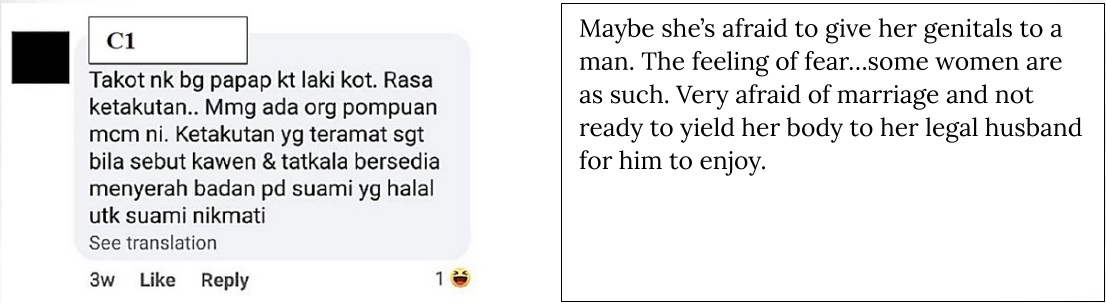
Figure 1. Example 1
C1 makes several presuppositions about Dr. X’s attitudes towards engaging in sexual activity and her role as a single woman. These presuppositions are evident through the use of the particle ‘kot’ (maybe) in the statement “takot nk bg papap kt laki kot” (Maybe she’s afraid to give her genital to a man), which presupposes that she may be hesitant or afraid to engage in sexual activity. Furthermore, the word ‘papap’ is a profane term that refers to female genitals and is used to allude to sexual activity.
Moreover, the comment “memang ada org pompuan mcm ni” (some women are as such) reflects gender stereotypes and bias towards single women, as C1 asserts the assumption that single women fear sexual intercourse. The statement “menyerah badan pd suami yg halal” (yield her body to her legal husband) implies a submissive role for women in a man’s world. Instead of emphasising the enjoyment of sexual intercourse for both men and women within marriage, the comment “utk suami nikmati” (for him [the husband] to enjoy) suggests the commenter’s view that marriage primarily exists for men to legally derive pleasure from sexual activity, and that women are expected to prioritise their husband’s pleasure in sexual activity.
This comment aligns with Liu’s (2023, p. 5) findings that women are often portrayed as “destined givers”. It also implies that women are expected to fulfil certain roles in society rather than having the freedom to make independent life choices. Ultimately, the fact that another user found this comment humorous and reacted with a laughing emoticon indicates that it serves as provocative social action, prompting particular responses from other social media users (Haugh, 2017).
External Convention-Driven (Sarcasm)
The belief that all single adults will end up lonely is a stereotype. Some commenters sarcastically suggested that Dr. X should consider building an old folks’ home specifically for unmarried individuals. This implies that staying single leads to loneliness and vulnerability in old age. Evidence of sarcasm can be seen in the following example.
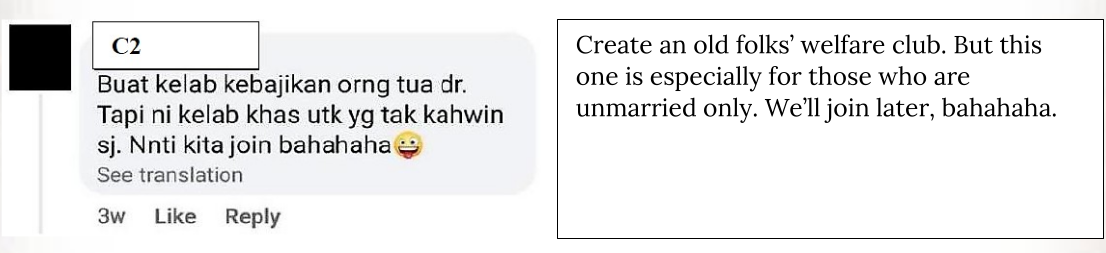
Figure 2. Example 2
C2’s comment may contain sarcasm, as it not only suggests creating a club for older people but specifies for those who are unmarried, followed by laughter (“bahahaha”) and the tongue-out emoticons at the end of the comment to indicate humour. The utterances “kelab kebajikan orng tua” (old folks’ welfare club) and “khas utk yg tak kahwin sj” (especially for those who are unmarried only) rest on the assumption that those who are married are less likely to end up in an old folks’ welfare club during old age because they will be taken care of by their children, reflecting the mindset of the society. In other words, this comment not only appears to tease Dr. X’s posts but also single adults in general. This finding aligns with Keltner et al.’s (2001) definition of teasing as it can be conveyed indirectly.
Form-Driven Implicational Impoliteness
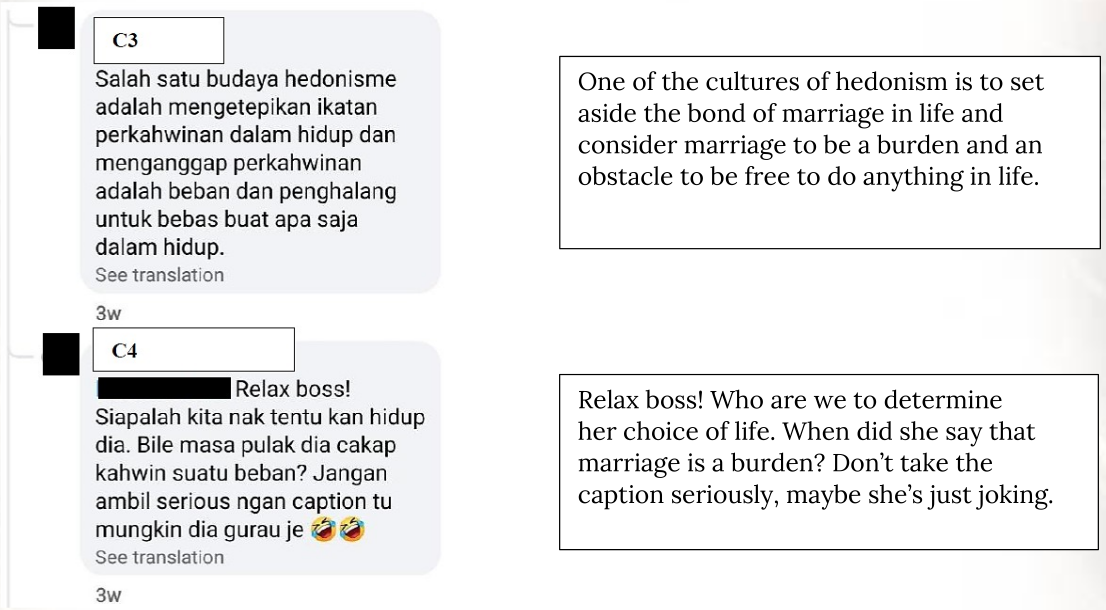
Figure 3. Example 3
Innuendo involves conveying an implied message through implicature in specific types of social behaviour (Bell, 1997). It usually hints at someone indirectly by relying on the addressee to infer the intended meaning based on context and subtle cues.
In Example 3, C3 does not specify a target but conveys a negative view of unmarried individuals by defining hedonism. Essentially, it implies that those who avoid marriage do so for hedonistic reasons. C3 flouts the Maxim of Quantity by relying on the reader to infer what is left unsaid. Without knowledge of the specific cultural context, the reader may not grasp the intended message. This comment insinuates that Dr. X’s post promotes hedonism, even though it seems neutral on the surface. This interpretation is reinforced by C4’s reply, who requests C3 not to take Dr. X’s post seriously. The reply further suggests that C3’s comment carried an impolite implication. The implicit message, framed as a general statement about hedonism, aligns with what Culpeper (2011) describes as off-record impoliteness.
Apart from insinuation, mimicry is another form-driven implicational impoliteness observed in the data, as it involves “a caricatured re-presentation” (Culpeper, 2011, p.161). Impolite mimicry reflects someone’s behaviour rather than their thoughts or utterances, similar to Sperber and Wilson’s (1986) concept of echoic irony. The following comments mimic the sentiments expressed by Dr. X in her original posts, either to present alternative viewpoints or to offer a humorous take on the subject of being single. In these comments, the term ‘buaya’ (crocodile) humorously distorts the original posts.

Figure 4. Example 4

Figure 5. Example 5
Dr. X’s original posts were titled “Zaman ni tak perlu kahwin” (In this era, there is no need to get married) and “Semoga bujang selamanya” (Hope to stay single forever). However, commenters often mimic these titles by rephrasing them and inserting the word ‘buaya’ when responding. For instance, in Example 4, C5 substitutes “tak perlu kahwin” (no need to get married) with the assertion “kena bela buaya” (have to raise crocodiles), accompanied by a rolling-on-the-floor-laughing emoji to convey humour. Similarly, C6 in Example 5 replaces the word ‘bujang’ (single) with ‘buaya’ (crocodile) to make a snide remark. While ‘buaya’ literally means crocodile in Malay, in this context, it refers to the Malay idiom ‘buaya darat’, which describes to men who engage in affairs with women and are unfaithful (Atmawati, 2018). Essentially, the use of this term prompts an impolite inference that indirectly critiques Dr. X’s posts in a subtle manner.
Silencer
Some commenters perceive Dr. X’s posts as an attempt to popularise the single life and regard it as heresy. Despite Dr. X posting on her personal social media pages, commenters employed imperative statements such as “keep it to yourself”, “kalau tak mau kawen diam je” (If you don’t want to marry, just keep quiet), and “tak payah keluar kenyataan” (no need to make a statement) to urge her to keep her decision to herself or refrain from publicly voicing it on social media, potentially to discourage others from following her example.
The following example can be seen as the commenter’s attempt to discourage Dr. X from expressing her thoughts or choices via the use of a silencer.
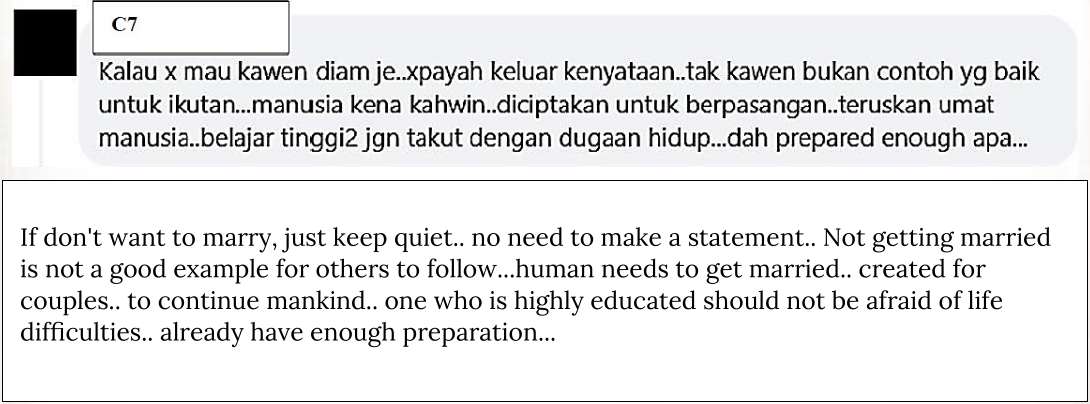
Figure 6. Example 6
Impoliteness can be observed through the use of the silencer “Kalau x mau kawen diam je” (If don’t want to marry, just keep quiet). C7 directs Dr. X to keep quiet and refrain from publicly making the statement about remaining single for good. Given that one has the right to post their views on their Facebook** page, regardless of whether it is public or private, such a directive can be considered as the commenter’s attempt to silence Dr. X to post her view.
As this is a celebrity’s Facebook** profile that has many followers, C7’s concern about Dr. X’s statement becoming a trend in society is evident when he uses the negative statement “tak kawen bukan contoh yg baik untuk ikutan” (not getting married is not a good example for others to follow). This negative statement may serve to express his disagreement with the said celebrity in expressing her marital stance on social media and dissuade her from sharing her opinion on this topic publicly. He continues with a general statement about mankind needing to get married (“manusia kena kahwin”), which Penelope (1990) calls ‘dummy it’, as the use of reference pronouns is not specified (Wood & Kroger, 2000). The commenter may be making a sweeping generalisation for all individuals. Furthermore, the use of the modal verb ‘kena’ (have to) rests on the assumption that it is not an option for humans to choose to stay single. Still, there is an obligation to get married to produce the next generation (“teruskan umat manusia”), including those who are highly educated.
Insult
Insults can include derogatory statements and implications with the intention to produce a display of low value at the target (Culpeper, 2011). In this study, only personalised third-person negative reference insults categorised in Culpeper’s (2011) conventionalised impoliteness formulae were identified. An example of insult can be observed in the following example.
Age is often considered an important factor that can affect one’s fertility rate, especially for women. It is also a common societal belief that getting married and conceiving a child at a younger age can be more conducive to starting a family (Ibrahim, 2016). At the time Dr. X posted her decision on social media, she was 36 years old. Hence, she has surpassed what is often considered the marriageable age, as studies indicate that women typically marry and have children between the ages of 25 to 30 (Azmawati et al., 2015; Gui, 2020; Himawan et al., 2018; Ibrahim, 2016; Sharp & Ganong, 2011).
The following example annotates how C8 makes an impolite comment using insults from the personalized third-person negative reference.

Figure 7. Example 7
Example 7 is a reply to another user’s comment on Dr. X’s post. It was selected due to the view that the commenter made towards single women, particularly Dr. X. C8 implies how Dr. X does not want to get married because she is “not marketable anymore” (x laku). This response resembles addressing someone as an ‘old maid’ (Ibrahim, 2016). Nevertheless, instead of addressing the comment directly at her, C8 comments in the third person’s point of view by employing the word ‘beliau’, referring to Dr. X from the formal pronoun ‘he/she’. Hence, the third-person negative reference insult is formed.
Negative Expressive (Ill-Wishes or Curses)
Commenters also expressed their disapproval of Dr. X’s decision by resorting to ill-wishes or curses. An example of this can be seen in Example 8.

Figure 8. Example 8
The statement “doa lah mati cepat” (pray for a quick death) is a negative expression conveying C9’s ill-wishes towards Dr. X. The utterance ‘dh tua’ (when you’re old) and ‘menyusahkan org dekat hospital atau rmh org tua2’ (burden others in the hospital or at old folk’s home) could be a form of stereotype towards single adults, portraying them as a burden to society because they do not have children to rely on in their old age. His comment strongly disapproves Dr. X’s decision to stay single. Such a comment could also be considered a form of disrespecting others’ choices.
Nevertheless, the ill-wishes or curses found in this study were not as severe as the ones found in Culpeper’s (2011) corpus. This finding aligns with Rabab’ah and Alali (2020), where the factors contributing to such findings could be the type of audience and the mode of communication, given that the conversation occurs asynchronously on a social media platform.
Pointed Criticism or Complaint
Pointed criticism is usually presented in pessimistic and distorted proportions (Rabab’ah & Alali, 2020).
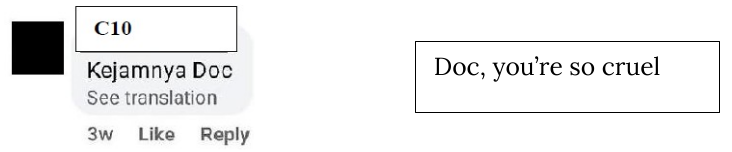
Figure 9. Example 9
In relation to responses about the celebrity’s choice of singlehood, Example 9 demonstrates how C10 criticises the celebrity’s personal choice of being single, claiming it is an act of cruelty, “Kejamnya Doc” (Doc, you’re so cruel). Furthermore, the use of the particle ‘-nya’ by C10 can also intensify the negative references directed towards her. It is interesting to observe how the commenter addresses Dr. X with respect, “Doc”, which acknowledges her as a PhD holder, the academician that she is, while also criticising her personal choice to remain single as a cruel thing to do.
Discussions
Table 4 shows examples of impoliteness triggers found in the data corresponding to Culpeper’s (2011) (non)conventionalised impoliteness formulae.
| (Non)conventionalised impoliteness formulae | Examples of impolite comments | Translations |
|---|---|---|
| 1. Unpalatable questions and/or presupposition |
Ayat seseorang yg cuba pujuk hati..berpura2 tak perlukan teman tapi dalam hati kesunyian..jangan tipu diri sendiri dr.. So, u expecting a God to be your husband? Gtfoh! Try to see how many women wasted their lives in club, minah rempit, prostitutions and many more. Same ish different story 🤦 Bodoh ke |
The words of someone trying to console the heart... pretending not to need a companion, but deep down feeling lonely.. don’t deceive yourself, dr. Is she stupid? |
| 2. External convention-driven implicational impoliteness (Sarcasm / teasing) |
laa. Bila bab laki pulak korng jgak yg meroyan entah apa2. Smpai membabitkan org yg tk besalah pulk tu. Typical perempuan. Kita paham, korng mana pernah salah 🤣 knapa lak dok sorang2. Banyak je rumah rumah org tua skrang ni. Duk je lah situ 🤣 Ya ya. Klu yg fikir x yah kawen, silakan. Cari kwn dikalangan bukan manusia. Ada je pun. |
When it comes to men, you don’t care about anything. Until it involves innocent people. Typical women. We understand, when did you ever make mistake. Why should you stay alone? There are many old folk’s homes these days. Just stay there. Yes yes. If you think you don’t need to get married, please go ahead. Find friends who are non-humans. They exist. |
| 3. Form-driven | Zaman ni kena bela buaya 🤣 Ramai juga lelaki takut nak kahwin...kalau tengok perempuan zaman sekarang pun, memang menakutkan. Perkara yang tak baik dan buruk sering dilabel pada lelaki...lelakinitulah,lelaki inilah. Padahal lelaki adalah asas kepada semua yang dinikmati para wanita. Yang memastikan keselesaan dapat dinikmati. Selalunya yg cakap nak bujang sepanjang hayat ni dia le yg cepat kahwin... |
In this era, we need to raise crocodile. Many men are also afraid to get married... if you look at women today, it’s really scary. Things that are negative are often labelled on men... that man, this man. Whereas men are the basis of everything that women enjoy. That ensures comfort can be enjoyed. Usually, the ones who say they want to be single for the rest of their lives are the ones who get married quickly... |
| 4. Silencer | bro...baca komen awal aku...i dont care and dont want to know your choice in life...married or not for whatever the reason....but keep it to yourself la, instead of telling getting married is no longer relevant or as beban. You tak nak kawin...up to you lah, tapi jangan lah kata kawin ni tak bagus. |
Bro...read my earlier comment...I don’t care and don’t want to know your choice in life... married or not for whatever the reason....but keep it to yourself, instead of telling getting married is no longer relevant or as burden. You do not want to get married... up to you, but don’t say that marriage is not good. |
| 5. Insults: Personalised third-person negative references (in the hearing of the target) |
Dah tak ada nafsu tu.. Dah tua dah |
No more lust Already old |
| 6. Negative expressive (e.g., curses, ill-wishes) | Klu sengaja x nak kahwin NERAKA la jawabnya | If you intentionally don’t want to get married, the answer is HELL. |
| 7. Pointed criticism / complaint | Kejamnya Doc | Doc, you’re so cruel |
Upon analysis, the data also reveal several differences when compared to Culpeper’s (2011) corpus on instances of English impoliteness, such as the form of address and the use of colloquial language.
Some commenters may perceive themselves as subordinates to Dr. X, not only due to her celebrity status but also because of her academic qualifications (holding a doctorate) and her position in academia (as an associate professor). Thus, some expressed their respect by addressing her with honorifics such as ‘Dr’, ‘Prof’, or ‘beliau’ (the formal pronoun for ‘he/she’) in this informal context. However, there were also commenters who may have viewed themselves as equals to Dr. X, addressing her more informally as ‘amoi’ (younger sister).
It is observed that commenters often use colloquialisms and/or code-switching to their mother tongue when committing a face-threatening act. The absence of pronouns in their impolite comments indicates the use of colloquial language. For example, “Klu sengaja x nak kahwin NERAKA la jawabnya” (If [missing pronoun] intentionally don’t want to get married, HELL is the answer). This finding aligns with Rabab’ah and Alali’s (2020) that the use of colloquial language in impolite comments might make the face-threatening act “more real and expressive” (p. 32).
Conclusions
This study sheds light on the prevalence of impoliteness in comments made by social media users towards single women. Based on the analysis of linguistic features in social media users’ comments, this study found various impoliteness triggers employed by commenters to attack the face of women who decide to remain single, which could reflect sexism. The commenters’ responses on Dr X’s posts also revealed various social factors, including sexuality, religion, descent, and old age. These factors are emphasised by those who disagree with her decision to remain single. These comments reflect the commenters’ mindsets, perceptions, or ideologies on one’s marital status. Consequently, individuals who deviate from the societal norms of marriage become subjects of stereotype effects, potentially leading to singlism and sexism towards single adults, especially single women. It is essential to comprehend how singlism is constructed through impoliteness on social media to address these stereotypical issues and promote greater acceptance of individual choices in society. Therefore, society should not intervene in one’s personal marital decision, as marriage should be a choice rather than an obligation.
Theoretically, this study can contribute to the field of pragmatics by examining how social media users employs impoliteness discourse to respond to women who choose not to marry. Practically, this study can serve as a catalyst for raising awareness about the importance of accepting individuals’ marital statuses without perpetuating negative stereotypes.
Further research might delve into the way single women are treated in the workplace in Malaysia. Apart from marital status, other societal pressures, such as parental status, academic qualifications, or career choices, warrant investigation in future studies.
Footnotes
1A social network owned by a company recognized as extremist in the Russian Federation. Hereinafter, it will be marked with the symbol ** (the editorial office is required to indicate this).
2See: https://www.Facebook.com/drsoowinccifanpage/posts/pfbid0LyiFr2bd4Ez1jReAHnSRNvsyxSj7PdHiY8vb23smiBKJKvjMm5Boo8wcfhd7qGiUl
3See: https://www.Instagram.com/p/CnR0a7KJvHt/?igshid=YmMyMTA2M2Y=
4See: https://twitter.com/soowincci/status/1613182149561286656
5See: https://www.Facebook.com/drsoowinccifanpage/posts/pfbid0UfWQTKRefPLENxzPE2HBvRxZq4gfnYRoGJRimj21PQLco33W7XeaEPDAoSFZK23fl
6See: https://www.Instagram.com/p/CnTsAXuLSEC/?igshid=YmMyMTA2M2Y=
7Dr X refers to the said celebrity; whereas, C refers to the commenter (e.g., C1 is Commenter 1).
References
Ahmad, N. A., & Masud, J. (2013). Inequality at Play in Community: Stigmatization of and Discrimination against Older Ever- single (Wo)Men. Jurnal Pembangunan Sosial, 16. https://doi.org/10.32890/jps.16.2013.11581
Alhamzah, T. (2022, April 1). #Showbiz: Soo Wincci first Miss World Malaysia who is also associate professor. New Straits Times. https://www.nst.com.my/lifestyle/groove/2022/04/785307/showbiz-soo-wincci-first-miss-world-malaysia-who-also-associate
Atmawati, D. (2018). Gender bias in Javanese society: A study in language forms choice to men and women. Humaniora, 9(3), 257–264. https://doi.org/10.21512/humaniora.v9i3.4937
Azmawati, A. A. (2011). “I Am Not Alone”: Managing singleness—Exploring single Malay Muslim women’s voices in Malaysia. Forum Komunikasi, 9(1), 1–16.
Azmawati, A. A., Mohd Hashim, I. H., & Endut, N. (2015). “Don’t Marry, Be Happy!” – How Single Women in Malaysia View Marriage. SHS Web of Conferences, 18, 03001. https://doi.org/10.1051/shsconf/20151803001
Bell, D. M. (1997). Innuendo. Journal of Pragmatics, 27(1), 35–59. https://doi.org/10.1016/S0378-2166(97)88001-0
Chinyelu, N. (2020). Sexist language in Nollywood movies. Interdisciplinary Journal of African & Asian Studies (IJAAS), 6(2), 139–149.
Culpeper, J. (1996). Towards an anatomy of impoliteness. Journal of Pragmatics, 25(3), 349–367. https://doi.org/10.1016/0378-2166(95)00014-3
Culpeper, J. (2011). Impoliteness: Using language to cause offence (Vol. 28). Cambridge University Press. https://doi.org/10.1017/CBO9780511975752
DePaulo, B. M., & Morris, W. L. (2005). TARGET ARTICLE: Singles in Society and in Science. Psychological Inquiry, 16(2–3), 57–83. https://doi.org/10.1080/1047840X.2005.9682918
Girme, Y. U., Sibley, C. G., Hadden, B. W., Schmitt, M. T., & Hunger, J. M. (2022). Unsupported and Stigmatized? The Association Between Relationship Status and Well-Being Is Mediated by Social Support and Social Discrimination. Social Psychological and Personality Science, 13(2), 425–435. https://doi.org/10.1177/19485506211030102
Gui, T. (2020). “Leftover Women” or Single by Choice: Gender Role Negotiation of Single Professional Women in Contemporary China. Journal of Family Issues, 41(11), 1956–1978. https://doi.org/10.1177/0192513X20943919
Hancock, L. L. (2017). How women experience and respond to singlism: Stereotyping and discrimination of singles [PhD Thesis]. Walden University.
Hardaker, C., & McGlashan, M. (2016). “Real men don’t hate women”: Twitter rape threats and group identity. Journal of Pragmatics, 91, 80–93. https://doi.org/10.1016/j.pragma.2015.11.005
Haugh, M. (2017). Teasing. In S. Attardo (Ed.), Handbook of Language and Humour (pp. 204–218). Routledge.
Hennink, M., Diamond, I., & Cooper, P. (1999). Young Asian women and relationships: Traditional or transitional? Ethnic and Racial Studies, 22(5), 867–891. https://doi.org/10.1080/014198799329297
Himawan, K. K., Bambling, M., & Edirippulige, S. (2018). The Asian Single Profiles: Discovering Many Faces of Never Married Adults in Asia. Journal of Family Issues, 39(14), 3667–3689. https://doi.org/10.1177/0192513X18789205
Ibrahim, R. (2016). “What Is Wrong With Me?” – Single Women’s Reflections on Missing the Marriage Transition. Asian Social Science, 12(12), 213. https://doi.org/10.5539/ass.v12n12p213
Keltner, D., Capps, L., Kring, A. M., Young, R. C., & Heerey, E. A. (2001). Just teasing: A conceptual analysis and empirical review. Psychological Bulletin, 127(2), 229–248. https://doi.org/10.1037/0033-2909.127.2.229
Kwok, K., & Kwok, D. K. (2023). Experiencing double silence: Sexuality education of south Asian minority youth in Hong Kong. Sex Education, 23(6), 740–755. https://doi.org/10.1080/14681811.2022.2134103
Levitt, A. (2010). Never-married women in their 30s are total losers, Mizzou study reveals. https://www.riverfronttimes.com/news/never-married-women-in-their-30s-are-total-losers-mizzou-study-finds-2602188
Lim, I. (2021, February 25). Federal court unanimously declares Selangor Shariah law criminalising ‘unnatural sex’ void, unconstitutional. Malay Mail. https://www.malaymail.com/news/malaysia/2021/02/25/federal-court-unanimously-declares-selangor-shariah-law-criminalising-unnat/1952701
Liu, C. (2023). The even darker side of gift-giving: Understanding sustained exploitation in family consumption system. Marketing Theory, 23(4), 709–723. https://doi.org/10.1177/14705931231199386
Manap, J., Kassim, A. C., Hoesni, S., Nen, S., Idris, F., & Ghazali, F. (2013). The Purpose of Marriage among Single Malaysian Youth. Procedia - Social and Behavioral Sciences, 82, 112–116. https://doi.org/10.1016/j.sbspro.2013.06.233
Mao, F. (2022, December 6). Indonesia passes criminal code banning sex outside marriage. BBC News. https://www.bbc.com/news/world-asia-63869078
Marriage and Divorce Statistics, Malaysia. (2022). Department of Statistics Malaysia. https://www.dosm.gov.my/portal-main/release-content/marriage-and-divorce-statistics-malaysia-2022
Maslow, A. H. (1943). A theory of human motivation. Psychological Review, 50(4), 370–396. https://doi.org/10.1037/h0054346
Maslow, A. H. (1954). Motivation and personality. Harper and Row.
Mills, S. (2008). Language and Sexism. Cambridge University Press.
Nai Peng, T. (2007). Trends in Delayed and Non-Marriage in Peninsular Malaysia. Asian Population Studies, 3(3), 243–261. https://doi.org/10.1080/17441730701746391
Omenugha, K. A. (2007). Playing unfair: The synergy of culture and sexism in Nigerian news discourse. In R. Taiwo, A. Odebunmi, & A. Adetunji (Eds.), Perspectives on Media Discourse (pp. 156–181). Lincom Europa.
Paltridge, B. (2006). Discourse Analysis. Continuum.
Penelope, J. (1990). Speaking Freely. Pergamon Press.
Pratama, H. (2018). Identifying sexist language on YouTube comment section. Language in the Online & Offline World 6: The Fortitude, 121–127.
Pung, W. C. & Siti Nur Amira Mohd Faizal. (2023). Impoliteness on Twitter by Malaysians. Trends in Undergraduate Research, 6(1), f1-9. https://doi.org/10.33736/tur.5476.2023
Qian, Y., & Qian, Z. (2014). The gender divide in urban China: Singlehood and assortative mating by age and education. Demographic Research, 31, 1337–1364. https://doi.org/10.4054/DemRes.2014.31.45
Rabab’ah, G., & Alali, N. (2020). Impoliteness in reader comments on the Al-Jazeera channel news website. Journal of Politeness Research, 16(1), 1–43. https://doi.org/10.1515/pr-2017-0028
Rafiq, R., Saleem, M., Durrani, A. K., & Siddique, A. R. (2022). As being Professional and Self-sufficient Lady, I Will Not Marry”- An Exploratory Study. Pakistan Journal of Psychological Research, 37(3), 435–452. https://doi.org/10.33824/PJPR.2022.37.3.26
Reynolds, J., & Taylor, S. (2005). Narrating singleness: Life stories and deficit identities. Narrative Inquiry, 15(2), 197–215. https://doi.org/10.1075/ni.15.2.02rey
Sharp, E. A., & Ganong, L. (2011). “I’m a Loser, I’m Not Married, Let’s Just All Look at Me”: Ever-Single Women’s Perceptions of Their Social Environment. Journal of Family Issues, 32(7), 956–980. https://doi.org/10.1177/0192513X10392537
Sher, M., & Saleem, A. (2023). Linguistic Sexism in ‘Rishta Culture’ of Peshawar: A Feminist Stylistic Analysis of Matrimonial Advertisements in Newspapers. International “Journal of Academic Research for Humanities,” 3(2), 154–167.
Sperber, D., & Wilson, D. (1986). Relevance: Communication and Cognition (Vol. 142). Harvard University Press.
Sultana, A., Zeeshan, M., & Ahmed, F. (2021). Dilemmas Of Singlehood In Contemporary Pakistani Culture: A Qualitative Study Of Unheard Voices. Pakistan Journal of Gender Studies, 21(1), 1–18. https://doi.org/10.46568/pjgs.v21i1.509
Tengkilisan, J. S. K., & Limanta, L. S. (2022). The Single Path: A Novel Breaking The Shackle of Marital Pressure. K@ta Kita, 10(2), 192–200. https://doi.org/10.9744/katakita.10.2.192-200
Wood, L. A., & Kroger, R. O. (2000). Doing Discourse Analysis: Methods for Studying Action in Talk and Text. Sage Publications. https://doi.org/10.4135/9781452233291
Wulf, K. A. (2000). Not All Wives: Women of Colonial Philadelphia. Cornell University Press. https://doi.org/10.7591/9781501745355
Yusof, T. A. (2018, September 28). Fewer people getting married, divorced last year. New Straits Times. https://www.nst.com.my/news/nation/2018/12/444748/fewer-people-getting-married-divorced-last-year