Guns, Gore, and Glory: A Content Analysis of Escalating Violence in Indian War Cinema (1990-2020)
University of Central Punjab (Lahore, Pakistan).
Email: omer.qureshi[at]ucp.edu.pk
 0009-0005-0282-4227
Beaconhouse National University (Lahore, Pakistan).
Email: farahat.ali[at]bnu.edu.pk
0009-0004-2047-3988University of Central Punjab (Lahore, Pakistan).
Email: fawad.baig[at]ucp.edu.pk
0000-0001-6351-8075Abstract
This study investigates the evolving portrayal of violence in Indian war films over a thirty-year period (1990–2020), analyzing shifts in frequency, intensity, and moral framing. Employing a quantitative content analysis of twelve stratified, high-rated films from IMDb and Rotten Tomatoes, the research operationalizes violence through four dimensions: weapon typology, duration of battle scenes, intensity of gore, and violence against non-combatants. Findings reveal a marked escalation in both the quantity and graphic nature of violent depictions in the later period (2006–2020), with statistically significant increases in small arms usage, prolonged battle sequences, and higher gore ratings, while violence toward civilians remains constant. The study applies the theories of Aestheticization of Violence and Just War Cinema to demonstrate how modern Bollywood war films stylize brutality while legitimizing it through nationalistic and moral narratives. These findings highlight a cinematic shift toward hyper-realistic and ideologically charged portrayals of war, raising critical questions about the normalization of violence, the ethics of visual storytelling, and the sociopolitical implications of media militarism. This research fills a critical gap in non-Western media studies and contributes to broader discourses on the intersection of entertainment, propaganda, and cultural memory.
Keywords
Violence, War Films, India, Gore, Bollywood, Hindi films, Depiction of Violence, Violence in War Movies, IMDB, Rotten Tomatoes
Оружие, кровь и слава: контент-анализ эскалации насилия в индийском военном кино (1990–2020)
Центральный университет Пенджаба (Лахор, Пакистан).
Email: omer.qureshi[at]ucp.edu.pk
0009-0005-0282-4227Национальный университет Биконхаус (Лахор, Пакистан).
Email: farahat.ali[at]bnu.edu.pk
0009-0004-2047-3988Центральный университет Пенджаба (Лахор, Пакистан).
Email: fawad.baig[at]ucp.edu.pk
0000-0001-6351-8075Аннотация
Данное исследование анализирует трансформацию репрезентации насилия в индийском военном кино за тридцатилетний период (1990–2020), фокусируясь на изменении частотности, интенсивности и моральной рамки изображаемого насилия. С применением количественного контент-анализа двенадцати стратифицированных высокооценённых фильмов (по данным IMDb и Rotten Tomatoes) насилие операционализируется через четыре аналитических параметра: типология вооружения, продолжительность боевых сцен, степень натуралистичности (gore) и насилие в отношении некомбатантов. Результаты демонстрируют значительное усиление как количества, так и графичности сцен насилия в более поздний период (2006–2020), что выражается в статистически значимом росте использования стрелкового оружия, увеличении продолжительности батальных эпизодов и повышении показателей натуралистичности, при этом уровень насилия в отношении гражданского населения остаётся стабильным. Теоретической рамкой исследования выступают концепции эстетизации насилия и «справедливого военного кино» (Just War Cinema), позволяющие выявить, каким образом современные болливудские военные фильмы стилизуют жестокость, одновременно легитимируя её через националистические и моральные нарративы. Полученные данные фиксируют сдвиг в сторону гиперреалистичных и идеологически насыщенных изображений войны, что ставит критические вопросы о нормализации насилия, этике визуального повествования и социополитических измерениях медиального милитаризма. Исследование восполняет важный пробел в не-западных медиаисследованиях и вносит вклад в более широкий академический дискурс на пересечении индустрии развлечений, пропаганды и культурной памяти.
Ключевые слова
насилие, военные фильмы, Индия, натуралистичность, Болливуд, фильмы на хинди, репрезентация насилия, насилие в военном кино, IMDb, Rotten Tomatoes
Introduction
The depiction of violence in Indian war movies serves as a potent tool for political propaganda, subtly shaping viewers’ perceptions and reinforcing political agendas. These films often dramatize real-life military conflicts, such as the Indo-Pak cross-border violence, to create compelling narratives that promote a jingoistic and nationalistic perspective (Raj & Suresh, 2022). Bollywood war movies like Uri: The Surgical Strike utilize stylized violence to evoke a sense of patriotism and justify military actions, thereby influencing public opinion and reinforcing the notion of a nationalistic identity (Aravind, 2023). Additionally, the portrayal of historical and biographical narratives in these films often aligns with the political ideologies of the ruling regime, promoting a monolithic national identity based on Hindutva principles (Gopinath, 2025). This strategic use of cinema not only entertains but also subtly indoctrinates viewers, making them more susceptible to the political messages embedded within the films. By presenting a masculinized and heroic image of soldiers, these movies reinforce traditional gender roles and nationalistic fervor, thereby further entrenching the political narratives they aim to propagate (Christensen & Haas, 2015; Ritzenhoff & Kazecki, 2014). Thus, Indian war movies act as powerful instruments of propaganda, shaping public perception and advancing political agendas through their depiction of violence and heroism.
War films, a prominent genre in contemporary cinema, vividly depict the multifaceted nature of conflict, often focusing on battles that occur on land, sea, or in the air. These films are not just about the physical confrontations but delve deeply into themes such as survival, camaraderie among soldiers, sacrifice, and the profound moral and ethical dilemmas posed by war. They frequently highlight the inhumanity and futility of war, reflecting on its devastating impact on society and individuals (Binns, 2017; Zheng, 2021). The portrayal of war in films serves as a powerful medium for exploring and disseminating national ideologies and historical narratives, as seen in various cultural contexts (Sjølyst-Jackson, 2013). Characters in these films become familiar to the public, often embodying the heroism and trauma associated with military conflicts, which in turn shapes public perception and collective memory (Ritzenhoff & Kazecki, 2014). War films also address the psychological and emotional toll on soldiers, providing a lens through which audiences can understand the complexities of war and its aftermath (Peebles, 2021). The genre’s ability to combine action, visual spectacle, and deep emotional conflict makes it a dynamic and influential form of entertainment that resonates with audiences worldwide (Binns, 2017).
Media violence refers to the explicit visual depiction of physical aggression between individuals, excluding off-screen acts of violence. This type of content is prevalent in various forms of media, including films, which can influence audience behavior and perceptions. Research indicates that exposure to media violence can lead to increased aggression and desensitization to violence among viewers (Bushman & Whitaker, 2012; Fanti et al., 2009). Studies on Indian cinema, including Bollywood, reveal that violent content is often depicted in a manner that normalizes and glamorizes aggressive behavior (Anderson & Bushman, 2002; Mahalakshmi & Lavanya, 2023). This trend is concerning as it can lead to viewers becoming more accepting of violence as a means to achieve goals, potentially encouraging real-world aggression (Huesmann & Taylor, 2006). Furthermore, the portrayal of protagonists engaging in violent acts more frequently than antagonists in some Indian films suggests a troubling narrative that justifies violence for the sake of heroism or justice (Mahalakshmi & Lavanya, 2023). This depiction can have significant implications for societal attitudes towards violence, reinforcing the notion that violence is an acceptable solution to conflicts.
This research aims to analyze the extent of violence depicted in Indian films across two distinct periods, focusing on the differences in frequency and intensity of violence, the use of implements of violence, and the portrayal of gore in war films. The study examines six Indian films selected based on ratings from IMDb and Rotten Tomatoes. By comparing films from an earlier period (1990-2005) with those from a later period (2006-2020), the research aims to identify trends and shifts in the portrayal of violence. These trends may reflect broader socio-cultural and political changes in India, such as the rise of muscular nationalism and the impact of global influences. This analysis is crucial as it provides insights into how cinematic portrayals of violence have evolved over time and the potential impact these changes may have on audiences.
The implications of this study are multifaceted. Firstly, understanding the evolution of violence in Indian films can shed light on broader societal changes and the shifting cultural landscape. For instance, previous research has shown that media violence can influence viewers’ perceptions and behaviors, potentially leading to increased aggression and desensitization to violence. By identifying specific trends in the depiction of violence, this study can inform discussions on protecting vulnerable audiences such as children and adolescents. Additionally, the findings can contribute to the academic discourse on the role of cinema in reflecting and shaping societal norms and values, particularly in relation to violence and aggression.
Objectives
-
To examine the evolution of violent content in war films by comparing the frequency, type, and duration of violent acts between earlier (1990-2005) and later (2006-2020) war films.
-
To assess the changes in the depiction of gore and violence against noncombatants in war films over time.
Literature Review
Researchers have long been concerned about the impact of media violence in war movies on societal behavior, particularly focusing on the potential for such content to incite real-world violence. Studies have shown that exposure to violent media, including films, can contribute to increased aggression and violent behavior, although it is not the sole cause (Bushman & Anderson, 2015; Huesmann & Taylor, 2006). The portrayal of violence in media has been a subject of public concern since the inception of these forms, with particular attention to its effects on children. Despite extensive research, there remains disagreement on the conclusiveness of these findings and the appropriate policy implications (Tulloch & Tulloch, 1998). Researchers have also noted that the context in which violence is depicted can influence its impact on viewers, with some depictions carrying greater risks than others (Timmer, 2011).
Violence in movies and war films can be broadly defined as the depiction of physical force intended to harm or kill, often accompanied by graphic imagery of injury or death. Gore, a subset of violence, refers to the explicit portrayal of bloodshed and bodily harm, often in a detailed and graphic manner (Bartsch & Mares, 2014). In war films, violence and gore are used to depict the brutal realities of combat, aiming to provide a realistic portrayal of the horrors of war. This can include scenes of battle, injuries, and death, often intended to evoke strong emotional responses from the audience (Binns, 2017; McDonald, 2015). The depiction of violence in these films is not merely for shock value but often serves to underscore the narrative’s themes of heroism, sacrifice, and the moral complexities of war (Binns, 2017; Zietsma, 2013).
Hollywood and Bollywood approach the depiction of violence and gore in war movies differently. Hollywood war films, such as Saving Private Ryan and Full Metal Jacket, often emphasize realistic and graphic portrayals of combat to highlight the chaos and brutality of war (Binns, 2017; McDonald, 2015). These films use advanced special effects and detailed cinematography to create immersive and impactful scenes of violence, often reflecting nationalistic and idealistic themes (Binns, 2017; Zietsma, 2013). In contrast, Bollywood war films, while also depicting violence, tend to incorporate a more stylized and dramatized approach. Films like Uri: The Surgical Strike use violence to create a video-game-like atmosphere, often serving political propaganda and ideological narratives (Raj & Suresh, 2022). Despite the presence of violence in Bollywood films, there is a notable lack of comprehensive studies examining its depiction compared to Hollywood, which has been extensively analyzed for its portrayal of violence in various genres (Singh, 2020; Zinck, 2019). This gap highlights the need for more research into how Bollywood represents violence and its potential impact on audiences.
Research has shown that violence in movies has increased substantially over the last few decades, yet its direct correlation with societal violence remains inconclusive (Markey et al., 2015). Theoretical and empirical analyses have explored various dimensions of violence and war in media, including historical patterns, cultural perspectives, and political implications (Karatzogianni, 2013). Additionally, studies have examined how war films use violent imagery to shape masculine subjectivities and critique nationalistic narratives (McDonald, 2015). Audience interest in violent media content has also been investigated, revealing that viewers may seek out gory content for its meaningfulness and reflection of reality (Bartsch & Mares, 2014). However, these studies predominantly focus on Western contexts, particularly Hollywood, and often overlook the unique cultural and historical contexts of other regions, such as India.
The existing literature has several gaps, particularly in its limited exploration of non-Western war films (Singh, 2020). Indian war movies, for instance, have not been extensively studied, despite India’s rich history of conflict and its burgeoning film industry. This lack of research leaves a significant gap in understanding how Indian war films portray violence and gore, and how these portrayals have evolved over time. By focusing on Indian war films, we can gain a more comprehensive understanding of global cinematic trends and the cultural specificities that influence the depiction of war and violence. To address this gap, we formulated the following hypothesis: H1: War films from the later period (2006-2020) contain significantly more gore and violence compared to war films from the earlier period (1990-2005). This hypothesis aims to fill the existing research void by examining the evolution of violent content in Indian war movies, thereby contributing to a better understanding of global media trends.
The portrayal of gore and violence against noncombatants in war films has seen a notable increase in both Hollywood and Bollywood. In Hollywood, the escalation of graphic violence can be linked to the broader cultural and political climate, especially post-9/11. The “war on terror” has significantly influenced Hollywood’s narrative, leading to films that emphasize high-tech spectacles and graphic depictions of violence, often reflecting real-life fears and threats (Boggs & Pollard, 2006, 2008). This period witnessed a rise in films that not only depicted intense violence but also explored themes of patriotism and militarism, as evident in movies like Rambo IV and Charlie Wilson’s War (Boggs & Pollard, 2008). The trend towards more graphic and prolonged depictions of violence is also evident in the way these films handle the psychological and physical impacts of war on both soldiers and civilians, aiming to provide a visceral experience for the audience (Philpott, 2010).
In contrast, Bollywood’s depiction of war and violence has been deeply intertwined with the rise of muscular nationalism and the socio-political ascendancy of Hindutva forces in the 2010s. Bollywood war films have increasingly showcased the soldier’s body as a symbol of national strength and masculinity, often marginalizing non-masculine and non-combatant figures (Aravind, 2023). This period has seen a shift towards more intense and prolonged scenes of violence, reflecting the broader cultural narratives of impending national threats and the valorization of military power. However, previous research has not extensively covered the long‑term portrayal of such violence in Bollywood, creating a gap that this study aims to fill. By examining the intensity and duration of violence in Bollywood war films from 2006 to 2020, this study seeks to understand how these depictions have evolved and what they reveal about contemporary socio-political dynamics. Consequently, based on the aforementioned literature, we have formulated the second hypothesis as H2: The intensity and duration of violence, along with the depiction of gore and violence against non-combatants, have risen in war films from the later period (2006-2020).
Violence and Gore in Bollywood War Films: Theoretical Perspectives
This study employs two theoretical frameworks—Aestheticization of Violence and Just War Cinema—to analyze the inclusion of violence and gore in Bollywood war films. The Aestheticization of Violence theory suggests that filmmakers use violence to create visually and emotionally compelling narratives that captivate audiences (Ma et al., 2020; der Derian, 2010). Additionally, the Just War Cinema theory posits that films often depict violence as a legitimate and necessary means to achieve moral ends, reflecting societal norms and values (Finlay, 2017). These theories help explain why producers and filmmakers focus on violent content while often neglecting to address its potential negative effects on viewers.
The Aestheticization of Violence theory posits that filmmakers use violence to create visually and emotionally compelling narratives that captivate audiences (Ma et al., 2020; der Derian, 2010). This theory is evident in Bollywood war films, where violence is often stylized to enhance the cinematic experience. The combination of violence and aesthetics creates a paradoxical experience for the audience, subverting stereotypes about violence and evoking new aesthetic experiences both physically and psychologically (Ma et al., 2020). This approach can be seen in the use of elaborate fight sequences, dramatic explosions, and intense battle scenes that are designed to be visually striking and emotionally engaging. The aestheticization of violence in Bollywood war films serves to draw viewers into the narrative, making the depiction of violence not just a plot device but a central element of the film’s artistic expression.
Just War Cinema theory, on the other hand, suggests that films often depict violence as a legitimate and necessary means to achieve moral ends, reflecting societal norms and values (Finlay, 2017). This theory is also applicable to Bollywood war films, which frequently portray violence as justified within the context of defending the nation or achieving a greater good. These films often align with the principles of Just War Theory, which balances the ideal of peace with the reality that violence and bloodshed occur in an imperfect world (Patterson, 2007). Bollywood war films typically emphasize the heroism and moral righteousness of the protagonists, who are depicted as fighting for a just cause. This portrayal reinforces societal beliefs about the legitimacy of violence in certain contexts, particularly in defense of the nation or in the pursuit of justice.
The intersection of these two theories in Bollywood war films can be seen in the way violence is both aestheticized and morally justified. The aestheticization of violence makes the depiction of gore and brutality more palatable and engaging for the audience, while Just War Cinema provides a moral framework that legitimizes the use of violence. This dual approach allows filmmakers to create compelling narratives that resonate with viewers on both an emotional and ethical level. By combining visually stunning depictions of violence with themes of moral righteousness, Bollywood war films are able to captivate audiences and reinforce societal norms about the acceptability of violence in certain contexts (Clément et al., 2017; Clément, 2023). This blend of aesthetic and ethical considerations ensures that the portrayal of violence in these films is both impactful and thought-provoking.
Methodology
In for data collection purpose, quantitative content analysis of Indian war films was conducted. The films were chosen from two online websites: IMDb and Rotten Tomatoes. The Internet Movie Database (IMDb) is an online database that contains information about movies, television, video games, celebrities, and film production. With a database of over two million films, this website offers an extensive amount of information about the film, including the actors, the movie’s beginning, the runtime, ratings and reviews, awards, and so on (Gosselt et al. (2015). This website is frequently visited by movie enthusiasts from all around the world seeking information on movies. ‘Rotten Tomatoes’ is another website about movies and movie reviews that originated in the United States. Its primary goal is to provide movie-related comments, ratings, information, and other related resources to the public1 (Fatemi & Tokarchuk, 2012).
This study employed quantitative content analysis to evaluate the frequency of violence depicted in Indian war films from 1990 to 2020. The population encompassed all Indian war films, examining three distinct decades: 1990–2000, 2001–2010, and 2011–2020, to investigate how the portrayal of violence has evolved over time. The sample consisted of Indian war films as noted in the table below (Table 1):
Table 1. Categorization of War and Historical Films by Release Decade
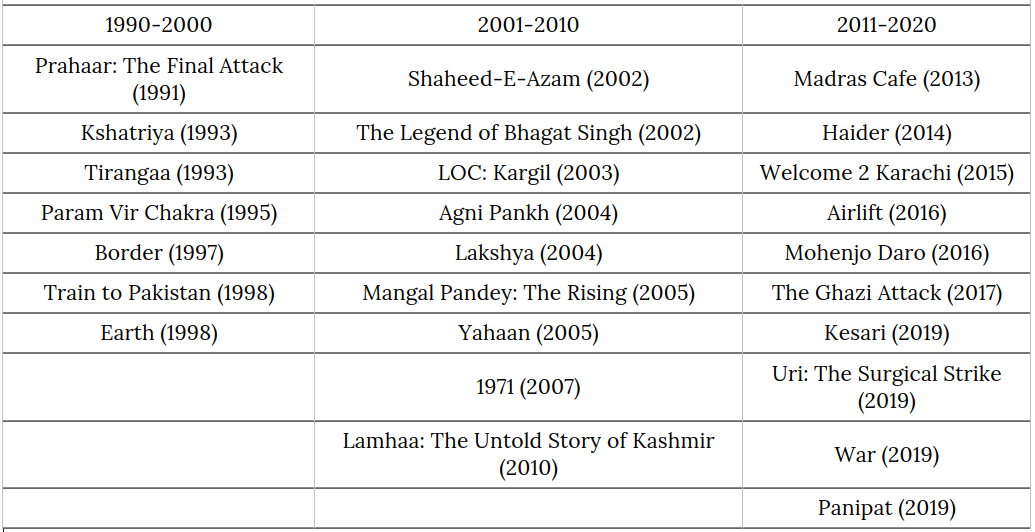
The stratified random sampling was used to select the movies for their analysis. We divided the population of Indian war movies into two strata based on the decade of release: 1990-2005 and 2006-2020. Then, we randomly selected six movies from each stratum; only those films from each decade are selected which have more than 7.0 rating on IMDb and more than 70% of audience score on Rotten Tomatoes. Resulting in a sample of 12 movies.
-
1990-2005: Border (1997), Earth (1998), Prahaar: The Final Attack (1991), Shaheed-E-Azam (2002), Lakshya (2004), The Legend of Bhagat Singh (2002),
-
2006-2020: 1971 (2007), Madras Café (2013), Haider (2014), Airlift (2016), The Ghazi Attack (2017), Uri: The Surgical Strike (2019)
Unit of Analysis: The unit is the depiction of violence scenes and timespan of scenes in war films.
Coding Scheme: Prior to the coding process, a pilot study was conducted by analyzing Border (1997), Lakshya (2004), and Uri: The Surgical Strike (2019) to refine the coding framework and enhance coder reliability. This preliminary analysis facilitated the operationalization of key indicators of violence, which were subsequently applied to all selected films.
The study categorized violence into four primary dimensions:
-
Implements of violence (types of weapons and means of attack)
-
Ratio of battle scenes to total film duration
-
Gore intensity (extent of visible injury and mutilation)
-
Violence directed at non-combatants (attacks on civilians, women, children, and infrastructure)
These coding dimensions were adapted from Monk-Turner et al. (2004) and refined to suit the context of Indian war cinema.
Operationalization of Violence Indicators
Implements of Violence
Violence was classified based on the means through which it was enacted. The following six categories were used:
-
Hand-to-hand combat: Physical altercations, including punches, kicks, use of the butt of a gun, and other direct physical force.
-
Blades: Weapons such as knives, swords, and bayonets.
-
Primary firearms: The principal weapons used in the depicted conflict, corresponding to the historical accuracy of the war setting (e.g., muskets for colonial wars, M16 rifles for modern conflicts). To ensure consistent measurement, each trigger pull – regardless of the number of bullets discharged – was counted as a single shot.
-
Small arms: Handguns, revolvers, and pistols.
-
Artillery: Large-scale weaponry such as tanks, cannons, anti-aircraft systems, and mortars.
-
Explosives and bombs: Grenades, landmines, flamethrowers, missile strikes, and aerial bombardment.
-
Each instance of the above categories was meticulously recorded and quantified for comparative analysis.
Ratio of Battle Scenes to Film Duration
To assess the intensity of battle sequences, the total duration of combat scenes was measured in seconds and then divided by the overall runtime of the film. For example, if a scene shows a battle that lasts for 5 minutes, the length of violence for that scene was 300 seconds. This produced a battle intensity ratio, allowing for standardized cross-film comparisons.
Gore Scale
To gauge the severity of depicted violence, the five-point gore scale (adapted from Monk-Turner et al., 2004) was employed:
-
Minimal gore: Minor wounds with negligible bloodshed.
-
Moderate gore: Visible bleeding and open wounds.
-
Severe gore: Profuse bleeding, gunshots to arteries, or significant bodily injury.
-
Extreme gore: Graphic injuries such as decapitations, amputations, or severe burns.
-
Maximal gore: Intense mutilation, exposure of internal organs, or incineration to the extent of skeletal exposure.
A gore rating was computed by dividing the total number of gory incidents by the accumulated score across all instances. For example, if a scene shows a minor wound with some blood, the gore for that scene was 1. If a scene shows a severed limb or a headshot with a lot of blood, the gore for that scene was 5.
Violence Against Non-Combatants
This category encompassed acts of violence directed towards civilians, children, women, animals, and civilian infrastructure. Instances were coded separately, ensuring a clear distinction between combatant and non-combatant violence. For example, if a scene shows a soldier killing a civilian, the violence directed at non-combatants for that scene was 1. If a scene shows no violence against non-combatants, the violence directed at non-combatants for that scene was 0. Each occurrence was systematically documented and aggregated for comparative assessment.
Data Collection and Analysis
The researcher viewed each movie before training the coders to help establish categories and act as a pretest for code reliability. Three coders independently assessed the same films to establish inter-coder reliability, and Cohen’s kappa was calculated to measure agreement among coders. A high level of inter-coder reliability (above 0.80) was maintained to ensure the accuracy of data interpretation. The study applied descriptive statistics, independent samples t-tests, and comparative analysis to examine trends in war film violence.
Results
Six films were released in the first time period comprising 16 years, i.e., 1990‑2005, which is our earlier period; and six films were released in 2006‑2020, which is termed as the later period. Table 2 examined the frequency of violence scenes in war films during two distinct time periods: the earlier period and the later period. In the earlier period, the most common categories of violent scenes were primary, small, and artillery, with frequencies of 280, 136, and 64, respectively. The presence of hands and blades was depicted in 75 and 23 scenes, respectively, whereas the bomb scenes were shown 49 times throughout the films. In contrast, there was a considerable increase in the frequency of violent scenes throughout the later period. The primary and small violence scenes remained popular, with an increase in number as 289 and 230, respectively. Moreover, there was a notable increase in the number of hand-to-hand combat and bomb scenes, with frequencies of 100 and 53, respectively. However, there was a slight decrease in the artillery frequency, which stood at 51.
Looking at the mean differences in implements of war between these two periods, we found that movies released in the earlier period had 15.67 instances of hand-to-hand combat, compared to 16.67 in the later period. A significant mean difference was found between these two periods (earlier compared to later) for blades (3.83/7.17), artillery (10.67/8.50), or explosives (8.17/8.33). Moreover, for primary (46.67/46.5) weapons and small arms (26.00/37.83), there was more violence in war films from the later period compared to those released earlier (see Table 2).
Table 2. Incidence of Implements of Violence, Length of Violence in Film, Gore and Violence to Noncombatants in Selected Films
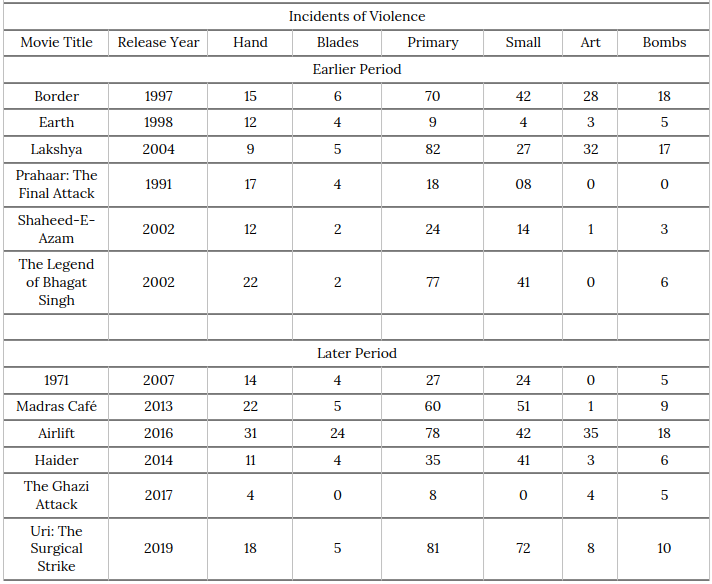
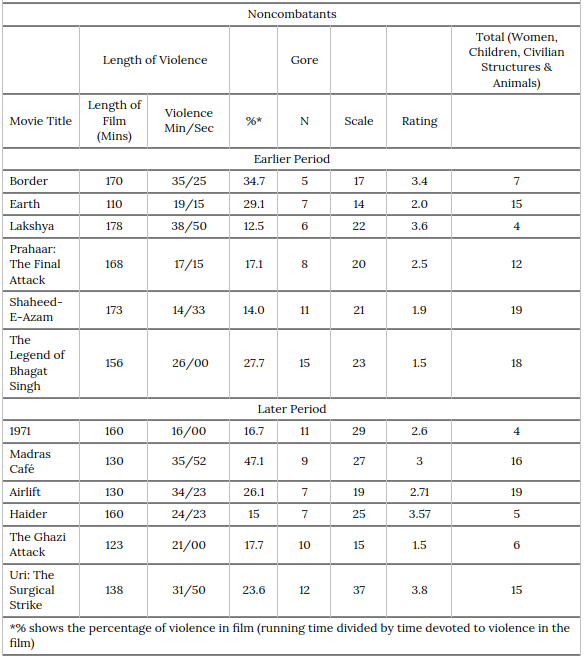
The proportion of battle scenes relative to the total movie length saw an increase over the two observed periods (see table 3). In the later period, films featured an average of 27.67 minutes of battle sequences, whereas earlier films had a lower average of 26.00 minutes. Additionally, the depiction of gore became more prominent, with later films having an average gore ratio of 10.83, compared to 8.67 in earlier war movies. Violence against non-combatants shows no change, with later films averaging 12.5 instances, compared to 12.5 in earlier releases. Following this, we analyzed notable differences in the use of weaponry, the proportion of battle scenes in relation to the overall film, the intensity of gore, and the portrayal of violence against noncombatants between the two time periods (see Table 2).
An analysis of war implements across different decades revealed notable distinctions in hand-to-hand combat (t = 3.35; p = 0.028), blade usage (t = 4.36; p = 0.012), artillery (t = -3.22; p = 0.291), and explosives (t = 3.95; p = 0.017). Additionally, significant differences emerged in the usage of primary weapons (t = 2.98; p = 0.02) and small arms (t = 3.40; p = 0.004). War films from 2006 to 2020 depicted more intense combat and gunfire than those from 1990 to 2005. Moreover, it is likely that the classification of primary weapons was more conservative in later films due to the complexity of tracking automatic gunfire. The portrayal of small arms, particularly handguns, was also more prevalent in modern war movies compared to those produced in earlier decades.
Gore was analyzed based on two factors: frequency of occurrence and severity. We found no significant difference in the number of gory instances between different decades (see table 3). However, there was a notable difference (t = 7.23; p = 0.002) in the overall gore rating when comparing older and more recent films. While the overall number of gory scenes remained relatively stable across time periods, the intensity and explicit nature of these depictions have significantly evolved over the years. Additionally, we observed a non-significant difference (t = 1.47; p = 0.425) in the portrayal of violence against non-combatants, highlighting no change in how war films depict the impact on civilians over time. This unexpected stability in non-combatant violence, despite the overall escalation in violent content, suggests a distinct narrative function for civilian depictions. The amount of violent content in modern war films has become increasingly prevalent, with a growing focus on realism and graphic intensity. Not only did our findings indicate that the overall quantity of violence in war films has increased over time, but they also suggest that the graphic detail and realism in these scenes have intensified.
Based on the findings, both hypotheses are supported, confirming that war films from the later period (2006-2020) exhibit significantly higher levels of violence, gore, increased duration of battle sequences, the higher frequency of intense combat scenes, while there is no difference in the depiction of non-combatant violence when compared to that from the earlier period (1990-2005).
Table 3. Length of Violence in Film, Gore and Violence to Noncombatants in Selected Films
Discussion
The results of this study reveal a clear escalation in the depiction of violence in Indian war films from the earlier period (1990–2005) to the later period (2006‑2020), supporting both hypotheses. Modern films exhibit significantly more frequent and intense portrayals of violence, marked by increased use of hand‑to‑hand combat, primary firearms, small arms, and explosives. The average duration of battle scenes also rose considerably, accompanied by a notable rise in the severity of gore and the frequency of violence against noncombatants. While the overall number of violent instances grew, the intensity and graphic nature of these scenes suggest a shift toward more visceral and realistic depictions of war. These changes reflect evolving cinematic strategies that embrace hyper-realism and spectacle, signaling a broader transformation in how violence is both represented and consumed in contemporary Indian war cinema.
These results align with previous studies that highlight the escalation of media violence over time and its potential psychological and societal effects (Bushman & Anderson, 2015; Huesmann & Taylor, 2006). The findings are particularly relevant in the context of Bollywood’s evolving cinematic strategies, where war films have increasingly served as tools of political propaganda, reinforcing nationalistic ideologies and justifying military actions (Aravind, 2023; Raj & Suresh, 2022). The significant increase in the use of primary firearms and explosives further highlights the trend towards hyper-realistic portrayals of combat, similar to the stylistic elements observed in Hollywood war films (Binns, 2017; McDonald, 2015).
The escalation of violence in Indian war films from 2006–2020 can too be interpreted within India’s evolving socio-cultural and political landscape. The period saw the rise of muscular nationalism and Hindutva ideologies, which emphasized a strong, militarized national identity, as reflected in films like Uri: The Surgical Strike (2019) (Gopinath, 2025). Additionally, post-9/11 global geopolitics and India’s increasing integration into global media markets may have influenced filmmakers to adopt hyper-realistic and spectacular portrayals of violence, akin to Hollywood trends (Boggs & Pollard, 2008). The liberalization of India’s economy and media in the 1990s, coupled with heightened Indo-Pak tensions, likely amplified nationalistic narratives, encouraging graphic depictions of military heroism to resonate with audiences facing perceived external threats. These socio-cultural shifts provide a critical lens for understanding why violence has become more visible, suggesting that the quantitative trends are not merely stylistic but deeply rooted in India’s changing political and cultural dynamics.
The findings of this study can be explained through the theories of Aestheticization of Violence and Just War Cinema. The Aestheticization of Violence theory posits that filmmakers utilize violence as a creative and cinematic tool to engage their audiences (Ma et al., 2020; der Derian, 2010). This is evident in Bollywood war films, where violence is often stylized, with dramatic battle sequences and visual spectacle enhancing the emotional impact of the narrative. The increased use of high-impact weaponry and prolonged battle sequences in modern war films aligns with this theory, as filmmakers seek to captivate audiences through heightened realism and spectacle. Bollywood war films from 2006–2020 frequently frame military conflicts as righteous struggles, aligning with nationalistic narratives that promote patriotism and militarism (Aravind, 2023). This justifies the increased depiction of violence and non-combatant casualties, as the narratives position such acts within a framework of national defense and heroism.
The unchanged depiction of violence against non-combatants across both periods presents an intriguing deviation from the overall trend of escalating violence. This stability suggests that Indian war films may deliberately limit violence against civilians to maintain an ethical anchor within their narratives. Civilians often serve as a symbolic subject – the protected entity for whose sake military violence is justified – aligning with Just War Cinema principles that legitimize violence through moral frameworks (Finlay, 2017). By keeping non-combatant violence constant, filmmakers may ensure that audiences can identify with the protected civilian population, thereby justifying the protagonists’ violent actions as necessary for national defense. This finding highlights a narrative constraint in Bollywood war films, where excessive civilian harm could undermine the moral legitimacy of the depicted violence and disrupt the nationalistic narratives that these films propagate.
Despite the valuable insights provided by this study, there are several limitations that should be acknowledged. Firstly, the sample size of 12 films may not fully represent the breadth of Bollywood war films over the examined periods. A larger dataset could provide a more comprehensive understanding of trends in war film violence. Secondly, the study relies on quantitative content analysis, which, while useful for measuring frequency and intensity, does not capture the nuanced ways in which violence is contextualized within narratives. Third, the lack of qualitative contextual analysis limits the study’s ability to interpret the narrative purposes of violent imagery, such as its potential to alienate audiences in anti-war contexts. Fourth, the novel finding that violence against non-combatants remained unchanged over time introduces a critical dimension to the study of Indian war cinema. This stability highlights the role of civilians as a narrative and ethical cornerstone, serving as the figurative subject for whose protection violence is enacted. This “protected subject” is essential for justifying military violence within the political and nationalistic narratives of Bollywood war films. The consistent depiction of civilian violence suggests that filmmakers strategically avoid excessive harm to non-combatants to maintain audience identification with the moral righteousness of the protagonists’ actions.
Theoretically, this finding enriches the application of Just War Cinema theory by highlighting how ethical constraints shape violent portrayals in non-Western contexts. Practically, it raises questions about the societal impact of such narratives, particularly how they reinforce militaristic ideologies while preserving a moral facade. The unexpected stability in non-combatant violence suggests that quantitative content analysis alone may not fully capture the narrative and ideological roles of civilians, necessitating broader methodological approaches. Future qualitative narrative analyses could explore how civilian characters are framed to evoke audience empathy, further elucidating the interplay between violence, ethics, and propaganda in Indian war films. Furthermore, future research could incorporate qualitative analyses to explore the thematic and ideological implications of violent depictions in greater depth. Lastly, this study does not account for audience reception or psychological impact, which are crucial factors in understanding the broader implications of media violence.
The results of this study have significant implications for both media studies and public discourse on violence in entertainment. The increasing prevalence and intensity of violence in Indian war films suggest a growing normalization of violent imagery, which may contribute to desensitization among viewers (Huesmann & Taylor, 2006; Bushman & Whitaker, 2012). This aligns with broader concerns about media violence influencing real-world aggression and shaping public attitudes toward militarism and nationalism.
From a cinematic perspective, the findings highlight the evolving role of Bollywood in propagating political ideologies. The shift toward more intense and graphic depictions of war can be seen as a reflection of India’s changing socio-political landscape, where nationalistic narratives have gained prominence (Biswas, 2025; Gehlawat, 2024). These trends highlight the need for critical media literacy initiatives to help audiences engage with war films more analytically, recognizing the ideological messages embedded within them. While the quantitative findings demonstrate a clear escalation in the frequency, intensity, and gore of violence in Indian war films from 2006–2020, the meaning of this increased visibility is inherently tied to the narrative context of each film. Violent imagery may serve varied purposes, such as glorifying military heroism in nationalistic narratives or, conversely, alienating audiences to critique war’s brutality, as seen in Brecht’s epic theater or cinematic movements like Dogme 95 and the Greek Weird Wave (Mosse, 2024; Vrbančić, 2009). For instance, films like Haider (2014) may employ graphic violence to underscore the tragic human cost of conflict, potentially distancing viewers to provoke anti-war reflection, whereas Uri: The Surgical Strike (2019) stylizes violence to evoke patriotic fervor. This contextual variability suggests that the quantitative increase in violence does not uniformly promote militarism but may reflect diverse ideological intents.
Integrating qualitative contextual analysis could further validate these findings by elucidating how violence aligns with or challenges the films’ narrative goals, enhancing the study’s interpretive depth. Moreover, comparing Bollywood’s representation of war and violence with that of Hollywood, Chinese, and other regional cinemas may reveal cultural distinctions in war storytelling. Additionally, investigating how regulatory bodies like the Central Board of Film Certification (CBFC) in India evaluate and control violent content in war films can shed light on media governance and the ethical obligations involved in filmmaking.
Conclusion
This study reveals a significant escalation in violence, gore, and battle duration in Indian war films from 2006–2020 compared to 1990–2005, reflecting a shift toward hyper-realistic and ideologically charged portrayals of war. Notably, the unchanged depiction of violence against non-combatants highlights a narrative strategy to preserve civilians as an ethical anchor, justifying military violence within nationalistic frameworks. This novel finding highlights the complexity of violence portrayal in Bollywood war cinema, where ethical constraints coexist with escalating brutality. These trends raise critical concerns about the normalization of violence, the blurring of simulation and reality in postmodern war films, and their broader societal implications, particularly in reinforcing militaristic and nationalistic ideologies. Further research into narrative framing and audience reception is essential to fully understand these dynamics.
Footnotes
1See: About Rotten Tomatoes. (2024, February 4). Rotten Tomatoes. https://www.rottentomatoes.com/about
References
Anderson, C. A., & Bushman, B. J. (2002). Media violence and the American public revisited. American Psychologist, 57(6–7), 448–450. https://doi.org/10.1037/0003-066X.57.6-7.448
Aravind, S. G. (2023). The Gender of War. In S. Gopinath & R. Deshmukh, Historicizing Myths in Contemporary India (1st ed., pp. 81–101). Routledge India. https://doi.org/10.4324/9781003363149-5
Bartsch, A., & Mares, M.-L. (2014). Making Sense of Violence: Perceived Meaningfulness as a Predictor of Audience Interest in Violent Media Content: Making Sense of Violence. Journal of Communication, 64(5), 956–976. https://doi.org/10.1111/jcom.12112
Binns, D. (2017). The Hollywood War Film: Critical Observations from World War I to Iraq. Intellect. https://doi.org/10.2307/j.ctv36xw1hm
Biswas, D. (2025). Beyond good and evil: Imagined nation in Hindi films. National Identities, 27(1–2), 123–138. https://doi.org/10.1080/14608944.2024.2306154
Boggs, C., & Pollard, T. (2006). Hollywood and the Spectacle of Terrorism. New Political Science, 28(3), 335–351. https://doi.org/10.1080/07393140600856151
Boggs, C., & Pollard, T. (2008). The Imperial Warrior in Hollywood: Rambo and Beyond. New Political Science, 30(4), 565–578. https://doi.org/10.1080/07393140802486260
Bushman, B. J., & Anderson, C. A. (2015). Understanding Causality in the Effects of Media Violence. American Behavioral Scientist, 59(14), 1807–1821. https://doi.org/10.1177/0002764215596554
Bushman, B. J., & Whitaker, J. L. (2012). Media Influence on Behavior. In Encyclopedia of Human Behavior (pp. 571–575). Elsevier. https://doi.org/10.1016/B978-0-12-375000-6.00386-4
Christensen, T., & Haas, P. J. (2015). Projecting politics: Political messages in American films. Routledge. https://doi.org/10.4324/9781315701493
Clément, M. (2023). Organising Political Violence: Radicalisation and Militancy as Narrative Activity. In D. Beck & J. Renner-Mugono (Eds.), Radicalization and Variations of Violence (pp. 15–32). Springer International Publishing. https://doi.org/10.1007/978-3-031-27011-6_2
Clément, M., Lindemann, T., & Sangar, E. (2017). The “Hero‐Protector Narrative”: Manufacturing Emotional Consent for the Use of Force. Political Psychology, 38(6), 991–1008. https://doi.org/10.1111/pops.12385
Der Derian, J. (2010). ‘Now We Are All Avatars.’ Millennium: Journal of International Studies, 39(1), 181‑186. https://doi.org/10.1177/0305829810374793
Fanti, K. A., Vanman, E., Henrich, C. C., & Avraamides, M. N. (2009). Desensitization to media violence over a short period of time. Aggressive Behavior, 35(2), 179–187. https://doi.org/10.1002/ab.20295
Fatemi, M., & Tokarchuk, L. (2012). An empirical study on IMDb and its communities based on the network of co-reviewers. Proceedings of the First Workshop on Measurement, Privacy, and Mobility, 1–6. https://doi.org/10.1145/2181196.2181203
Finlay, C. J. (2017). Bastards, brothers, and unjust warriors: Enmity and ethics in Just War Cinema. Review of International Studies, 43(1), 73–94. https://doi.org/10.1017/S0260210516000255
Gehlawat, A. (2024). Bollypolitics: Popular Hindi Cinema and Hindutva. Bloomsbury Publishing. https://doi.org/10.5040/9781350401914
Gopinath, S. (2025). Politics of apoliticality and the Indian citizen in popular Hindi cinema. National Identities, 27(1–2), 109–121. https://doi.org/10.1080/14608944.2024.2364180
Gosselt, J., Hoof, J. V., Gent, B., & Fox, J.-P. (2015). 2921| Violent Frames. Analyzing Internet Movie Database Reviewers’ Text Descriptions of Media Violence and Gender Differences from 39 Years of U.S. Action, Thriller, Crime, and Adventure Movies. International Journal of Communication, 9(0), 21.
Huesmann, L. R., & Taylor, L. D. (2006). The Role of Media Violence in Violent Behavior. Annual Review of Public Health, 27(1), 393–415. https://doi.org/10.1146/annurev.publhealth.26.021304.144640
Karatzogianni, A. (Ed.). (2013). Violence and War in Culture and the Media. Routledge. https://doi.org/10.4324/9780203143308
Ma, T., Liu, H., & Yang, H. (2020). Interactive Narrative Generation of Aesthetics of Violence in Films. 2020 IEEE 20th International Conference on Software Quality, Reliability and Security Companion (QRS-C), 657–662. https://doi.org/10.1109/QRS-C51114.2020.00111
Mahalakshmi, M. R., & Lavanya, R. (2023). Good or bad? Depiction of crime and violence in contemporary Tamil cinema. SN Social Sciences, 3(6), 95. https://doi.org/10.1007/s43545-023-00684-w
Markey, P. M., French, J. E., & Markey, C. N. (2015). Violent Movies and Severe Acts of Violence: Sensationalism Versus Science: Severe Acts of Violence. Human Communication Research, 41(2), 155–173. https://doi.org/10.1111/hcre.12046
McDonald, T. H. (2015). War-image as affect, war-image as spectacle in turn-of-the-millennium Hollywood: How are violent masculinities expressed? NORMA, 10(3–4), 236–249. https://doi.org/10.1080/18902138.2015.1102379
Monk‐Turner, E., Ciba, P., Cunningham, M., McIntire, P. G., Pollard, M., & Turner, R. (2004). A Content Analysis of Violence in American War Movies. Analyses of Social Issues and Public Policy, 4(1), 1‑11. https://doi.org/10.1111/j.1530-2415.2004.00031.x
Mosse, R. (2024). The Rationality of War: Brecht’s Theatre Experiments at the Limit of the Epic. In A. Heinrich & A.-C. Simke (Eds.), Dramaturgies of War (pp. 263–279). Springer International Publishing. https://doi.org/10.1007/978-3-031-39318-1_14
Patterson, E. (2007). Jus post bellum and international conflict: Order, justice, and reconciliation. In Rethinking the Just War Tradition (pp. 35–52). Suny Albany. https://doi.org/10.2307/jj.18254888.7
Peebles, S. (2021). The Forever Wars. In J. Haytock (Ed.), War and American Literature (1st ed., pp. 254‑268). Cambridge University Press. https://doi.org/10.1017/9781108654883.021
Philpott, S. (2010). Is anyone watching? War, cinema and bearing witness. Cambridge Review of International Affairs, 23(2), 325–348. https://doi.org/10.1080/09557571003735378
Raj, S. J., & Suresh, A. K. (2022). Surgical Strikes on Screen: Narrations of Terrorism and Military Cross-Border Violence In Bollywood Cinema. In S. Choe (Ed.), The Palgrave Handbook of Violence in Film and Media (pp. 169–186). Springer International Publishing. https://doi.org/10.1007/978-3-031-05390-0_9
Ritzenhoff, K. A., & Kazecki, J. (Eds.). (2014). Heroism and Gender in War Films. Palgrave Macmillan US. https://doi.org/10.1057/9781137360724
Singh, S. K. (2020). Satire, masculinity and the rhetoric of conflict resolution in War Chhod Na Yaar and Kya Dilli Kya Lahore. New Cinemas: Journal of Contemporary Film, 17(2), 151–162. https://doi.org/10.1386/ncin_00014_1
Sjølyst-Jackson, P. (2013). Remembered/replayed: The nation and male subjectivity in the Second World War films Ni Liv (Norway) and The Cruel Sea (Britain). In T. G. Ashplant, G. Dawson, & M. Roper (Eds.), The Politics of War Memory and Commemoration (pp. 165–181). Routledge. https://doi.org/10.4324/9780203770115
Timmer, J. (2011). Restricting Portrayals of Film Violence to Reduce the Likelihood of Negative Effects in Viewers: Did the Framers of the Motion Picture Production Code Get It Right? Journal of Popular Film and Television, 39(1), 29–36. https://doi.org/10.1080/01956051.2010.494186
Tulloch, M. I., & Tulloch, J. C. (1998). Violence in Films and Television. In Encyclopedia of Applied Ethics (pp. 483–494). Elsevier. https://doi.org/10.1016/B978-0-12-373932-2.00412-9
Vrbančić, M. (2009). Dogville in Brechtville. Hrvatski Filmski Ljetopis, 15(59), 43–53.
Zheng, Y. (2021). Research and Application of LDA Model in Movies Images Based on the Visual Effects of Computer Images. Journal of Physics: Conference Series, 1952(2), 022060. https://doi.org/10.1088/1742-6596/1952/2/022060
Zietsma, D. (2013). Subverting heroic violence: Ang Lee’s Taking Woodstock and Hulk as antiwar narratives. In The Philosophy of Ang Lee (pp. 192–209). University Press of Kentucky.
Zinck, P. (2019). Disobedient bodies: Gendered violence in South Asian and desi film. South Asian Popular Culture, 17(3), 269–282. https://doi.org/10.1080/14746689.2019.1668590