Examining Women’s Representation in Media: A Bibliometric Analysis
Bandırma Onyedi Eylül University (Balıkesir, Turkey).
Email: akurnaz[at]bandirma.edu.tr
 0000-0002-2190-7838
Bandırma Onyedi Eylül University (Balıkesir, Turkey).
Email: ikumcuoglu[at]bandirma.edu.tr
0000-0002-4019-0473Abstract
The representation of women in the media constitutes one of the important research topics in the field of media. The aim of this study is to reveal the scientific trends, conceptual structure and academic dynamics in the field by systematically examining the studies on the representation of women in the media through bibliometric analysis method. For this purpose, the literature on the representation of women in the media was analyzed through performance and science mapping analyses. The analyses were carried out using the R programming language. Within the scope of the research, 1087 articles published between 1981–2024 and searched in the Web of Science database were analyzed. According to the research findings, it was revealed that there was an increase in the number of publications on women’s representation in the media after 2011; the most productive journal was ‘Feminist Media Studies’ and the most influential journal was ‘Sex Roles’. Marika Tiggemann was found to be both the most productive and the most cited author with six articles. When the distribution of publications by country was analyzed, it was found that the USA was the country that produced the most publications. In the analysis of cooperation between countries, it was determined that the USA is at the centre and has multilateral cooperation with many countries. The most frequently repeated keywords in studies on women’s representation in the media are ‘gender’ and ‘social media’. In recent years, concepts such as ‘family’, ‘gender-based violence’, ‘media coverage’, ‘social media’, ‘content analysis’, and ‘race’ have come to the fore. The most cited paper was the article titled “Social media effects on young women’s body image concerns: Theoretical perspectives and an agenda for research” by R. M. Perloff in 2014.
Keywords
Women’s Representation, Media, Bibliometric Analysis, R Programming Language, Women, Media and Women, Representation, Social Media, Gender, Sexuality
Репрезентация женщин в медиа: библиометрический анализ
Университет Бандырма Оньеди Эйлюл (Балыкесир, Турция).
Email: akurnaz[at]bandirma.edu.tr
0000-0002-2190-7838Университет Бандырма Оньеди Эйлюл (Балыкесир, Турция).
Email: ikumcuoglu[at]bandirma.edu.tr
0000-0002-4019-0473Аннотация
Репрезентация женщин в медиа является одной из значимых тем исследований в области медиа и коммуникаций. Цель данной работы — выявить научные тренды, концептуальную структуру и академическую динамику в этой сфере посредством систематического анализа исследований по теме репрезентации женщин в медиа с использованием библиометрического метода. Для достижения этой цели были проведены анализы производительности и наукометрического картирования, выполненные с помощью языка программирования R. В рамках исследования проанализировано 1087 статей, опубликованных в период с 1981 по 2024 год и индексированных в базе данных Web of Science. Результаты показали значительный рост количества публикаций после 2011 года. Наиболее продуктивным журналом оказался Feminist Media Studies, а наиболее влиятельным — Sex Roles. Наиболее продуктивным и цитируемым автором стала Марика Тиггеман, на чьём счету шесть статей. Анализ географического распределения публикаций выявил, что наибольшее количество работ производится в США. Также установлено, что США занимают центральное место в международном сотрудничестве, демонстрируя многосторонние научные связи с другими странами. Наиболее часто встречающимися ключевыми словами в проанализированных работах стали «гендер» и «социальные медиа». В последние годы особое внимание уделяется таким темам, как «семья», «гендерное насилие», «медийное освещение», «социальные медиа», «контент-анализ» и «раса». Наиболее цитируемой статьёй оказалась работа Р. М. Перлофф 2014 года под названием “Social media effects on young women’s body image concerns: Theoretical perspectives and an agenda for research”.
Ключевые слова
репрезентация женщин, медиа, библиометрический анализ, язык программирования R, женщины, медиа и женщины, репрезентация, социальные медиа, гендер, сексуальность
Introduction
Throughout history, women have navigated through phases that mirrored numerous transformations across social, cultural, and political landscapes. The waves of equality generated by the Enlightenment and the French Revolution facilitated the emergence of the idea that women could exist as independent individuals within societal life. Consequently, the struggle for women’s human rights, which escalated in the late 18th century, persisted throughout the 19th century and evolved into a battle for women’s liberation by the 1960s. Within the framework of these struggles, attempts were made to comprehend the relationship between media portrayals of women and their subordinate status in society (Jaddou & Williams, 1981; Rakow 1986; Smith, 1982). The manner in which media positioned women was examined across a broad spectrum, spanning from news reports to television programs, and from advertisements to films and series.
The feminist movements that originated in the United States during the 1960s, and spread to Europe in the late 1960s and 1970s, initiated the discourse on the representation of women in media by focusing on the realms of media and women. Feminist media studies have emphasized the connections between media portrayals of women and the societal practices that oppress and relegate women to a secondary position (Byerly & Ross, 2006; Rhode, 1995; Tuchman, 2000; Van Zoonen, 1994). During this period, under the influence of prevailing cultural approaches in communication studies, it was underscored that media representation is “constructive” and, rather than reflecting social reality, it shapes it. In this context, the view that the secondary status of women in social life is reproduced through the constructive role of media gained prominence. According to this perspective, the inequalities that everyday life presents to women are reconstructed in the media’s meaning-making process (Çelenk, 2010, p. 230; Steeves, 2005, pp. 151‑154).
Early-stage studies in the field of women and media focused on the representations of women in popular culture products such as soap operas, women’s magazines, and romance novels (Ang, 1985; McRobbie, 1991; Radway, 1987). A pioneering study in this area is Lichter et al.’s research on television and women over a 30-year period from 1955 to 1986. The research, which examined the main themes and characters during prime-time television viewing hours, revealed that female characters had less visibility, were portrayed as weaker, less educated, engaged in lower-status jobs, and confined to domestic settings (Lichter et al., 1986, p. 17). Tuchman (2000) explains this situation as television’s “symbolic annihilation of women”. Although the visibility of women in television programs has increased over time, the portrayal of women as vulnerable victims or passive figures subjected to ridicule has persisted. The media perceives women as simplistic beings. Their agendas are devoid of serious issues, with their problems stemming solely from romantic relationships (Gauntlett, 2008, p. 47). Reception studies focusing on the field of women and media in the literature detail the experiences of women as consumers of popular culture products. In one of the seminal texts in this area, “The Feminine Mystique”, Friedan (2013) conducted interviews with women, exploring the relationship between women’s feelings about their lives and popular culture messages. The study revealed that women, as consumers of popular culture products, expressed anger towards the images of women in television programs and advertisements. Reception studies on soap operas have highlighted the differences between female and male viewers, focusing on the connections women make between these dramas and their real lives (Modleski, 1995; Rakow, 1995).
Studies on women in media that focus on body image have also attracted considerable attention. According to these studies, the female body is consistently presented as a sexual object, primarily intended for the male audience, which is often considered the ideal viewer. These representational forms of women serve to reinforce a male-dominated visual narrative. One of the pioneering works in this field, Laura Mulvey’s (1975) “Visual Pleasure and Narrative Cinema”, revealed that cinema is structured upon the male gaze. The female body is idealized through a voyeuristic male perspective. Similarly, John Berger, in his work “Ways of Seeing”, through the concept of “the gaze”, highlighted that while women are presented as passive objects in advertisements, they are often represented as nude subjects in Western art (Berger, 2016). With the questioning of gender roles, the relationship between the concept of “sexualization” and media has been examined in depth. These studies focus on how gender relations are represented in the media and how audiences interpret them (Mendes & Carter, 2008). The media reproduces discourses that deepen gender-based discrimination and gender inequality through methods such as exposure, sensationalism, and the reinforcement of prejudices (Butler, 1990, 1993; Van Zoonen, 1994, p. 4). The concept of “sexualization”, which emphasizes that women’s representation in media is confined to body image, has recently focused on the effects of social media on women’s body image (Dobson, 2015; Perloff, 2014; Tiggemann & Zaccardo, 2018; Ward, 2002, 2003, 2016). In recent years, the proliferation of digital media tools has also affected feminist movements. The concept of digital feminism is generally seen as an area where feminists’ digital activism and feminist movements intersect (Martin & Valenti, 2013; Mendes, 2015). It is also thought to strengthen the interaction structures of feminists in various areas such as blogs, forums, social media platforms (Chandra, 2020; Martin & Valenti, 2013; Mendes, 2015; Mendes et al., 2019). Although digital media tools are seen as important tools in terms of increasing women’s visibility, it has been revealed that women are more exposed to cyber violence (Mendes et al., 2019). In the digital world where women are imprisoned in unrealistic body images, the concept of sexualization and the effects of social media on the female body have been focused on (Harper & Tiggemann, 2008, Holland & Tiggemann, 2016; Perloff, 2014; Tiggemann & Zaccardo, 2018; Ward, 2016).
In news media, as in all areas of media, women are either marginalized or represented in limited ways (Byerly & Ross, 2006; Rakow & Kranich, 1991). Women who are the subject of news often function more as objects supporting the news rather than as speaking subjects (Rakow & Kranich, 1991, p. 12). News texts are predominantly fabricated narratives produced by men (Global Media Monitoring Project, 2021; Ross & Padovani, 2017; Sui et al., 2024). Consequently, media in general, and news in particular, carries a male-centric perspective (Byerly & Ross, 2006; Ross, 2014; Ross, & Carter, 2011; Tuchman, 2000; Van Zoonen, 1994). In news media, women are typically represented either as vulnerable victims of violence or murder (Comas-d’Argemir, 2015; Ross, & Carter, 2011; Taccini & Mannarini, 2024) or as commodified bodies (Evans, 2017; Guizzo et al., 2017; Ward, 2016). The achievements of women in numerous fields, particularly sports, are often ignored by news media (Cooky et al., 2013; Cooky et al., 2015; Fink, 2015; Fink & Kensicki, 2002). Overall, women constitute a significant research area for media studies. Women frequently appear in media and are represented in various forms. How this situation is reflected in the literature and what topics studies on women in media focus on are crucial considerations.
This study aims to examine scholarly works on women in media to reveal the scientific trends and structure of the field. To this end, scientific studies on women in media were analyzed using the bibliometric analysis method. Bibliometric analysis enables the evaluation of existing literature by systematically examining scientific studies published within a specific period in a scientific discipline or a particular field of study (Van Raan, 2005; Yin et al., 2018). With the bibliometric analysis method, key reference sources, productive and influential authors, and significant journals and countries within a research area can be identified (Zhang et al., 2016). In this research, scientific studies on women in media were addressed with performance analysis and science mapping techniques, and answers to the following research questions were sought:
-
Research Question 1: What is the number and publication trend of women in media studies?
-
Research Question 2: Which are the most productive and influential journals, authors, and countries in women in media studies?
-
Research Question 3: What are the most cited articles and the most influential publications in women in media studies?
-
Research Question 4: What are the most frequently repeated keywords in women in media studies? How is the distribution of trend topics studied over the years?
-
Research Question 5: What is the intellectual structure of the women in media studies field?
-
Research Question 6: What is the conceptual structure of the women in media studies field? How does the thematic development in the field progress?
-
Research Question 7: What is the social structure of the women in media studies field?
Although there are bibliometric studies on women’s studies in the literature (Hassan et al., 2021; Navarro-Beltrá & Martín-Llaguno, 2013; Tavares et al., 2021; Tsay & Li, 2017), no bibliometric study on the representations of women in media has been found. In addition, a significant part of the bibliometric studies in the field of women and media in the literature consists of works in the field of advertising and mostly addressing gender issues (Adalı et al., 2024; Navarro-Beltrá & Martín‑Llaguno, 2013; Tavares et al., 2021). Therefore, there is a lack of studies in the literature that focus on women’s representation in the media in a broad framework. Therefore, this study aims to contribute to this gap in the women and media literature. The significance of this research is highlighted by the necessity to analyze the general working trends in the women in media literature, to evaluate the effectiveness of journals, authors, and countries related to the field, and to examine the fundamental dynamics, important studies, collaborations, and developments within the area. Furthermore, it is anticipated that examining women in media studies using the bibliometric analysis method will provide several benefits to both the literature and practitioners.
With the advancement of technology and digitalization, the number of works in a specific research area has increased in recent years, and access to these works has become easier. However, the increase in the number of scientific works in a field makes it difficult for researchers or practitioners to have a structured holistic view of the area. Therefore, by identifying the fundamental dynamics of the women in media study area, which forms the aim of this study, and by evaluating the development of the field with a holistic perspective, the current state of the literature can be defined. Simultaneously, it is expected that this study will provide researchers with significant outputs for their future studies and guide them on which topics they should focus.
Studies in the international literature on women’s representation in the media have generally focused on specific types of media such as soap operas, women’s magazines, television programmes, news, and films (Ang, 1985; McRobbie, 1991; Radway, 1987). Representations of women in certain time periods have been analyzed in depth through methods such as content analysis, discourse analysis and reception studies (Friedan 1963; Lichter et al., 1986, Modleski, 1995; Rakow, 1995). These studies have focused on more specific issues such as the commodification of the female body in the media, sexualization, and how the media produces gender inequality and how it positions women. This study, on the other hand, instead of addressing the representation of women in the media in a specific media genre or a specific time period, uses bibliometric analysis technique in order to reveal the general trends, structure, and development of the literature. Thus, it is aimed to reveal the general outlook and dynamics of the literature on women’s representation in the media.
The fundamental structure of this study consists of methodology, findings, discussion, and conclusion sections. The methodology section includes detailed information on the bibliometric method, data collection process, data analysis, and data characteristics. The findings section presents performance analyses and science mapping analyses. Finally, the discussion and conclusion section offer general evaluations regarding the study, theoretical contributions, and recommendations for future research.
Methodology
In this study, international scholarly works on women in media were analyzed using the bibliometric analysis method. Bibliometric analysis facilitates the examination of a large volume of literature within a research field from a comprehensive perspective (Zhou et al., 2015). Although bibliometric analysis generally enables the examination of large and objective data (citation count, publication count, keywords, etc.), it relies on subjective evaluations in terms of analysis interpretations. In other words, bibliometric analysis is useful for dissecting and mapping the structure and evolutionary development of scientific knowledge by rigorously making sense of large volumes of unstructured data (Donthu et al., 2021). With bibliometric analysis, influential authors, publications, journals, countries, and institutions publishing in a specific research field can be identified and their performance can be revealed. Furthermore, based on the works in the relevant research field, significant information about intensively studied topics, the diversity of research themes, and the multidisciplinary character of the research area can be provided. Thus, current developments in the relevant research field, the direction in which research is evolving, and leading study topics can be uncovered (Wang et al., 2014; Van Nunen et al., 2018). Two techniques are used for bibliometric analysis: performance analysis and science mapping. While performance analysis evaluates the contributions of research components to the scientific field, science mapping focuses on the relationships between research components and provides visualization of these relationships (Donthu et al., 2021). Additionally, science mapping allows for the unveiling of the conceptual, intellectual, and social structure and dynamics of the scientific field (Cobo et al. 2011a; Zupic & Cater 2015). Offering the ability to visualize and analyze scientific knowledge production processes, science mapping is regarded as a significant tool in understanding the theoretical and practical dimensions of the scientific field.
Performance analysis examines the contributions of research components, such as authors, institutions, countries, and journals, to the scientific field (Cobo et al., 2011a). Within the scope of performance analyses, it is also possible to conduct word analyses like most frequent keywords and keyword trend topics (Aria & Cuccurullo, 2017). Various metrics are utilized in measuring the performance analyses of research components. Data such as annual publication count, citation count, h-index, g-index, and i-index are crucial metrics for productivity and effectiveness within the scientific field. In science mapping analysis, the most commonly used techniques are co-citation, co-occurrence, and collaboration analyses (Aria & Cuccurullo, 2017; Donthu et al., 2021; Van Eck & Waltman, 2014). These techniques, through network-visualized analyses, enable the acquisition of significant information about the intellectual, conceptual, and social structure of the scientific field. These analysis techniques offer complementary features for understanding and visualizing different aspects of scientific fields.
Data Collection Process and Data Analysis
In the literature, it is emphasized that a flowchart should be established for bibliometric studies (Donthu et al., 2021; Ragazou et al., 2022; Yáñez-Dávila et al., 2023). For this study, a 6-stage bibliometric analysis flowchart is shared in Figure 1. Since the purpose of this study is to examine works on women in media, the research field was selected as studies on “women and media” in the 1st stage.
In the 2nd stage, the database selection was carried out. In bibliometric studies, databases such as summaries of data, keywords, reference information, author, institution, and country information are required for analyses in database selection (Gaviria-Marin et al., 2019; Zengin & Suveren, 2025). Although there is no general consensus in database preference, it generally depends on the researcher’s preference (Atabay & Güzeller, 2021). Relevant data can be obtained through various databases such as Web of Science (WoS), Google Scholar, Scopus, and PubMed. Especially WoS and Scopus databases provide the most comprehensive bibliographic data sources (Zhu & Liu, 2020). The WoS database is regarded as a significant database in bibliometric studies and is widely preferred (Yang et al., 2013). Therefore, the data retrieval was conducted through the Web of Science Core Collection database on 10.09.2024.
In the 3rd stage, research concepts were formulated. In the Web of Science Core Collection database, by selecting the “title” header, the search formula (woman OR women OR female OR lady OR ladies OR she OR dame) AND (“media”) was entered into the search section to conduct the search. Thus, relevant words appearing in the titles of studies in the database were included in the research. As a result of the screening, a total of 2758 publications were obtained.
In the 4th stage, certain constraints were applied to the data. Initially, Web of Science category constraints were employed. The research included the following areas: (1) communication, (2) women’s studies, (3) humanities multidisciplinary, (4) sociology, (5) political science, (6) social science interdisciplinary, (7) cultural studies, (8) history, (9) business, (10) film radio and television, (11) management, (12) religion, (13) social issues, (14) Asian studies, (15) ethnic studies, (16) family studies, and (17) ethics. As a result of the field constraint, 1508 works were obtained. Another constraint was applied to the document type. Only “article” and “review article” works were selected, and a total of 1087 publications were included in the analysis.
In the 5th stage, the selection of programs for analyses was carried out. The research data were examined using the bibliometric analysis technique, and Biblioshiny (Aria & Cuccurullo, 2017), the web-based interface application of the Bibliometrix package program used in the R programming language for bibliometric analysis, was employed.
Finally, in the 6th stage, a decision was made regarding data analysis. Bibliometric analyses are categorized into two: performance analysis and science mapping analysis (Noyons et al., 1999). Performance analysis allows for the evaluation of different scientific actors, such as researchers, institutions, and countries, based on publication and citation data. Science mapping analysis, on the other hand, reveals the temporal representation of the conceptual, intellectual, and social structure of a specific research field (Cobo et al., 2011a; Moral-Muñoz et al., 2020). In this study, bibliometric analyses of the research data were analyzed within the scope of performance analyses and science mapping techniques.
In accordance with performance analyses, annual scientific production, most productive journals, most productive authors, most productive countries, most cited documents, most frequent keywords, and keyword trend topics were analyzed. Productivity analyses were evaluated based on the number of articles. Citation counts were considered for citation analyses. Word analyses were examined by considering the frequency of repetition of keywords in the article. These analyses provide scientifically grounded answers to the questions posed within Research Question 1, Research Question 2, Research Question 3, and Research Question 4.
Within the scope of science mapping analyses, co-citation analysis, keyword co-occurrence analysis, thematic map analysis, author collaboration analysis, and country collaboration analysis were included. Through science mapping, the intellectual, conceptual, and social structure of women in media studies is analyzed. Among the most widely used techniques, co-citation analysis reveals the intellectual structure, keyword co-occurrence and thematic map analysis reveal the conceptual structure, and author and country collaboration analysis reveals the social structure (Donthu et al., 2021; Van Eck & Waltman, 2014). Science mapping analyses will provide answers to Research Question 5, Research Question 6, and Research Question 7.
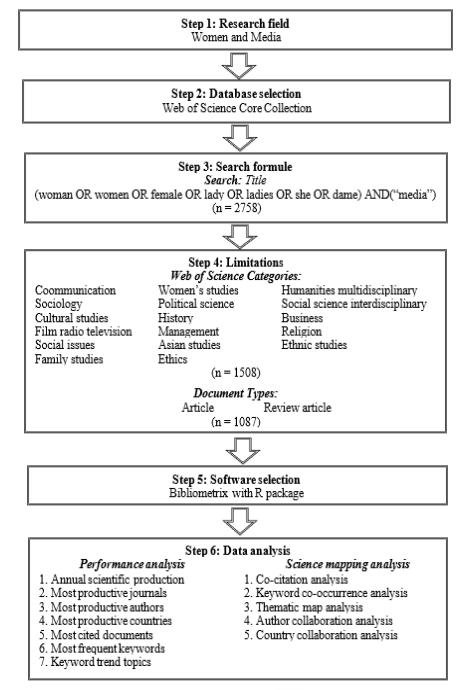
Figure 1. Flowchart of bibliometric analysis
Data Properties
Table 1 provides general information regarding the research data. It is observed that the first work in the women in media database dates back to 1981. In the period from 1981 to 2024, 1087 articles were produced in the field of women in media by 1933 authors, using 43277 references with an average of 39 references per publication. 52.80% of the publications were prepared as multi-authored (n=574), and 47.28% were prepared as single-authored publications (n=513).
Table 1. Main information
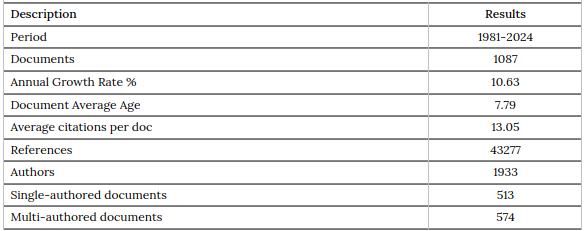
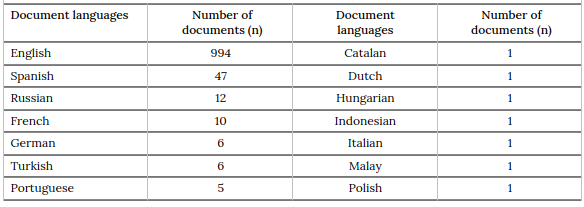
Table 2 presents the publication languages of studies produced in the field of women in media. According to this, it is observed that 91.44% of the studies produced in this field are published in English (n=994). English, which ranks first in the list, is followed by Spanish (n=47) with 4.32%, while Russian (n=12) ranks third with a rate of 1.10%. It is noted that works published in French and German, which appear in the top five, remain below 1%. Based on the information in Table 2, it is possible to state that the English language dominates the field.
Table 2. Distribution of documents by languages
Findings
Performance Analysis. Annual Scientific Production
Figure 2 examines the distribution of academic publications in the field of women in media studies over the years. When looking at general trends, it is observed that studies in this field were initially quite limited, but have shown a significant increase over time.
From 1981 to 1990, the number of publications on women in media studies remained at a significantly low level. This situation indicates that academic awareness of women’s representation in media was limited during this period or that studies in this field had not yet been carried out systematically enough. From the late 1990s onwards, a noticeable increase in publication numbers began, and this increase became more pronounced in the early 2000s. It is understood that research on women’s representation in media began to attract more attention in the academic literature during this period. While the total number of publications was 48 by 2000, the total number of publications increased to 184 by the end of 2010.
It is noteworthy that a significant increase in the number of articles published in the field of women in media studies occurred as of 2011. During this period, the intensification of debates on gender equality and the widespread adoption of digital media platforms contributed to the rapid increase in academic interest in this field. It is observed that this rise in publication numbers gained momentum, particularly in 2018 and onwards. This rise can be attributed to the effects of social media on women’s body images and digital feminist activism practices. Notably, the peak in publication numbers is seen in 2023, with 119 articles published. decrease in publication numbers is observed in 2024. This decrease is thought to be due to the fact that the data for this study were obtained before the completion of 2024. The number of articles published in 2011 and onwards is 903.
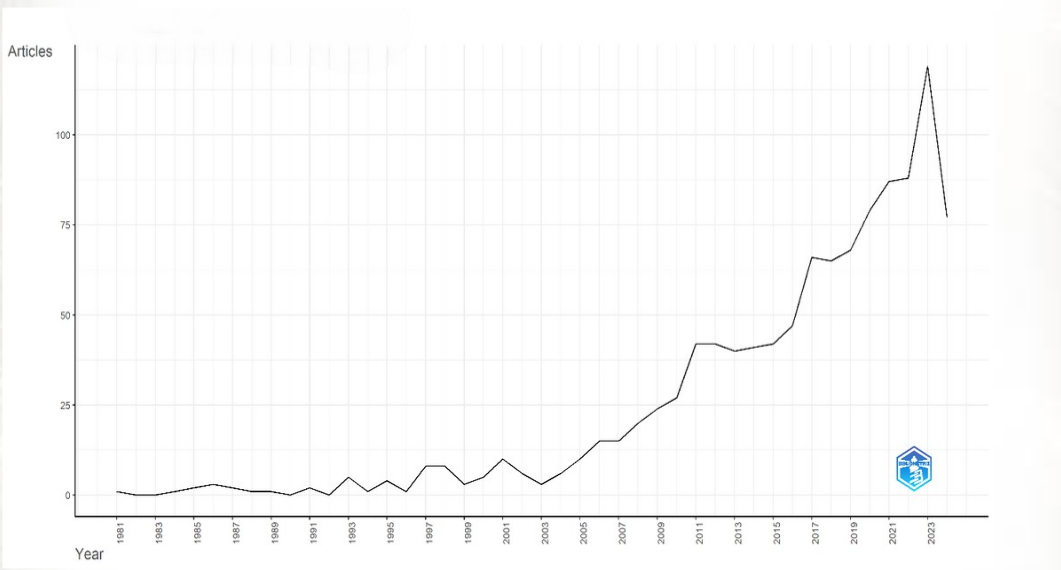
Figure 2. Annual scientific production
Most Productive Journals
Table 3 ranks the top ten most productive academic journals in the field of women in media studies, based on total article count and total citation count. This table provides crucial data for understanding in which journals academic production and impacts are concentrated in this field.
Table 3. Most productive journals
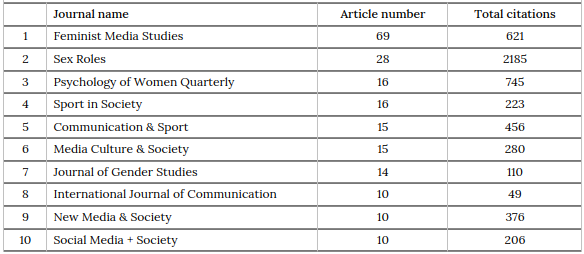
The most productive journal in the field has been Feminist Media Studies with a total of 69 articles. Simultaneously, it ranks as the third most influential journal in this field with a total citation count of 621. In terms of both productivity and influence, Feminist Media Studies holds a central position in the field of women in media studies. Sex Roles, which ranks second in productivity, although publishing 59.42% fewer articles than Feminist Media Studies, is the most influential journal in the field with 2185 citations. This indicates that the articles published by the journal are heavily referenced by other researchers and hold a significant place in the literature. Psychology of Women Quarterly, ranking third, proves its influence on the field with a total of 745 citations despite publishing 16 articles. When looking at the journals published in the field of women in media in general, it is observed that journals publishing on more specific topics such as women’s studies, feminism, and gender produce more works and receive more citations in the field. Journals that offer more general frameworks such as communication, media, social media, and new media have featured fewer works in the field of women and media.
Most Productive Authors
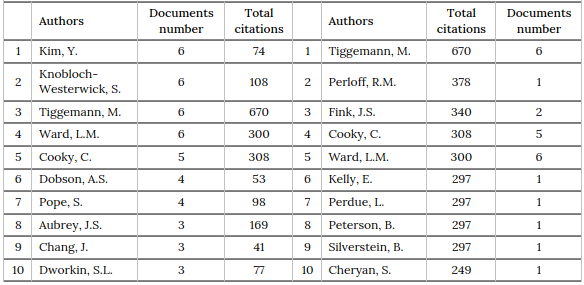
A total of 1933 authors have contributed to studies on women in media. Table 4 ranks the top ten most productive and most cited authors in the field of women in media studies, based on the number of articles they have published and the total number of citations these articles have received. This table provides data to evaluate individual academic contributions and the impact of these contributions within the field.
Among the top four most productive authors are Youno Kim, Silvia Knobloch-Westerwick, Marika Tiggemann, and L. Monique Ward, each having published six articles. Cheryl Cooky also ranks as the fifth most productive author with five articles. However, there are significant differences among these authors in terms of scientific impact. Among the top five most productive authors, the three most influential authors in terms of citation count are Marika Tiggemann with 670 citations, Cheryl Cooky with 308 citations, and L. Monique Ward with 300 citations.
Table 4. Most Productive and most cited authors
Youno Kim, the most productive author, publishes works in areas such as gender, media, globalization, women, and the sociology of media/culture at the American University of Paris. Furthermore, this author has published works in leading journals of the communication field, such as Media Culture & Society, International Journal of Cultural Studies, Communication Theory, and Cultural Studies/Critical Methodologies (Kim, 2006; 2010; 2011a; 2011b).
Silvia Knobloch-Westerwick, the second most productive author, continues her academic studies at Technische Universität Berlin. Research articles have been published in leading peer-reviewed journals of the communication field such as Mass Communication and Society, International Journal of Communication, New Media & Society. The author has contributed to the field especially with her work focusing on science communication and gender (Knobloch-Westerwick et al., 2013). Additionally, although Kim and Knobloch-Westerwick stand out in terms of productivity, their total citation counts remain at 74 and 108 respectively, indicating a more limited academic impact.
Marika Tiggemann, who ranks third in productivity but is the most influential author, continues her studies at Flinders University and stands out with her work on body image in social media (Harper & Tiggemann, 2008; Holland & Tiggemann, 2016; Tiggemann & Zaccardo, 2018). It is evident that Tiggemann strongly contributes to the literature in the field and that her work serves as an important reference point for theoretical and applied research in the field.
L. Monique Ward, the fourth most prolific author in the field of women in media, continues her career at the University of Michigan and conducts studies in the areas of media, sexuality, sexualization, and gender development (Ward, 2002; 2003; 2016). Cheryl Cooky, the fifth most prolific author, continues her academic work at Purdue University College of Liberal Arts. She stands out particularly with her works focusing on sports communication, gender, and female athletes (Cooky et al., 2010; Cooky et al., 2013; Cooky et al., 2015). Ward and Cooky attract attention with their total citation counts (300 and 308). These authors appear to have made a balanced contribution to the field in terms of both productivity and scientific impact. This situation demonstrates that Ward and Cooky’s works add value to the field both quantitatively and qualitatively.
Richard M. Perloff ranks second in effectiveness with 378 citations, and Janet S. Fink ranks third with 340 citations. Richard M. Perloff (2014) contributed to the women and media literature with his theoretically grounded research examining the effects of social media on young women’s body image concerns. Janet S. Fink (2015) continues her academic studies at the University of Massachusetts Amherst. The author has contributed to the field with her works on women’s sports.
Finally, when looking at Table 4, it is possible to say that, excluding Tiggemann, who has both a high number of publications (6) and citations (670), there is no direct correlation between the number of publications produced by other authors and the number of citations they receive. The total citation count (482 citations) received by Kim, Knobloch-Westerwick, and Ward, who are among the most productive authors with 6 publications, is 28.05% less than Tiggemann’s citation count (670 citations). The total citations received by authors with fewer than 4 publications (2442 citations) are 34.84% more than the citations received by authors with more than 4 publications (1591 citations). Authors with fewer publications have received more citations than authors with more publications.
Most Productive Countries
Table 5 details the geographical distribution of academic production in the field of women in media studies, illustrating the contribution levels of different countries to this field. The total number of published documents and the percentage of these documents in the academic literature provide data to analyze the impact of countries on the field. It can be stated that the feminist movements that emerged in the USA in the 1960s contributed to the increase in studies on women and media. It can be thought that the development of mass media in the USA has also led to the concentration of studies on the representation of women in the media in this field.
Table 5. Most productive countries
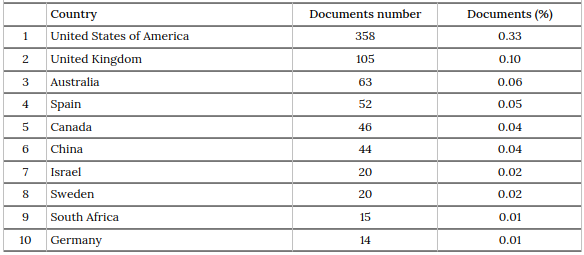
According to Table 5, the United States (USA) stands out as the most productive country in this field, with a total of 358 publications. The USA’s contribution of 33% of the total output indicates its leading position in the field of women in media studies. This situation can be associated with the USA’s strong academic infrastructure, comprehensive research funding, and research ecosystem involving a high level of international collaboration.
The United Kingdom follows the USA with a total of 105 publications. The United Kingdom, providing 10% of the total contribution, holds an important position in the field. While the USA and the United Kingdom exhibit a clear leadership in the women in media studies literature, it is evident that these two countries provide a distinct advantage compared to other nations. Countries with moderate productivity include Australia (63 publications, 6%), Spain (52 publications, 5%), and Canada (46 publications, 4%). Out of the total 1087 studies on women in media, 624 (approximately 57%) were produced by authors from institutions in the United States of America, the United Kingdom, Australia, Spain, and Canada.
Countries exhibiting lower productivity include China, Israel, Sweden, South Africa, and Germany. China, with a total of 44 publications, contributes 4%, placing it in the middle ranks, while countries like Israel and Sweden have contributed only 2% with 20 publications. South Africa and Germany provide less than 1% of the total contribution with 15 and 14 publications, respectively. Despite the low productivity levels of these countries, it is assessed that the socio-cultural perspectives they offer to the literature add a different dimension to the field.
Most Cited Documents
Table 6 lists the top ten most cited academic works in the field of women in media studies and evaluates the impact of these studies in the literature using citation counts from both WoS and Google Scholar. This table provides an important framework for understanding the thematic focuses, methodological contributions, and academic impacts of influential research in the literature.
When Table 6 is examined, it is observed that the top four most cited articles are published in the “Sex Roles” journal, which is in the Q1 category and has an impact factor of 3.0 in 2023. In the ranking based on the total citation counts in WoS and Google Scholar, it has been noted that six out of the top ten publications are again published in the “Sex Roles” journal. Since the “Sex Roles” journal is the most influential journal in the field of women in media, it is an expected result that most of the most cited publications are published in this journal (see Table 3).
Within the research data, the work with the highest number of citations is R. M. Perloff’s (2014) article titled “Social media effects on young women’s body image concerns: Theoretical perspectives and an agenda for research”, published in the “Sex Roles” journal. This work presents a theoretical framework suggesting that the interactive nature of social media, the strong presence of peer influence, and the content features such as visual image sharing can significantly affect body image anxieties. This article stands out as the most influential study in the field, with a total of 378 WoS citations and 1362 Google Scholar citations. These high citation numbers indicate that the effects of social media on women’s perception of their bodies are a significant topic for both academic and societal discussions.
The second most cited work is the article titled “The role of the mass media in promoting a thin standard of bodily attractiveness for women” by Silverstein, Perdue, Peterson, and Kelly (1986). Published in the “Sex Roles” journal, this study focuses on the role of the media in presenting thinness as a crucial aspect of attractiveness for the female body. To this end, the ways in which the female body is represented in the media are examined. The study, which reveals that thin women are featured more than men in the media, concludes that thinness is becoming an increasingly important criterion of attractiveness for women. With a total of 297 WoS citations and 1180 Google Scholar citations, this work is among the historically and theoretically significant contributions in the literature. The study has guided discussions in the field by addressing the media’s role in shaping gender norms and women’s perception of their bodies.
The third most cited work is the article titled “The stereotypical computer scientist: Gendered media representations as a barrier to inclusion for women” by Cheryan, Plaut, Handron, and Hudson (2013). Similar to the first two works, this article, published in the “Sex Roles” journal, examines the stereotypes about individuals in the field of computer science and whether changing these stereotypes through media influences women’s interest in computer science. This study contributes to discussions on gender representation and equality in media with 249 WoS citations and 637 Google Scholar citations.
Table 6. Most Global Cited Documents
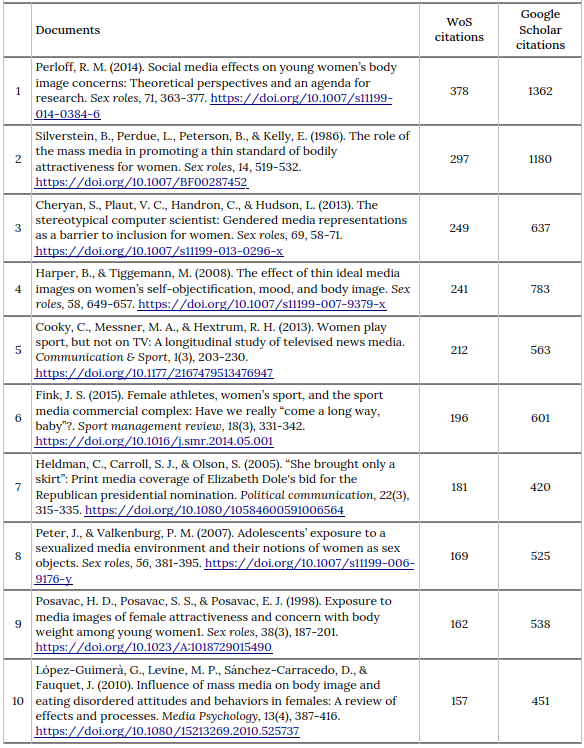
In other studies included in Table 6, topics such as women’s body perception through media, sports, and gender representations are addressed. The study by Harper and Tiggemann (2008) details the effects of thin body images promoted by media on women’s self-objectification, mood, and body perception. With a total of 241 WoS citations and 783 Google Scholar citations, this study stands out as a fundamental source on the subject. Similarly, the study by Cooky, Messner, and Hextrum (2013) analyzes the forms in which female athletes are represented in the media and addresses gender inequalities in television news media. This study contributes to the context of the sports-media relationship with a total of 212 WoS citations.
The study by Fink (2015) analyzes how female athletes are represented in media advertisements and the perception of women within the context of sports commerce. With 196 WoS citations, this study contributes to the literature on the representation of female athletes in the media. Additionally, the study by Heldman, Carroll, and Olson (2005) focuses on the mediatic representation of Elizabeth Dole in her political campaign and addresses how women are represented in the media in the political sphere.
Peter & Valkenburg (2007), examining the sexualization of women through media and its social effects, analyzed in one study the impact of adolescents’ exposure to sexualized media content on their perception of women and received a total of 169 WoS citations. Similarly, the study by Posavac, Posavac, and Posavac (1998) examined the effects of media on women’s body perception and the anxiety caused by these effects in women. This study stands out in this regard with a total of 162 WoS citations. López-Guimerà et al. (2010), on the other hand, addressed the effects of media on eating disorders and women’s behavioral tendencies and received 157 WoS citations.
Most Frequent Keywords
The frequency of keywords plays a critical role in understanding which concepts researchers focus on and how these concepts form the basis of the field. This analysis is important in determining which concepts are dominant in the women in media literature and which themes shape the research agenda.
Table 7 presents the most commonly used keywords in studies on women in the media and their occurrence rates. The keywords ‘media’ and ‘women’ are not included in the table, as they directly reflect the research topic. According to the table, ‘gender’ and ‘social media’ are the most prevalent keywords. This indicates that gender is widely discussed in relation to social media and that these two themes are central to the field. The prominence of ‘violence’, ‘feminism’ and ‘representation’ among the keywords suggests that the representation of women in the media and violence against women have been extensively examined in the literature. It also shows that feminist theories and representations of women provide an important theoretical framework for research in this area. This finding supports the role of feminist media studies in the literature on women in the media.
Table 7. Most frequent keywords
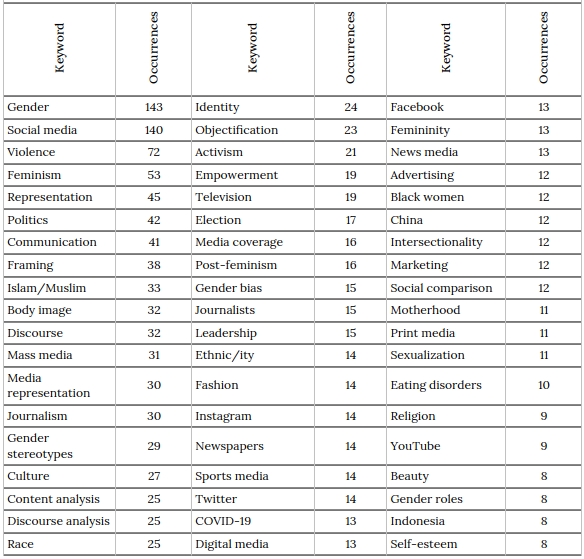
Table 7 shows that the literature on women in media also has an interdisciplinary structure. For example, concepts such as ‘intersectionality’, ‘gender bias’, and ‘objectification’ address the intersection of gender with different social hierarchies and the ways in which women are objectified in the media. The existence of such concepts shows that gender is not treated as a one-dimensional phenomenon in the studies but is evaluated in a broader sociocultural context.
Media types and digital platforms are also among the topics frequently addressed in the studies. Keywords such as ‘news media’, ‘television’, ‘Instagram’ and ‘Twitter’ reveal that women’s representations are analyzed in digital media environments as well as in traditional media. Especially the increasing role of digital media platforms in social interaction highlights the studies on how gender themes are processed on these platforms.
Keywords such as ‘body image’, ‘empowerment’, ‘social comparison’ and ‘sexualization’ in the table reflect the growing academic interest in the effects of media on women’s bodily perceptions and social empowerment.
Keyword Trend Topics
Keyword trend topics provide the most frequently repeated keywords on a yearly basis and allow us to understand the periodical development processes of a research field. Keyword trend topics make an important contribution to understanding how the prominent concepts in the literature on women in the media have changed over time and the effects of these changes on the thematic structure of the field. In this context, it can be considered as a tool for predicting the current dynamics of the field and future research directions. Figure 3 and Table 8 analyze the trends and frequencies of the keywords of studies on women in the media according to years. In order to better evaluate the trends in the field in Figure 3, Figure 3 has been tabulated (see Table 8).
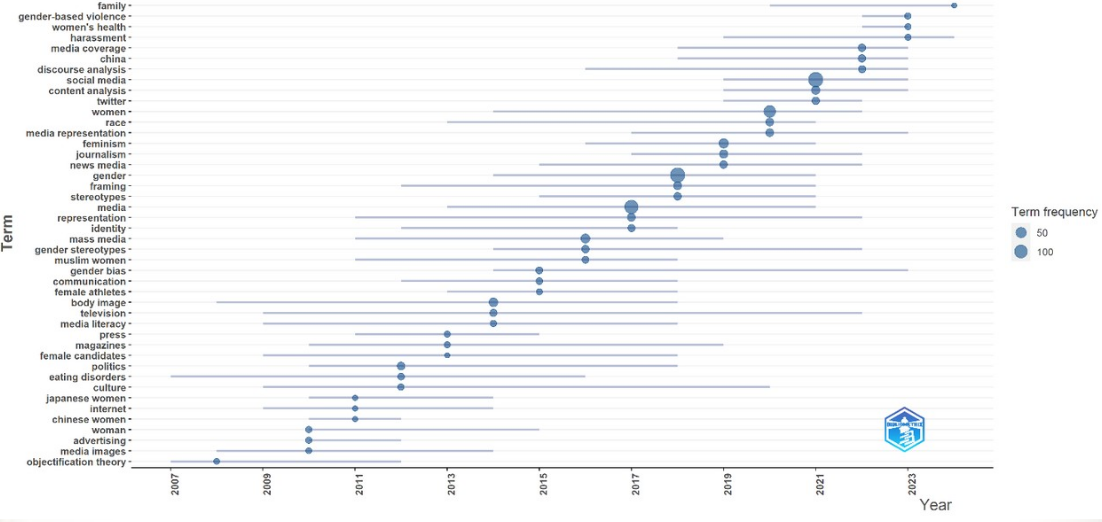
Figure 3. Keyword trend topics by year
According to Figure 3 and Table 8, ‘family’ in 2024 and gender-based violence and women’s health in 2023 are seen to be prominent in the literature. Concepts such as ‘gender-based violence’, ‘women’s health’ and ‘harassment’ show that gender inequalities are addressed in the media context and that these issues have become a priority in current academic discussions.
In 2022, the keywords ‘media coverage’ and ‘China’ were repeated the most. In this period, it is seen that the studies carried out especially in China come to the fore. In 2021, it draws attention as a period in which the keywords ‘social media’, ‘content analysis’ and ‘Twitter’ appeared with high frequency in the literature. This trend shows that the importance of digital media platforms in gender studies is increasing. Social media has been intensively addressed as a field that transforms individuals’ gender perceptions and representations of women. In addition, the high frequency of the concept of ‘content analysis’ indicates that digital media contents are evaluated with systematic analysis methods.
Table 8. Keyword trend topics
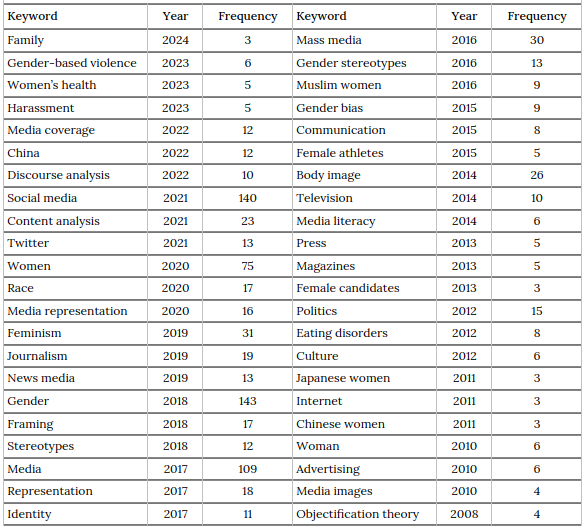
In 2020, ‘race’ and ‘media representation’ and in 2019, ‘feminism’ and ‘journalism’ were the most frequently repeated keywords. In 2018, concepts such as ‘gender’, ‘framing’ and ‘stereotypes’ came to the fore. Studies in this period focused on analyzing how gender roles are constructed by the media and the effects of this construction on social perceptions. The 2017–2008 period shows that the issues of women’s representation and objectification in the media have an important place in the literature. In this period, keywords such as ‘objectification theory’ (2008), ‘media images’ (2010), ‘body image’ (2014) and ‘representation’ (2017) came to the fore. It is understood that feminist media studies critically analyzed the representation of women in the media in this period. In addition, keywords such as ‘Chinese women’ (2011), ‘Muslim women’ (2016) and ‘Japanese women’ (2011) show that representations of women in the media are addressed in different cultural contexts.
Science Mapping Analysis. Co-citation Analysis
Co-citation analysis means that two publications are co-cited if there is a third publication citing any two publications (Small, 1973 cited in Van Eck & Waltman, 2014, p. 3). The more the number of publications in which any two publications are co-cited in other publications, the stronger the co-citation relationship between the two publications, and it is also likely that these two publications that are co‑cited are related to each other (Leung et al., 2017). This analysis technique is used to reveal the intellectual accumulation of the scientific field and provides the most effective publication clusters (Donthu et al., 2021). Co-citation analysis is an important technique for understanding the intellectual foundations of a scientific field, the theoretical frameworks and the effects of the main pioneering studies in this field. This analysis enables the identification of the most influential studies in literature, the examination of the relationships between studies, and the understanding of the intellectual development and knowledge production dynamics of the field.
Figure 4 shows the co-citation network based on the reference sources of international studies on women in media. Bibliometrix R Network Layout Kamada & Kawai was used to visualize the co-citation network analysis, Louvain technique was used for the clustering algorithm (Aria & Cuccurullo, 2017; Zupic & Cater 2015) and the number of nodes was set to 100. This choice was made in order to summarize the overall structure of the literature and avoid over-complication by analyzing the 100 most influential studies of the network and the relationships between these studies. Kamada & Kawai organize the connections between nodes to present the network in a visually more understandable way. This algorithm is a frequently preferred method especially in the visualization of citation networks and clearly reveals the relational structure in the literature. The Louvain algorithm divides the nodes into groups based on the principle of modularity optimization and allows the identification of intellectual clusters in the literature. This algorithm contributes to understanding which studies in the literature converge around certain theoretical frameworks or topics (Aria & Cuccurullo, 2017; Bretas & Alon, 2021; Zupic & Cater 2015).
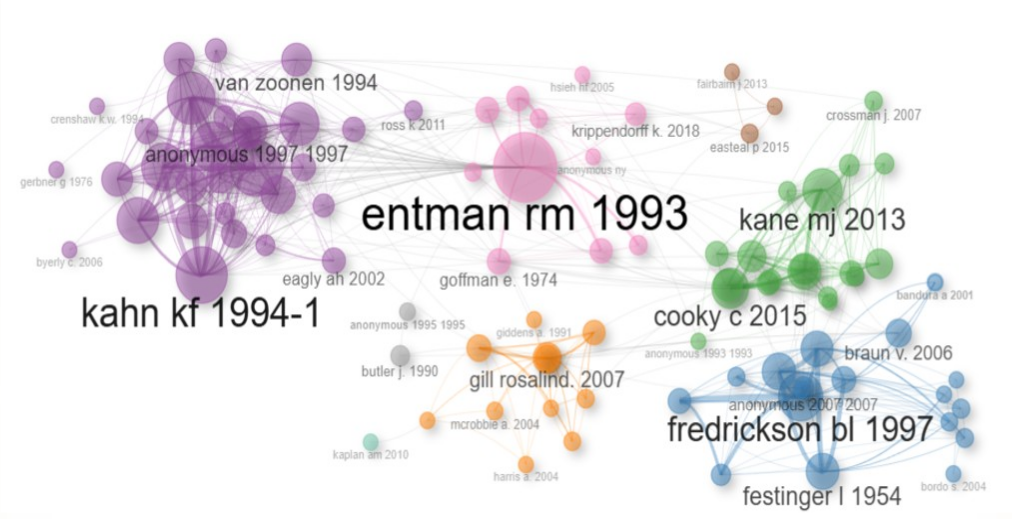
Figure 4. Co-citation network
In Figure 4, each cluster is shown in different colors. The links in the figure represent the frequency of co-citation relationships between two works. Thick and dense links between works or clusters indicate that two works are frequently co‑cited in the same studies and that these works form a strong network of relationships in the literature. The size of the rings containing authors and their works is shaped by the number of citations, and the size of the ring increases as the number of citations increases (Aria et al., 2020). The fact that the central works in the clusters are associated with more dense connections emphasizes that these studies have an important position in literature. The transitive links between different clusters reveal the existence of interdisciplinary approaches and how thematic differences are integrated. According to the results of the co-citation network analysis, seven different clusters emerged, and five clusters dominate the field. These clusters are as follows:
Cluster 1: Framing theory
The first cluster is visualized with pink color and the work of Entman (1993) comes to the fore. Entman’s framing theory forms the intellectual basis of this cluster. Entman (1993) presents a framework that analyses the impact of media content on social perceptions. Another important work in this cluster belongs to Goffman (1974). Goffman (1974) analyzed framing theory in his study. This cluster is shaped around studies that analyze how gender representations are framed through the media and how these representations shape social dynamics. This cluster is a frequently used theoretical reference point for critical media analyses in the literature.
Cluster 2: Objectification theory and social comparison theory
The second cluster is visualized with the color blue, and the work of Fredrickson and Roberts (1997) leads this cluster. This study provides an important theoretical framework that addresses the objectification of women in media representations and its psychological effects within the scope of objectification theory. Another important work in this cluster is Festinger’s (1954) “A theory of social comparison processes”. This theory deals with the processes of individuals comparing themselves with others through the media and the effects of these processes on individuals’ body perception and psychological well-being. This cluster is closely related to concepts such as ‘body image,’ ‘mental health,’ ‘self-esteem,’ ‘representation’ and ‘stereotypes’. In the literature, this cluster is considered as the centre of critical analyses based on feminist theories.
Cluster 3: Representation of women in the media
Cluster 3, visualized in purple, is centred on Kahn’s (1994) study. This study critically analyses the distorted representation of women politicians in the media and shows how gender inequalities are reproduced through the media. This cluster has an important place in the literature in the context of women’s political representation. Another important work in the cluster is Van Zoonen’s “Feminist media studies” published in 1994. The study analyses the role of the media and its content in reinforcing gender stereotypes and setting the public agenda. This cluster has an important place in the literature in the context of women’s representation in the media.
Cluster 4: Representation of women athletes in the media
At the centre of Cluster 4 is the study by Cooky et al. (2015), which is visualized in green. This study addresses the processes of marginalization of female athletes and analyses how gender inequality is perpetuated in the context of sport through the media. The work of Kane et al. (2013) is another influential work in this cluster. This study reveals how elite female athletes react to the way they are represented in the sports media. At this point, Cluster 4 includes studies on how female athletes are represented in media content and their reactions to this representation.
Cluster 5: Postfeminist media culture
Cluster 5 is visualized in orange and the concept of postfeminist media culture developed by Gill (2007) forms the centre of this cluster. The elements of postfeminist media culture analyze how gender is reproduced in the media context and how it affects the social roles of individuals. The cluster is related to concepts such as ‘empowerment,’ ‘sexualization’ and ‘identity’ and covers the literature on feminist media studies from a postfeminist perspective.
Cluster 6 is represented by Butler’s (1990) “Feminism and the subversion of identity”, while Cluster 7 is represented by Easteal et al.’s (2015) “Enduring themes and silences in media portrayals of violence against women”.
Keyword Co-occurence Analysis
Co-occurrence analysis is based on the frequency with which keywords appear together in scientific works. As the number of publications in which any two keywords appear together increases, the co-occurrence relationship also increases. Keywords are terms that represent the essence of a scientific work. Therefore, co‑occurrence analysis is very important to discover the concept network and conceptual structure of research topics and trends in a scientific field (Callon et al., 1991; Leung et al., 2017). Keyword co-occurrence analysis aims to visualize how certain keywords are used together in the literature and the relationships between these words. This technique is important in understanding thematic groups in the research field and the links between these groups. Keyword co-occurrence analysis also displays the conceptual structure that reveals the basic concepts of a research field and the relationships between these concepts.
Figure 5 presents a co-occurrence network that visualizes the relationships between keywords used in studies on women in the media and the thematic densities arising from these relationships. The link density of keywords in the network provides a better understanding of the theoretical framework and research trends in the field. Bibliometrix R Network Layout Kamada & Kawai was used to visualize the keyword co-occurrence analysis, and the number of nodes was set as 100.
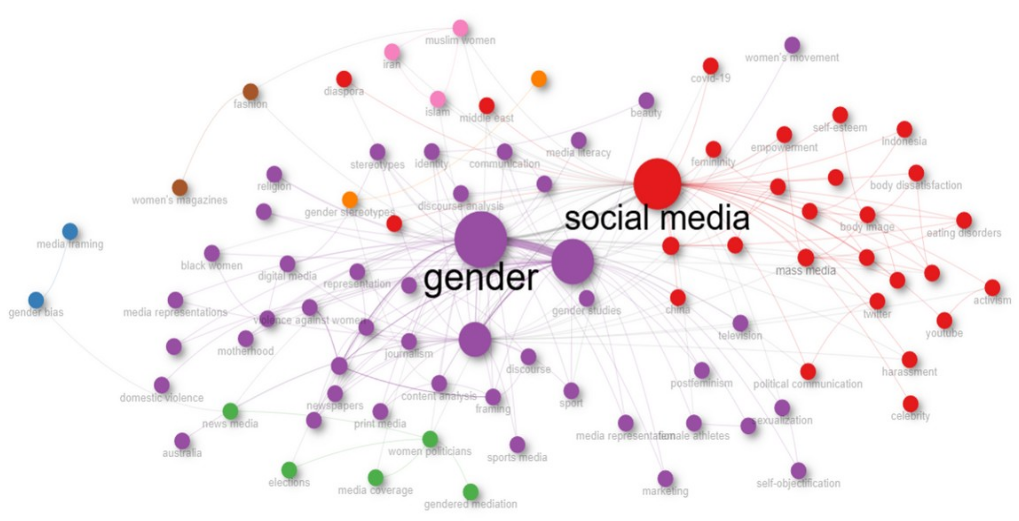
Figure 5. Keyword co-occurrence network
When Figure 5 is analyzed, it is seen that there are seven different clusters in the studies on women in the media, but two clusters in particular dominate the field. These clusters are as follows:
Cluster 1: Social media
In the centre of Cluster 1, which is visualized in red, is the keyword ‘social media’. This concept is at the centre of the network and establishes dense connections with other keywords. This situation reveals that the social media cluster is an important research focus in women in media studies. Other important words in this cluster are mass media, feminism, post feminism, body image and social comparison. Again, the prominence of concepts such as eating disorders, empowerment, objectification, body dissatisfaction in this cluster reflects the issues frequently addressed in critical studies on women’s representations in the media. This group represents the literature in feminist media studies that focuses on the objectification of women and how their body perceptions are shaped.
The keywords related to social media tools in the cluster were Instagram, Twitter, Facebook and YouTube. This emphasizes the impact of digitalization on gender studies. The density of the concepts in this group shows that academic interest in the potential of digital media to transform gender perception is increasing.
Cluster 2: Gender
Cluster 2, which is visualized in purple, has the keyword ‘gender’ at its centre. This shows that gender is another important research focus in women’s studies in media. The prominent keywords in this cluster are media, women, violence against women, identity, race, ethnicity, black women, framing, journalism, media representation, content analysis, discourse analysis. Based on the keywords, it is seen that the conceptual issues in this cluster are discussed in the context of gender-based violence, racism, identity formation, women’s representation and in the context of content analysis and discourse analysis. Based on the connections between keywords, it shows that the words in Cluster 2 are related to each other both theoretically and methodologically.
Cluster 3 is shown in green, and the word ‘news media’ is at the centre of the cluster. This is followed by women politicians and elections. Cluster 4 is visualized with pink color and consists of the keywords Islam and Muslim women in the centre. Cluster 5 is visualized with blue color and consists of the keywords ‘gender bias’ and ‘media framing’. Cluster 6 is colored orange and consists of the keywords ‘gender stereotypes’ and ‘advertising’, while Cluster 7 is colored brown and consists of the keywords ‘fashion’ and ‘women’s magazines’.
Thematic Map Analysis
Thematic map analysis is another technique used in the evaluation of conceptual structure (Aria & Cuccurullo, 2017; Cobo et al., 2011b; Lim et al., 2024). Thematic map is created based on the keywords of scientific works and provides important information about the future of the field. It provides important output on how the thematic and thematic development in a scientific field progress (Lim et al., 2024). Thematic maps are a strategic diagram used to define the conceptual structure of a scientific field; they determine which themes are formed, and analyze the importance and development of these themes (Cobo et al., 2011a). In the thematic map, themes are evaluated according to centrality and intensity. While centrality expresses the importance of the theme, intensity gives an idea about the development of the theme (Aria et al., 2021; Nasir et al., 2020). In determining the prominent themes related to a field of study and which are extremely important for the field, it is necessary to examine the motor and basic themes in the thematic map (Cobo, 2012).
Figure 6 shows the thematic map based on the keywords of the studies on women in the media. As a result of the thematic map analysis, it is seen that there are seven themes in the women in media literature. Among these seven themes, especially three of them are quite inclusive in the field since they contain a large number of keywords. These themes are gender, social media and mass media.
Thematic maps divide the literature in a scientific field into four quadrants. The themes in the upper right quadrant represent high density and high centrality and are referred to as motor themes. Motor themes show the research areas/topics that are developed and important for a particular research area (Akter et al., 2021). As shown in Figure 6, Social media and Mass media themes are the motor themes of women in media literature. In the social media theme – feminism, Instagram, Twitter, Facebook, activism, post-feminism, YouTube, political communication and femininity keywords are included. In the mass media motor theme – body image, China, identity, communication, eating disorders, empowerment, objectification, self-esteem, sexualization keywords are included.
The themes in the lower right quadrant have low density and high centrality and are called basic themes. Basic themes refer to a large number of studies in a particular field and give the main topics studied in the field (Aria et al., 2020). Again, based on Figure 6, Gender theme is the only basic theme of women in media literature. The keywords within the Gender theme are as follows: media, women, content analysis, journalism, representation, framing, race, media representation, violence against women.
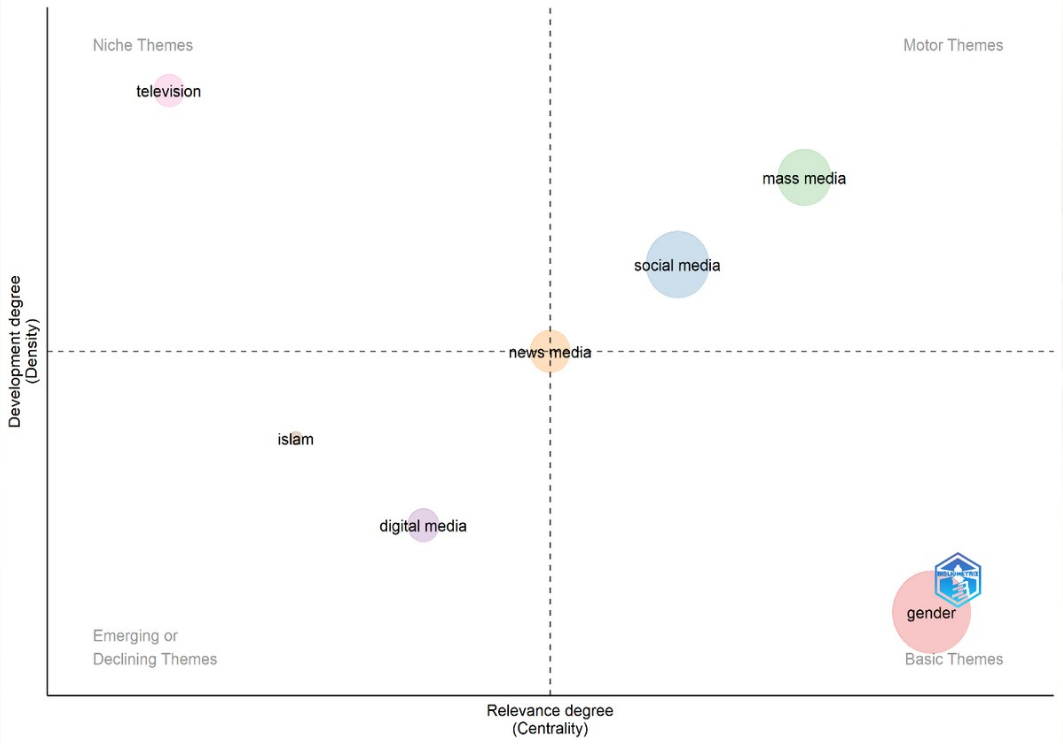
Figure 6. Thematic map
The themes in the upper left quadrant have high density and low centrality and are referred to as niche themes. Niche themes are highly developed but isolated topics in a particular research area (Aria et al., 2020; Cobo et al., 2011b). According to Figure 6, the Television theme is in the niche themes quadrant. The keywords within the Television theme are as follows: advertising, fashion, sexuality, woman, women’s magazines, body, magazines, pornography, and press.
The themes in the lower left quadrant represent high intensity and high centrality and are called emerging or declining themes (Aria et al., 2020; Cobo et al., 2011b). Emerging themes are themes that need to be further developed in the research field, while declining themes are themes that are less studied and gradually abandoned in the research field (Cobo et al., 2011a). As can be seen in Figure 6, two themes emerged in the emerging or declining quadrant. The first of these is the relatively more central theme of Digital media. This theme includes the keywords ‘intersectionality, black women, motherhood, critical discourse analysis, women’s movement, women’s rights, media discourse and Turkey’. The relatively more intense theme is Islam. In the Islam theme, the keywords Muslim women, religion and Iran were included.
Finally, the new media theme was located at the very centre of the thematic map and was not included in a quadrant. It is seen that this theme is quite central in the literature on women in the media. The keywords within this theme are: ‘media coverage, women politicians, discourse analysis, gender bias, covid-19, media framing, elections, new coverage’ and ‘comfort women’.
Author Collaboration Analysis
Collaboration analysis is based on the visualization of publications based on co-authorship. Collaborations can be analyzed by researchers, researcher institutions or countries (Van Eck & Waltman, 2014). Collaboration analysis is very important to understand the cooperation and interaction between researchers and to reveal the social structure in the scientific field (Donthu et al., 2021). Author collaboration analysis is a technique for understanding the collaboration dynamics of a scientific field. Author collaboration analysis, which reveals the social structure of the scientific field, allows visualizing the collaborations established between different researchers and evaluating the contributions of authors in the literature.
In this study, network layout Kamada & Kawai, clustering algorithm Louvain technique was used to analyze the collaboration network, and the number of nodes was determined as 100. Figure 7 shows the author collaboration network visualization in the studies on women in the media. The density of author collaborations is indicated by the thickness of the lines between the rings where the author names appear. The thicker the author collaboration, the thicker the lines. Again, the size of the rings is formed according to the number of works produced by the author (Aria et al., 2020).
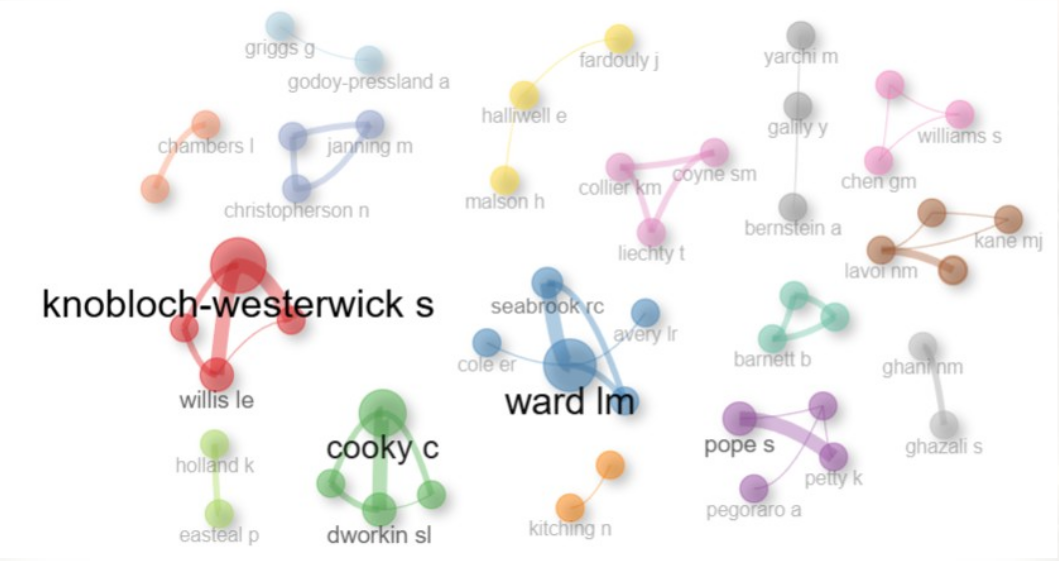
Figure 7. Author collaboration network
There are 16 different clusters in the author collaboration network and each cluster is visualized with a different color. In the red cluster, where S. Knobloch-Westerwick is at the centre, she collaborates intensively with L. E. Willis and also with K. T. Luong and A. R. Kennard. Another important cluster is the cluster visualized in blue, where L. M. Ward is at the centre in terms of the number of works. The author collaborates intensively with R.C. Seabrook and S. Giaccardi. In the green cluster, which also includes C. Cooky, the author has intensive collaborations with R. Dycus, M. A. Messner and S. L. Dworskin, as well as with each other.
Country Collaboration Analysis
Country collaboration analysis reveals the social structure of a scientific field. Collaborations are formed according to the countries where the institutions of the authors producing works in a field are located and the contributions of the countries to the literature are examined. In the creation of the network for country collaboration, network layout Kamada & Kawai, clustering algorithm Louvain technique was used and the number of nodes was determined as 100.
Figure 8 details the social structure and dynamics of international academic relations by analyzing the network of collaboration between countries in the women in media literature. Seven different clusters were formed within the scope of country collaborations. Among these clusters, the cluster visualized in red with the USA at its centre is very important in terms of women in media literature. USA is positioned as a central node in the inter-country cooperation network, and this position reflects the magnitude of the country’s contribution to the international academic literature. The USA has multifaceted and intensive co-operation with different countries. Within this cluster, the USA makes a global contribution to the literature by establishing strong links with countries from different continents such as China, South Korea, Canada, Italy, Turkey and Ukraine. In addition, collaborations with countries such as Malaysia, Pakistan and Nigeria show that the US is not limited to the Western world, but strengthens academic ties in Asia, the Middle East and Africa.
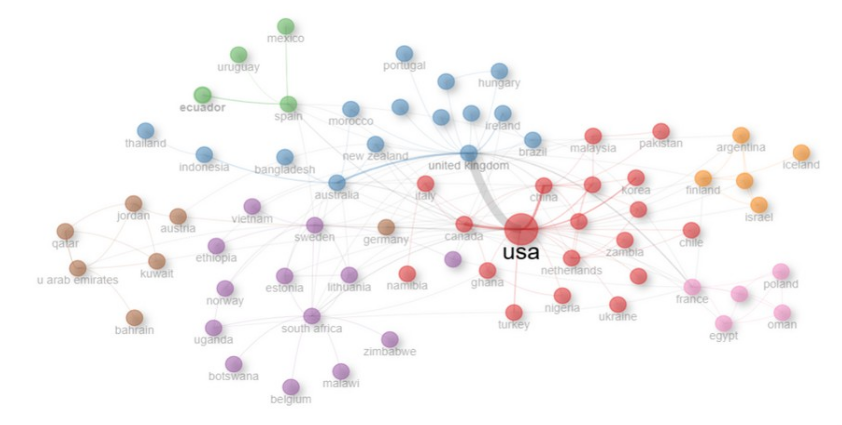
Figure 8. Country collaboration network
The USA also has strong collaborations with countries in different clusters. In particular, the USA’s cooperation with the United Kingdom is important in terms of emphasizing the intensity and continuity of academic ties between English‑speaking countries. In the blue cluster with the United Kingdom at the center, the UK has strong collaborations with Australia, Ireland and New Zealand.
Another cluster with South Africa at the center is visualized in purple. South Africa is also in cooperation with the USA. Other countries in this cluster are African countries such as Uganda, Malawi, Zimbabwe, European countries such as Sweden, Belgium, Estonia, Norway and Asian countries such as Vietnam.
In the cluster represented in brown, Kuwait is in the center and has collaborations with United Arab Emirates, Austria, Jordan, Qatar, Bahrain and Germany. Spain is in the green cluster, France in the pink cluster and Finland in the orange cluster.
Discussion and Conclusions
This study aims to reveal the main trends, conceptual structure, social relations, and intellectual dynamics in the field by systematically analyzing the academic literature on women in media through bibliometric analysis. Covering the period between 1981 and 2024, this study examines the literature on women in media through performance and science mapping analyses. Trends in the number of publications of studies on women in the media, the most prolific journals, authors and countries, and citation analysis were evaluated. The most studied topics in the field and the change in trend topics over the years are discussed. In addition, co-citation, co-occurrence and collaboration networks were created and thematic mapping was carried out. The findings confirm that women’s studies in media is a multidisciplinary and constantly evolving research field, and they provide a basis for future studies.
As a result of the bibliometric analysis, it was determined that a total of 1087 articles meeting the criteria were published in the field of women in the media between 1981 and 2024. The increase in the number of publications, especially in the period after 2011, is striking. This can be attributed to factors such as the rise in academic awareness on gender equality, the impact of feminist movements and the spread of digital media. In this process, which is conceptualized as digital feminism, feminist movements have started to organize on social media (Martin & Valenti, 2013; Mendes, 2015). It can be stated that examples of digital feminist activism such as the Slutwalk Movement (2011), the #NiUnaMenos Movement (2015), and the #MeeToo Movement (2017) have focused academic attention on this field. In addition, it is noteworthy that studies linking the concept of sexualization with how unrealistic body images on social media affect young women in particular (Harper & Tiggemann, 2008, Holland & Tiggemann, 2016; Perloff, 2014; Tiggemann & Zaccardo, 2018; Ward, 2016).
When the most productive journals are analyzed, the journal “Feminist Media Studies” comes to the fore, while “Sex Roles” draws attention in the ranking of the most influential journal based on the number of citations. Marika Tiggemann was found to be both the most prolific and the most cited and influential author with six articles. In particular, Richard M. Perloff with one article and Janet S. Fink with two articles were the second and third most cited authors and made significant contributions to the field. In the inter-author collaboration analysis, the collaborations within three different clusters centered on S. Knobloch-Westerwick, L. M. Ward and C. Cooky are quite striking. This situation reveals that research in the field is carried out in international cooperation. When the distribution of publications by country is analyzed, the USA is the country that produces the most publications in the field of women in media. This shows the academic leadership and research capacity of the USA in the field. Feminist movements that emerged in the USA in the 1960s focused on the media and women and concentrated on the representation of women in the media (Jaddou & Williams, 1981; Rakow 1986; Smith, 1982). It is possible to say that political and social debates based on gender equality and women’s rights have increased interest in the academic field. It can be stated that the structure of the USA, which dominates the global media industry, has also influenced studies on women and media. It can be said that the development of mass media such as cinema, radio and television in the USA has led academic studies to focus on the representation of women in these media. Studies on women’s representations on television (Ang, 1985; Friedan, 1965; Lichter, 1986; Radway, 1987), women’s representations in cinema (Mulvey, 1975), women’s representations in advertisements (Berger, 2016; Courtney & Lockeretz, 1971; Goffman, 1979; Sexton & Haberman, 1974) are important works that have shaped the field. It can be stated that this historical background forms the basis of the US interest in the field and the academic production in this field.
The United Kingdom and Australia are other countries that have made significant contributions to the field. In the analysis of cooperation between countries, it was determined that the USA is at the center and has multilateral cooperation with many countries.
According to the findings of the citation analysis, Perloff’s (2014) work has the highest number of citations in studies on women in the media. The work examines the effects of social media on young women’s body perception with a theoretical framework. The other most cited work is Silverstein et al.’s (1986) study on how mass media promotes women’s standards of physical attractiveness. Both of the most cited works deal with the impact of the media on the female body. The findings of the co-citation analysis are based on the references of the studies on women in the media and give the main works cited together in the field. Accordingly, although there are seven clusters in total, four clusters are particularly important for the field. The cluster we call “framing theory” is represented by Entman (1993), with the works in this cluster corresponding with the topic. The studies in the second important cluster mainly examine “objectification theory and social comparison theory” and the cluster takes its name from here. The important representative of this cluster is Fredrickson and Roberts (1997). Another cluster is named “representation of women in the media”, and the prominent study belongs to Kahn (1994). Again, the cluster we call “representation of women athletes in the media” is also very important, and the work of Cooky et al. (2015) stands out in this cluster. These clusters represent the main theoretical approaches, research topics and intellectual debates in the field.
The most frequently repeated keywords in women’s studies in media are “gender” and “social media”, except for the words “media” and “women”. This shows that women’s studies in media are frequently discussed on the basis of gender and predominantly in the context of social media. Within the scope of the research data, the works of Marika Tiggeman (Harper & Tiggemann, 2008, Holland & Tiggemann, 2016; Tiggemann & Zaccardo, 2018) and the prominent work of R. M. Perloff (2014) emphasize that social media negatively affects women’s body images and reinforces gender roles. The results of international studies on social media and gender are similar to those in the literature. UNESCO’s “Gender Report: Technology on Her Terms” revealed that social media reinforces gender stereotypes. According to the report, unrealistic body images on social media cause girls to experience self-confidence problems (Gender report..., 2024). The report presented by the European Parliament in 2023 also stated that social media presents different content to male and female users through algorithms and thus reinforces gender stereotypes (Park et al., 2023).
The keywords “violence”, “feminism” and “representation” are also among the top five most frequently repeated words. The issues of violence against women, feminism and the representation of women in the media have been extensively studied in the literature. When the keyword “violence” is analyzed specifically, the fact that the issue of violence is studied very frequently can be attributed to gender-based violence against women continuing to be experienced intensely. The World Health Organization (WHO) considers violence against women as a major public health problem and a violation of women’s human rights. According to WHO estimates, approximately 1 in 3 women worldwide are subjected to violence, and most of this violence is intimate partner violence (Violence against Women..., 2024). According to data from the European Union (EU) survey on societal violence in 2021, 50 million women aged 18–74 in the EU, or 31% of women, have experienced physical (including threats) and sexual violence in their adult lives. The data also revealed that 32% of women have had a violent partner in their lifetime (Every third woman..., 2024). The European Union Gender Based Violence Survey 2024 report reached similar findings as the 2021 report and concluded that the number of women victims of violence has continued to increase over the past 3 years. According to the report, women are more likely to be victims of domestic violence than men (Every third woman..., 2024). In addition, women are intensely exposed to cyber violence (Cyberviolence against women..., 2024). The term cyber violence against women and girls is used to describe new acts of violence mediated by online technology (Combating Cyber Violence..., 2022). Cyber violence includes acts of violence committed using the internet and/or mobile technology, such as online harassment, cyber dating abuse, revenge porn and cyber stalking (EIGG, 2022; Cyberviolence against women..., 2024). A 2014 survey of 42,000 women across the EU by the European Union Agency for Fundamental Rights found that 1 in 10 women had received inappropriate proposals or obscene emails on social media. Looking at gender-based differences in experiences of online harassment, it was found that girls were more likely than boys to experience hurtful or abusive behavior (Newman et al., 2022).
Feminism is also one of the most repeated keywords. According to the IPSOS International Women’s Day 2024 survey, while 33% of women identified themselves as feminists in 2019, this rate increased to 39% in 2024. This data shows that approximately two out of every five people (39%) in 31 countries identify themselves as feminists (International Women’s Day 2024..., 2024). The 2017 “MeeToo Movement” and the “Women’s March” protests in the same year, which targeted Trump for his anti-women rhetoric, led to feminism becoming a popular concept among young women (Will, 2019). The constitutional guarantee of abortion as a constitutional right in France has also been recognized as a promising development for many feminist movements around the world (Overview of gender..., 2024). However, these positive developments do not mean that gender equality has been fully achieved. Data indicate that at the current rate of progress, it will take another 134 years to achieve gender equality worldwide (Global Gender Gap Report..., 2024; Overview of gender..., 2024). Therefore, the fact that feminism-related studies are intensively included in the literature can be attributed to both the increased interest in the feminist movement and the failure to achieve gender equality.
The fifth most repeated keyword in the study was “representation”. According to the results of the co-citation network analysis, Kahn’s (1994) study stands out in the first cluster, the representation of women in the media. In the cluster of representation of women athletes in the media, which emerged in the co-citation network analysis, the studies of Cooky et al. (2015) and Kane et al. (2013) came to the fore. Among the studies focusing on the representation of female athletes in the media, Cooky et al. (2013) and Fink, (2015) are also among the most cited works. Cooky, one of the most productive writers, has also looked at the field of representation from the perspective of female athletes with her studies in 2010 and 2015. At the 2024 Paris Olympics, the number of female and male athletes participating was equal for the first time. With this feature, the 2024 Paris Olympics stood out as the most gender-equal Olympic Games in history. However, despite the equality in participation, studies on the unequal representation of female athletes in the media will remain important today and in the future.
When the trending topics studied are analyzed, it is seen that concepts such as “family”, “gender-based violence”, “media coverage”, “social media”, “content analysis” and “race” have come to the fore in recent years. This finding shows that research topics in the field have changed over time and the focus has shifted to current issues. Issues such as the changing roles of women in work and family life, and the effects of different forms of work such as working from home on women’s family life are more emphasized. The results of the keyword co-occurrence analysis supported the findings of the word analysis. Although a total of seven clusters were formed as a result of the analysis, the two main clusters centered on the keywords “social media” and “gender” are very important. The most frequently repeated words with the keyword “social media” are ‘mass media, feminism, post feminism, body image’ and ‘social comparison’. The most frequently repeated words with “gender” were ‘media, women, violence against women, identity, race, ethnicity, black women’ and ‘framing’. This finding shows that identity-based research areas such as race, ethnicity and black women have taken their place in the literature.
As a result of thematic map analysis, the motor themes of the field of women in media, that is, the important research areas of the field, are “social media” and “mass media”. The social media theme includes the concepts of feminism, Instagram, Twitter, Facebook, activism; the mass media theme includes the concepts of body image, identity, eating disorders, empowerment, objectification. The main theme of the field, that is, the most studied areas in the field, is the theme of “gender”. Within the gender theme, the words ‘media, women, content analysis, journalism, representation, framing’ and ‘race’ are included. The niche theme studied in the field of women in the media was the theme of “television”. Within this theme, the words ‘advertising, fashion, sexuality, woman, women’s magazine’ and ‘body’ were included and studies on these topics were more limited. This finding shows that television is still important in the field of women and media, albeit in a limited way. The emerging or declining themes of the field are “digital media” and “Islam”. In the literature, topics such as the positioning of women in Muslim societies, women’s movements and modernization are of interest. These themes are areas that need further study in the field. In the theme of digital media, the concepts of intersectionality, black women, motherhood, and in the theme of Islam, the concepts of Muslim women, religion and Iran come to the fore. Women’s rights in Iran, women’s protests and feminism are noteworthy research topics. Researchers who want to work or are working in this field can focus on these topics.
Theoretical and Practical Implications and Recommendations for Future Studies
The findings of this study may have some theoretical and practical implications for the field of women’s representations in the media. The literature on the topic falls within the field of study of many different disciplines such as media studies, gender, psychology, sociology, communication, and cultural studies. Based on the findings, it is very important to address literature from a multidisciplinary perspective in future studies. Again, within the scope of this study, Framing Theory, Objectification Theory, Social Comparison Theory indicate the basic theories in the field and researchers who will work in this field in future studies can shape their studies on the basis of these theories. Again, as a result of the thematic analysis, important gaps in the literature are related to concepts such as ‘Islam’, ‘Muslim women’, ‘digital violence’, ‘race and ethnicity’. Studies on women in the media based on these concepts can be focused on those.
Some implications can also be drawn for practitioners, educators, and policy makers in the field of women’s representations in the media. Research findings reveal the need for digital media literacy. The negative effects of social media on body perception have serious consequences especially for young women. The dissemination of media literacy training will enable young people in particular to recognize and distinguish sexist representations by questioning media content. Creating policies that encourage the media to represent women in a more balanced and realistic manner will increase the role of the media in combating gender inequality. Current data from media organizations on women’s representation in the media will be useful in terms of providing in-depth information. In addition, establishing legal frameworks to combat cyber violence and effectively punishing these offences will strengthen women’s presence in the social sphere.
It is thought that this study will determine the current state of the literature on women’s representation in the media and provide ideas for future research. Increasing the number of studies in the field, analyzing them in more depth and examining them in different contexts is important for a more positive and empowering representation of women in the media. This kind of research allows for understanding the complex dynamics between media and gender, developing a critical perspective and creating a more equitable media environment. In particular, raising awareness among media professionals about women and the media can make women’s representation in the media more fair and inclusive. Media professionals who are aware of gender equality can go beyond presenting women only within the framework of stereotypical roles and emphasize more realistic forms of representation. They can produce content that will not trigger women’s body image concerns and reinforce sexist perceptions. Instead of a publishing approach that commodifies the female body, it can develop a language that focuses on women’s mental and intellectual achievements. It can play an active role in producing policies that aim to raise social awareness about violence and discrimination against women. Bibliometric analyses allow for the identification of general trends in the field and a more comprehensive interpretation of these trends, thus enabling future studies to be directed in a more informed and effective manner. Accordingly, future research can contribute to more inclusive and transformative changes in the representation of women in the media by taking into account current trends.
This study aims to contribute to the literature on women in media, to provide a perspective on the field and to guide researchers. In this direction, a number of issues can be focused on for future studies. First of all, the concept of digitalization, which is also prominent in the conceptual structure of women in media literature, is very important for the field. Within the scope of digitalization, new media platforms or artificial intelligence applications can contribute to women’s studies. The development and application of new research methods, for example, big data analysis, social network analysis, artificial intelligence-based content analysis and mixed methods research can be used to conduct more in-depth and comprehensive analyses. The role of AI and algorithms in gender construction can be emphasized. Comprehensive studies can be conducted on the differences between the ways in which AI positions women and men. Studies on sexist disinformation spread through social media can lead to socially beneficial conclusions in terms of ensuring gender equality and preventing gender-based violence.
These recommendations overlap with the main goals of digital feminism. Inclusive studies in the field of digital feminism can support the production of conscious policies regarding women’s representation in the digital world. Studies on the concept of digital feminist activism can reveal the reflections of women’s roles in social events in the digital world. Media representations in different cultural contexts can be analyzed. In particular, it may be important to analyze how media representations of women are shaped in cultural, political and economic contexts and to evaluate the interactions between different cultural norms and values. Women and representation studies can be analyzed from a broader perspective within the framework of artificial intelligence and algorithms and more comprehensive findings can be obtained.
Adopting interdisciplinary approaches in women’s studies, especially by integrating different disciplines such as psychology, sociology, communication and media studies, cultural studies, political science and gender studies, a more comprehensive and multidimensional analysis framework can be created. Finally, current and emerging social issues can be emphasized. By focusing on issues such as gender inequality, discrimination, violence, hate speech, cyberbullying, gender-based discrimination, racism and media representation of LGBTI+ individuals, the impact of the media on these issues can be analyzed in detail. Analyses to be conducted especially on social media can serve as a reference for other studies in the field of women and media by keeping the pulse of public opinion. Such studies focusing on social media can provide important data for many civil society organizations and international organizations aiming to ensure gender equality. Studies to be conducted within this framework will strengthen academic knowledge on women’s representation in the media and contribute to the development of more informed policies to ensure gender equality.
References
Adalı, G., Yardibi, F., Aydın, Ş., Güdekli, A., Aksoy, E., & Hoştut, S. (2025). Gender and Advertising: A 50‑Year Bibliometric Analysis. Journal of Advertising, 54(3), 411–431. https://doi.org/10.1080/00913367.2024.2343291
Akter, S., Uddin, M. H., & Tajuddin, A. H. (2021). Knowledge mapping of microfinance performance research: A bibliometric analysis. International Journal of Social Economics, 48(3), 399–418. https://doi.org/10.1108/IJSE-08-2020-0545
Ang, I. (2013). Watching Dallas: Soap Opera and the Melodramatic Imagination (1st ed.). Routledge. https://doi.org/10.4324/9781315002477
Aria, M., Alterisio, A., Scandurra, A., Pinelli, C., & D’Aniello, B. (2021). The scholar’s best friend: Research trends in dog cognitive and behavioral studies. Animal Cognition, 24(3), 541–553. https://doi.org/10.1007/s10071-020-01448-2
Aria, M., & Cuccurullo, C. (2017). bibliometrix: An R-tool for comprehensive science mapping analysis. Journal of Informetrics, 11(4), 959–975. https://doi.org/10.1016/j.joi.2017.08.007
Aria, M., Misuraca, M., & Spano, M. (2020). Mapping the Evolution of Social Research and Data Science on 30 Years of Social Indicators Research. Social Indicators Research, 149(3), 803–831. https://doi.org/10.1007/s11205-020-02281-3
Atabay, E., & Güzeller, C. O. (2021). A Bibliometric Study on Eye-TrackingResearch in Tourism. Tourism, 69(4), 595–610. https://doi.org/10.37741/t.69.4.8
Berger, J. (2016). Görme biçimleri [Forms of Vision]. Metis Publications. (In Turkish).
Bretas, V. P. G., & Alon, I. (2021). Franchising research on emerging markets: Bibliometric and content analyses. Journal of Business Research, 133, 51–65. https://doi.org/10.1016/j.jbusres.2021.04.067
Butler, J. (1990). Gender trouble: Feminism and the subversion of identity. Routledge.
Butler, J. (1993). Bodies that Matter: On the discursive limits of “sex.” Routledge.
Byerly, C. M., & Ross, K. (2006). Women & Media. Blackwell Publishing. https://doi.org/10.1002/9780470774908
Callon, M., Courtial, J. P., & Laville, F. (1991). Co-word analysis as a tool for describing the network of interactions between basic and technological research: The case of polymer chemsitry. Scientometrics, 22(1), 155–205. https://doi.org/10.1007/BF02019280
Çelenk, S. (2010). Kadınların medyada temsili ve etik sorunlar [Women’s Representation in the Media and Ethical Issues]. In B. Çaplı & H. Tuncel (Eds.), Televizyon haberciliğinde etik [Ethics in Television Journalism] (pp. 229–236). Sel Publications. (In Turkish).
Chandra, G. (2020). The Anonymous Feminist: Agency, trauma, personhood, and the #MeToo movement. In G. Chandra & I. Erlingsdóttir (Eds.), The Routledge Handbook of the Politics of the #MeToo Movement (1st ed., pp. 99–108). Routledge. https://doi.org/10.4324/9780367809263
Cheryan, S., Plaut, V. C., Handron, C., & Hudson, L. (2013). The Stereotypical Computer Scientist: Gendered Media Representations as a Barrier to Inclusion for Women. Sex Roles, 69(1–2), 58‑71. https://doi.org/10.1007/s11199-013-0296-x
Cobo, M. J., López-Herrera, A. G., Herrera-Viedma, E., & Herrera, F. (2011a). An approach for detecting, quantifying, and visualizing the evolution of a research field: A practical application to the Fuzzy Sets Theory field. Journal of Informetrics, 5(1), 146–166. https://doi.org/10.1016/j.joi.2010.10.002
Cobo, M. J., López-Herrera, A. G., Herrera-Viedma, E., & Herrera, F. (2011b). Science mapping software tools: Review, analysis, and cooperative study among tools. Journal of the American Society for Information Science and Technology, 62(7), 1382–1402. https://doi.org/10.1002/asi.21525
Cobo, M. J., López‐Herrera, A. G., Herrera‐Viedma, E., & Herrera, F. (2012). SciMAT: A new science mapping analysis software tool. Journal of the American Society for Information Science and Technology, 63(8), 1609–1630. https://doi.org/10.1002/asi.22688
Comas-d’Argemir, D. (2015). News of partner femicides: The shift from private issue to public problem. European Journal of Communication, 30(2), 121–136. https://doi.org/10.1177/0267323114544865
Combating Cyber Violence against Women and Girls. (2022). Publications Office of the European Union. https://eige.europa.eu/sites/default/files/documents/combating_cyber_violence_against_women_and_girls.pdf
Cooky, C., Messner, M. A., & Hextrum, R. H. (2013). Women Play Sport, But Not on TV: A Longitudinal Study of Televised News Media. Communication & Sport, 1(3), 203–230. https://doi.org/10.1177/2167479513476947
Cooky, C., Messner, M. A., & Musto, M. (2015). “It’s Dude Time!”: A Quarter Century of Excluding Women’s Sports in Televised News and Highlight Shows. Communication & Sport, 3(3), 261‑287. https://doi.org/10.1177/2167479515588761
Cooky, C., Wachs, F. L., Messner, M., & Dworkin, S. L. (2010). It’s Not About the Game: Don Imus, Race, Class, Gender and Sexuality in Contemporary Media. Sociology of Sport Journal, 27(2), 139–159. https://doi.org/10.1123/ssj.27.2.139
Courtney, A. E., & Lockeretz, S. W. (1971). A Woman’s Place: An Analysis of the Roles Portrayed by Women in Magazine Advertisements. Journal of Marketing Research, 8(1), 92. https://doi.org/10.2307/3149733
Cyberviolence against women: What is it and how to prevent it? (2024, December 6). European Parliament. https://www.europarl.europa.eu/topics/en/article/20241205STO25880/cyberviolence-against-women-what-is-it-and-how-to-prevent-it
Dobson, A. S. (2015). Postfeminist Digital Cultures. Palgrave Macmillan US. https://doi.org/10.1057/9781137404206
Donthu, N., Kumar, S., Mukherjee, D., Pandey, N., & Lim, W. M. (2021). How to conduct a bibliometric analysis: An overview and guidelines. Journal of Business Research, 133, 285–296. https://doi.org/10.1016/j.jbusres.2021.04.070
Easteal, P., Holland, K., & Judd, K. (2015). Enduring themes and silences in media portrayals of violence against women. Women’s Studies International Forum, 48, 103–113. https://doi.org/10.1016/j.wsif.2014.10.015
Entman, R. M. (1993). Framing: Toward Clarification of a Fractured Paradigm. Journal of Communication, 43(4), 51–58. https://doi.org/10.1111/j.1460-2466.1993.tb01304.x
Evans, A. (2018). Sex and Celebrity Media. In F. Attwood, B. McNair, & C. Smith (Eds.), The Routledge companion to media, sex and sexuality (pp. 248–258). Routledge.
Every third woman in the EU experienced gender-based violence. (2024, November 25). Eurostat. https://ec.europa.eu/eurostat/web/products-eurostat-news/w/ddn-20241125-3
Festinger, L. (1954). A Theory of Social Comparison Processes. Human Relations, 7(2), 117–140. https://doi.org/10.1177/001872675400700202
Fink, J. S. (2015). Female athletes, women’s sport, and the sport media commercial complex: Have we really “come a long way, baby”? Sport Management Review, 18(3), 331–342. https://doi.org/10.1016/j.smr.2014.05.001
Fink, J. S., & Kensicki, L. J. (2002). An Imperceptible Difference: Visual and Textual Constructions of Femininity in Sports Illustrated and Sports Illustrated for Women. Mass Communication and Society, 5(3), 317–339. https://doi.org/10.1207/S15327825MCS0503_5
Fredrickson, B. L., & Roberts, T.-A. (1997). Objectification Theory: Toward Understanding Women’s Lived Experiences and Mental Health Risks. Psychology of Women Quarterly, 21(2), 173–206. https://doi.org/10.1111/j.1471-6402.1997.tb00108.x
Friedan, B. (2013). The Feminine Mystique. WW Norton & Company.
Gauntlett, D. (2008). Media, Gender and Identity: An Introduction. Routledge. https://doi.org/10.4324/9780203930014
Gaviria-Marin, M., Merigó, J. M., & Baier-Fuentes, H. (2019). Knowledge management: A global examination based on bibliometric analysis. Technological Forecasting and Social Change, 140, 194‑220. https://doi.org/10.1016/j.techfore.2018.07.006
Gender report: Technology on her terms. (2024). UNESCO. https://www.unesco.org/gem-report/en/2024genderreport
Gill, R. (2007). Postfeminist media culture: Elements of a sensibility. European Journal of Cultural Studies, 10(2), 147–166. https://doi.org/10.1177/1367549407075898
Global Gender Gap Report 2024: It will take 134 years to reach gender parity. (2024, September 20). United Nations Western Europe. https://unric.org/en/global-gender-gap-report-2024-it-will-take-134-years-to-reach-gender-parity/
Goffman, E. (1974). Frame Analysis: An Essay on the Organization of Experience. Northeastern University Press.
Goffman, E. (1979). Gender advertisements. Harper & Row.
Guizzo, F., Cadinu, M., Galdi, S., Maass, A., & Latrofa, M. (2017). Objecting to Objectification: Women’s Collective Action against Sexual Objectification on Television. Sex Roles, 77(5–6), 352–365. https://doi.org/10.1007/s11199-016-0725-8
Harper, B., & Tiggemann, M. (2008). The Effect of Thin Ideal Media Images on Women’s Self-Objectification, Mood, and Body Image. Sex Roles, 58(9–10), 649–657. https://doi.org/10.1007/s11199-007-9379-x
Hassan, R., Chhabra, M., Shahzad, A., Fox, D., & Hasan, S. (2021). A Bibliometric Analysis of Journal of International Women’s Studies for Period of 2002-2019: Current Status, Development, and Future Research Directions. Journal of International Women’s Studies, 22(1), 1–37.
Heldman, C., Carroll, S. J., & Olson, S. (2005). “She Brought Only a Skirt”: Print Media Coverage of Elizabeth Dole’s Bid for the Republican Presidential Nomination. Political Communication, 22(3), 315–335. https://doi.org/10.1080/10584600591006564
Holland, G., & Tiggemann, M. (2016). A systematic review of the impact of the use of social networking sites on body image and disordered eating outcomes. Body Image, 17, 100–110. https://doi.org/10.1016/j.bodyim.2016.02.008
International Women’s Day 2024: Attitudes towards gender equality. (2024). IPSOS. www.ipsos.com/sites/default/files/ct/news/documents/2024-06/International-Womens-day-2024-report.pdf
Jaddou, L., & Williams, J. (1981). A theoretical contribution to the struggle against the dominant representations of women. Media, Culture & Society, 3(2), 105–124. https://doi.org/10.1177/016344378100300202
Kahn, K. F. (1994). The Distorted Mirror: Press Coverage of Women Candidates for Statewide Office. The Journal of Politics, 56(1), 154–173. https://doi.org/10.2307/2132350
Kane, M. J., LaVoi, N. M., & Fink, J. S. (2013). Exploring Elite Female Athletes’ Interpretations of Sport Media Images: A Window Into the Construction of Social Identity and “Selling Sex” in Women’s Sports. Communication & Sport, 1(3), 269–298. https://doi.org/10.1177/2167479512473585
Kim, Y. (2006). The Body, TV Talk, and Emotion: Methodological Reflections. Cultural Studies ↔ Critical Methodologies, 6(2), 226–244. https://doi.org/10.1177/1532708605276917
Kim, Y. (2010). Female individualization?: Transnational mobility and media consumption of Asian women. Media, Culture & Society, 32(1), 25–43. https://doi.org/10.1177/0163443709350096
Kim, Y. (2011a). Diasporic nationalism and the media: Asian women on the move. International Journal of Cultural Studies, 14(2), 133–151. https://doi.org/10.1177/1367877910382184
Kim, Y. (2011b). Female Cosmopolitanism? Media Talk and Identity of Transnational Asian Women. Communication Theory, 21(3), 279–298. https://doi.org/10.1111/j.1468-2885.2011.01387.x
Knobloch-Westerwick, S., Glynn, C. J., & Huge, M. (2013). The Matilda Effect in Science Communication: An Experiment on Gender Bias in Publication Quality Perceptions and Collaboration Interest. Science Communication, 35(5), 603–625. https://doi.org/10.1177/1075547012472684
Leung, X. Y., Sun, J., & Bai, B. (2017). Bibliometrics of social media research: A co-citation and co-word analysis. International Journal of Hospitality Management, 66, 35–45. https://doi.org/10.1016/j.ijhm.2017.06.012
Lichter, R. S., Lichter, L. S., & Rothman, S. (1986). From Lucy to Lacey: TV’s dream girls. Public Opinion, 9(3), 16–19.
Lim, W. M., Kumar, S., & Donthu, N. (2024). How to combine and clean bibliometric data and use bibliometric tools synergistically: Guidelines using metaverse research. Journal of Business Research, 182, 114760. https://doi.org/10.1016/j.jbusres.2024.114760
López-Guimerà, G., Levine, M. P., Sánchez-carracedo, D., & Fauquet, J. (2010). Influence of Mass Media on Body Image and Eating Disordered Attitudes and Behaviors in Females: A Review of Effects and Processes. Media Psychology, 13(4), 387–416. https://doi.org/10.1080/15213269.2010.525737
Martin, C. E., & Valenti, V. (2013). #FemFuture: Online revolution. New Feminist Solutions, 8, 1–34.
McRobbie, A. (1991). Feminism and Youth Culture. Macmillan Education UK. https://doi.org/10.1007/978-1-349-21168-5
Mendes, K. (2015). Slutwalk: Feminism, activism and media. Palgrave Macmillan. https://doi.org/10.1057/9781137378910
Mendes, K., & Carter, C. (2008). Feminist and Gender Media Studies: A Critical Overview. Sociology Compass, 2(6), 1701–1718. https://doi.org/10.1111/j.1751-9020.2008.00158.x
Mendes, K., Ringrose, J., & Keller, J. (2019). Digital Feminist Activism: Girls and Women Fight Back Against Rape Culture (1st ed.). Oxford University Press. https://doi.org/10.1093/oso/9780190697846.001.0001
Modleski, T., & Greenwald, M. (1995). Our Heroes Have Sometimes Been Cowgirls: An Interview with Maggie Greenwald. Film Quarterly, 49(2), 2–11. https://doi.org/10.2307/1213309
Moral-Muñoz, J. A., Herrera-Viedma, E., Santisteban-Espejo, A., & Cobo, M. J. (2020). Software tools for conducting bibliometric analysis in science: An up-to-date review. El Profesional de La Información, 29(1). https://doi.org/10.3145/epi.2020.ene.03
Mulvey, L. (1975). Visual Pleasure and Narrative Cinema. Screen, 16(3), 6–18. https://doi.org/10.1093/screen/16.3.6
Nasir, A., Shaukat, K., Hameed, I. A., Luo, S., Alam, T. M., & Iqbal, F. (2020). A Bibliometric Analysis of Corona Pandemic in Social Sciences: A Review of Influential Aspects and Conceptual Structure. IEEE Access, 8, 133377–133402. https://doi.org/10.1109/ACCESS.2020.3008733
Navarro-Beltrá, M., & Martín-Llaguno, M. (2013). Bibliometric analysis of research on women and advertising: Differences in print and audiovisual media. Comunicar, 21(41), 105–114. https://doi.org/10.3916/C41-2013-10
Newman, N., Fletcher, R., Robertson, C. T., Eddy, K., & Nielsen, R. K. (2022). Reuters Institute digital news report 2022. Reuters Institute for the Study of Journalism. https://doi.org/10.60625/RISJ-X1GN-M549
Noyons, E. C. M., Moed, H. F., & Van Raan, A. F. J. (1999). Integrating research performance analysis and science mapping. Scientometrics, 46(3), 591–604. https://doi.org/10.1007/BF02459614
Overview of gender inequality around the world. (2024, March 8). Focus2030. https://focus2030.org/Gender-inequality-around-the-world-in-2024-special-report
Park, K., Ging, D., Murphy, S., & Mcgrath, C. (2023). The Impact of the Use of Social Media on Women and Girls. European Parliament. European Parliament. https://www.europarl.europa.eu/RegData/etudes/STUD/2023/743341/IPOL_STU(2023)743341_EN.pdf
Perloff, R. M. (2014). Social Media Effects on Young Women’s Body Image Concerns: Theoretical Perspectives and an Agenda for Research. Sex Roles, 71(11–12), 363–377. https://doi.org/10.1007/s11199-014-0384-6
Peter, J., & Valkenburg, P. M. (2007). Adolescents’ Exposure to a Sexualized Media Environment and Their Notions of Women as Sex Objects. Sex Roles, 56(5–6), 381–395. https://doi.org/10.1007/s11199-006-9176-y
Posavac, H. D., Posavac, S. S., & Posavac, E. J. (1998). Exposure to Media Images of Female Attractiveness and Concern with Body Weight Among Young Women1. Sex Roles, 38(3–4), 187–201. https://doi.org/10.1023/A:1018729015490
Radway, J. A. (1991). Reading the romance: Women, patriarchy, and popular literature. University of North Carolina Press.
Ragazou, K., Passas, I., & Sklavos, G. (2022). Investigating the Strategic Role of Digital Transformation Path of SMEs in the Era of COVID-19: A Bibliometric Analysis Using R. Sustainability, 14(18), 11295. https://doi.org/10.3390/su141811295
Rakow, L. F. (1986). Rethinking Gender Research in Communication. Journal of Communication, 36(4), 11–26. https://doi.org/10.1111/j.1460-2466.1986.tb01447.x
Rakow, L. F. (1995). Popüler kültüre feminist yaklaşımlar: Ataerkinin hakkını teslim etmek [Feminist Approaches to Popular Culture: Acknowledging Patriarchy’s Role]. In S. İrvan & M. Binark (Eds.), Kadın ve popüler kültür [Women and Popular Culture] (pp. 15–40). Ark Publications. (In Turkish).
Rakow, L. F., & Kranich, K. (1991). Woman as Sign in Television News. Journal of Communication, 41(1), 8–23. https://doi.org/10.1111/j.1460-2466.1991.tb02289.x
Rhode, D. L. (1995). Media Images, Feminist Issues. Signs: Journal of Women in Culture and Society, 20(3), 685–710. https://doi.org/10.1086/495006
Ross, K. (2014). Women in Media Industries in Europe: What’s Wrong with this Picture? Feminist Media Studies, 14(2), 326–330. https://doi.org/10.1080/14680777.2014.909139
Ross, K., & Carter, C. (2011). Women and news: A long and winding road. Media, Culture & Society, 33(8), 1148–1165. https://doi.org/10.1177/0163443711418272
Ross, K., & Padovani, C. (Eds.). (2017). Gender Equality and the Media: A Challenge for Europe (First published). Routledge.
Sexton, D. E., & Haberman, P. (1974). Women in Magazine Advertisements. Journal of Advertising Research, 14(4), 41–46. https://doi.org/10.1080/00218499.1974.12519192
Silverstein, B., Perdue, L., Peterson, B., & Kelly, E. (1986). The role of the mass media in promoting a thin standard of bodily attractiveness for women. Sex Roles, 14(9–10), 519–532. https://doi.org/10.1007/BF00287452
Smith, M. Y. (1982). Research Retrospective: Feminism and the Media. Communication Research, 9(1), 145–160. https://doi.org/10.1177/009365082009001005
Steeves, L. H. (2005). Feminist teoriler ve medya çalışmaları [Feminist Theories and Media Studies]. In M. Küçük (Ed.), Medya, iktidar, ideoloji [Media, Power, Ideology] (pp. 123–191). Bilim ve Sanat Publications. (In Turkish).
Sui, M., Paul, N., Hewitt, C., Maki, J., & Searles, K. (2024). Is news for men?: Effects of women’s participation in news-making on audience perceptions and behaviors. Journalism, 25(1), 41–60. https://doi.org/10.1177/14648849221125412
Taccini, F., & Mannarini, S. (2025). News Media Representation of Intimate Partner Violence: A Systematic Review. Sexuality Research and Social Policy, 22(1), 252–267. https://doi.org/10.1007/s13178-023-00922-z
Tavares, C. Q., Massuchin, M. G., Sousa, N. N. D., & Silva, G. A. (2021). Comunicação e Gênero como área de pesquisa: Características e desenvolvimento dos estudos a partir da análise bibliométrica. Intercom: Revista Brasileira de Ciências Da Comunicação, 44(3), 83–102. https://doi.org/10.1590/1809-58442021305
Tiggemann, M., & Zaccardo, M. (2018). ‘Strong is the new skinny’: A content analysis of #fitspiration images on Instagram. Journal of Health Psychology, 23(8), 1003–1011. https://doi.org/10.1177/1359105316639436
Tsay, M., & Li, C. (2017). Bibliometric analysis of the journal literature on women’s studies. Scientometrics, 113(2), 705–734. https://doi.org/10.1007/s11192-017-2493-9
Tuchman, G. (2000). The Symbolic Annihilation of Women by the Mass Media. In L. Crothers & C. Lockhart (Eds.), Culture and Politics (pp. 150–174). Palgrave Macmillan US. https://doi.org/10.1007/978-1-349-62397-6_9
Van Eck, N. J., & Waltman, L. (2014). Visualizing Bibliometric Networks. In Y. Ding, R. Rousseau, & D. Wolfram (Eds.), Measuring Scholarly Impact (pp. 285–320). Springer International Publishing. https://doi.org/10.1007/978-3-319-10377-8_13
Van Nunen, K., Li, J., Reniers, G., & Ponnet, K. (2018). Bibliometric analysis of safety culture research. Safety Science, 108, 248–258. https://doi.org/10.1016/j.ssci.2017.08.011
Van Raan, A. F. J. (2005). For Your Citations Only? Hot Topics in Bibliometric Analysis. Measurement: Interdisciplinary Research & Perspective, 3(1), 50–62. https://doi.org/10.1207/s15366359mea0301_7
Van Zoonen, L. (1994). Feminist Media Studies. Sage.
Violence against Women. (2024). World Health Organization. https://www.who.int/news-room/fact-sheets/detail/violence-against-women
Wang, B., Pan, S.-Y., Ke, R.-Y., Wang, K., & Wei, Y.-M. (2014). An overview of climate change vulnerability: A bibliometric analysis based on Web of Science database. Natural Hazards, 74(3), 1649‑1666. https://doi.org/10.1007/s11069-014-1260-y
Ward, L. (2003). Understanding the role of entertainment media in the sexual socialization of American youth: A review of empirical research. Developmental Review, 23(3), 347–388. https://doi.org/10.1016/S0273-2297(03)00013-3
Ward, L. M. (2002). Does Television Exposure Affect Emerging Adults’ Attitudes and Assumptions About Sexual Relationships? Correlational and Experimental Confirmation. Journal of Youth and Adolescence, 31(1), 1–15. https://doi.org/10.1023/A:1014068031532
Ward, L. M. (2016). Media and Sexualization: State of Empirical Research, 1995–2015. The Journal of Sex Research, 53(4–5), 560–577. https://doi.org/10.1080/00224499.2016.1142496
Who makes the news? (2021). 6th Global Media Monitoring Project. https://whomakesthenews.org/wp-content/uploads/2021/07/GMMP2020.ENG_.FINAL20210713.pdf
Will, K. S. (2019, November 20). Two-thirds of young women in the UK identify as feminists, survey shows. World Economic Forum. https://www.weforum.org/stories/2019/11/young-women-uk-feminism/
Yáñez-Dávila, D., Santoyo, E., & Santos-Raga, G. (2023). Worldwide research progress and trends on geothermal water–rock interaction experiments: A comprehensive bibliometric analysis. Earth Science Informatics, 16(1), 1–24. https://doi.org/10.1007/s12145-022-00926-0
Yang, L., Chen, Z., Liu, T., Gong, Z., Yu, Y., & Wang, J. (2013). Global trends of solid waste research from 1997 to 2011 by using bibliometric analysis. Scientometrics, 96(1), 133–146. https://doi.org/10.1007/s11192-012-0911-6
Yin, J., Gong, L., & Wang, S. (2018). Large-scale assessment of global green innovation research trends from 1981 to 2016: A bibliometric study. Journal of Cleaner Production, 197, 827–841. https://doi.org/10.1016/j.jclepro.2018.06.169
Zengin, H., & Suveren, Y. (2025). Bibliometric Analysis of the Concept of Consumption in Sociological Studies. Academy Review, 1(62), 66–83. https://doi.org/10.32342/3041-2137-2025-1-62-5
Zhang, X., Chen, H., Wang, W., & Ordóñez De Pablos, P. (2016). What is the role of IT in innovation? A bibliometric analysis of research development in IT innovation. Behaviour & Information Technology, 35(12), 1130–1143. https://doi.org/10.1080/0144929X.2016.1212403
Zhou, Z., Goh, Y. M., & Li, Q. (2015). Overview and analysis of safety management studies in the construction industry. Safety Science, 72, 337–350. https://doi.org/10.1016/j.ssci.2014.10.006
Zhu, J., & Liu, W. (2020). A tale of two databases: The use of Web of Science and Scopus in academic papers. Scientometrics, 123(1), 321–335. https://doi.org/10.1007/s11192-020-03387-8
Zupic, I., & Čater, T. (2015). Bibliometric Methods in Management and Organization. Organizational Research Methods, 18(3), 429–472. https://doi.org/10.1177/1094428114562629