Daria A. Kolesnikova
Herzen Pedagogical University. Saint Petersburg, Russia. Email: daria.ko[at]gmail.com ORCID https://orcid.org/0000-0003-2111-0703
Received: 15 March 2025 | Revised: 1 April 2025 | Accepted: 15 April 2025
Abstract
This article explores the historical continuities between weaving technologies, early computational systems, and contemporary interface design, uncovering the often-overlooked roles of gender, labour, and materiality in digital culture. Challenging the conventional perception of interfaces as neutral and purely functional, it argues that they encode power structures, inheriting legacies from textile production to algorithmic governance. Drawing from feminist cybernetics and media theory — including the works of Sadie Plant, Luce Irigaray, and T’ai Smith — the paper reconceptualizes interfaces as dynamic sites of resistance, performativity, and alternative knowledge-making. These are spaces where interaction is not only understood but embodied through experiments, bodily techniques, and artistic practice. By weaving together insights from media theory, cybernetics, interface design, and textile history, this study examines how interface patterns operate structurally, cognitively, and performatively. Engaging with the works of Anni Albers, Doris Langley Moore, and Philip and Emily Morrison, it interrogates the parallels between weaving, computation, and interface epistemologies. Using case studies of cyberfeminist artists such as Kristina Pashkova — who works with digital Jacquard weaving, glitch aesthetics, and algorithmic textiles — the article extends Ada Lovelace’s vision into the present, questioning who controls computational systems and how textile labour translates into digital infrastructures. By positioning the weave as both a material metaphor and an analytical framework, this research unravels the deep connections between textiles, computation, and the politics of interface design.
Keywords
Interfaces; Weaving Technologies; Digital Materiality; Algorithmic Governance; Textile Media; Cyberfeminism; Computational Labour; Glitch Aesthetics; Embodied Interaction; Digital Infrastructures
Колесникова Дарья Алексеевна
Российский государственный педагогический университет им. А.И. Герцена. Санкт-Петербург, Россия. Email: daria.ko[at]gmail.com ORCID https://orcid.org/0000-0003-2111-0703
Рукопись получена: 15 марта 2025 | Пересмотрена: 1 апреля 2025 | Принята: 15 апреля 2025
Аннотация
В статье исследуются исторические связи между ткацкими технологиями, ранними вычислительными системами и современным проектированием интерфейсов, с акцентом на часто упускаемые из виду роли гендера, труда и материальности в цифровой культуре. Оспаривая традиционное восприятие интерфейсов как нейтральных и сугубо функциональных объектов, автор утверждает, что они кодируют властные структуры, унаследованные от практик текстильного производства до алгоритмического управления. Основываясь на идеях феминистского кибернетического мышления и медиа-теории, в частности, работах Сэйди Плант, Люс Иригарэй и Т’ай Смит, статья переосмысливает интерфейсы как динамичные пространства сопротивления, перформативности и альтернативного производства знания. Интерфейсы представлены как зоны, где взаимодействие постигается не только интеллектуально, но и телесно через эксперименты, физические практики и художественные формы. Соединяя идеи медиатеории, кибернетики, дизайна интерфейсов и истории текстиля, исследование анализирует структурное, когнитивное и перформативное функционирование интерфейсных паттернов. Обращаясь к работам Анни Альберс, Дорис Лэнгли Мур и Филипа и Эмили Моррисон, автор выявляет параллели между ткачеством, вычислениями и эпистемологиями интерфейса. На примере деятельности киберфеминистских художниц, таких как Кристина Пашкова, работающих с цифровым жаккардовым ткачеством, эстетикой сбоев и алгоритмическим текстилем, статья актуализирует идеи Ады Лавлейс, поднимая вопросы о контроле над вычислительными системами и о том, как текстильный труд трансформируется в цифровые инфраструктуры. Используя ткань как материальную метафору и аналитическую рамку, исследование раскрывает глубокие связи между текстилем, вычислениями и политикой проектирования интерфейсов.
Ключевые слова
интерфейсы; ткацкие технологии; цифровая материальность; алгоритмическое управление; текстильные медиа; киберфеминизм; вычислительный труд; эстетика сбоев; воплощённое взаимодействие; цифровые инфраструктуры
Interfaces are not mere intermediaries between humans and machines but conceptual spaces that demand epistemological and ontological inquiry. They do not simply facilitate communication; they shape the very nature of interaction, creating a paradox where mediation itself is both generated and concealed. The conventional perception of interfaces as passive tools obscures their role in defining subjectivity, agency, and perception.
Posthumanist and new materialist perspectives complicate this understanding by viewing interfaces as entangled with material and nonhuman agencies. As Rosi Braidotti (Braidotti, 2013) and Karen Barad (Barad, 2007) argue, digital technologies are not simply external instruments but extensions of posthuman subjectivity, where human bodies, machinic processes, and algorithmic systems co‑produce new forms of agency. From this perspective, interfaces are not merely intermediaries between humans and machines but active forces that shape cognition, embodiment, and politics. This calls for an interrogation of their ontological status: are they passive thresholds, active filters, or even autonomous agents in their own right?
As performative boundaries, interfaces emerge only through interaction, distinguishing meaningful data from background noise, shaping user experience by structuring engagement. This paradox of visibility and invisibility, presence and erasure, positions interfaces as what media and game studies researchers Lenkevich and Latypova term “micro-media machines of a-mediality”, mechanisms that simultaneously generate and conceal mediation, producing an illusion of immediacy while regulating user behaviour within computational infrastructures (Lenkevich & Latypova, 2015, p. 184). This paradoxical condition aligns with Alexander Galloway’s (Galloway, 2012) notion of “interface effects,” where interfaces do not simply represent reality but actively structure it, enforcing specific modes of engagement through design, affordances, and protocols.
At the same time, interfaces operate as laboratories of bodily transformation, continually reshaping sensory and cognitive experience. Extending beyond cognition, interfaces discipline the body, embedding normative behaviours and responses. “Interfaces teach us how to live in the future, shape perception, and set the logic of interaction with the world, media, and the self” (Lenkevich & Latypova, 2024, p. 159). This extends beyond cognition, as interfaces also discipline the body, embedding normative behaviours and reactions. Game controllers, biometric scanners, and gestural interfaces function as experimental sites where bodies are conditioned, calibrated, and integrated into algorithmic systems. These technologies do not simply extend human capacities; they restructure embodiment itself, blurring the boundaries between biological processes and computational logic (Hayles, 1999).
This phenomenon becomes even more pronounced in the post-algorithmic landscape, where interfaces mediate not only human-machine relations but also human-world relations. Media philosopher Konstantin Ocheretyany describe the “algorithmic revolution” as a moment of crisis in which human agency dissolves into computational processes, rendering individual actions indistinguishable from machinic operations (Ocheretyany, 2024). The increasing automation of knowledge, labour, and language has led to a condition in which history itself is no longer seen as a human-driven process but as something governed by code. This radical transformation has generated a pervasive sense of alienation, where individuals find themselves seeking digital sanctuaries — “cosy-topias” — as spaces of refuge from algorithmic control. But this search for cosiness is itself a phantasm: an attempt to reclaim agency in an environment where traditional notions of nature, authenticity, and autonomy have been displaced by machine learning, predictive analytics, and behavioural engineering (Ocheretyany & Pogrebnyak, 2024).
Within this framework, interfaces emerge as both instruments of control and potential sites of resistance. On the one hand, contemporary interface design is governed by principles of behavioural conditioning, consumer-driven UX patterns, and marketing strategies aimed at reducing user agency to predictable, algorithmically modulated behaviours. On the other hand, speculative aesthetics and glitch methodologies disrupt these structures, introducing unpredictable elements into digital interaction. The embrace of glitch as an aesthetic and political strategy — what Legacy Russell (Russell, 2020) terms Glitch Feminism reconfigures error not as malfunction but as intervention, destabilizing the assumed neutrality of technological infrastructures.
This study focuses on the reflections of interfaces within a broader historical and conceptual framework that connects weaving, computation, and feminist cybernetics. The parallels between textiles and digital infrastructures run deep — both structurally, in their use of binary logic, and materially, in the ways labour is embedded in their production. The Jacquard loom, often considered a precursor to modern computing, exemplifies how textile-based automation prefigured algorithmic governance. Feminist theorists such as Sadie Plant and Luce Irigaray have explored these connections, revealing how gendered labour in textile production has shaped the development of digital technologies.
By engaging with cyberfeminist perspectives, glitch aesthetics, and alternative interface design, this study challenges dominant narratives of technological neutrality. Instead, it argues for a critical reimagining of interfaces as sites of embodied, performative, and resistant knowledge production. Feeling and affect play a crucial role in this framework, as artistic and media objects evoke emotional responses that, in turn, reshape critical engagement. Digital media culture, or rather the media structures shaped by digitality, is examined through affective condensations, understood as relational objects. These objects function as material-semiotic interfaces and serve as methodological entry points into digital ecologies. By situating these objects within the digital public sphere, this study constructs a critical mapping that explores the intersections of gender, affect, and media, as well as the processes of de/subjection within digital media cultures (Bee, Gradinari, & Köppert, 2024).
Drawing from new materialist approaches, this research conceptualizes interfaces not as static entities but as mutable, contingent systems shaped by human and non-human forces. The speculative aesthetics of contemporary cyberfeminist art practices further destabilize the rigid binaries of digital interaction, expanding possibilities for rethinking agency, embodiment, and computation beyond deterministic logics.
The origins of computation are not found in silicon chips and electronic circuits but in threads and looms. The relationship between textile patterns and computational logic is deeply rooted in the material and structural properties of woven fabrics. Textile production, far from being a simple craft, operates as a system of encoded instructions, embodying rules and constraints similar to those found in digital computation.
One of the key features of textile structures is their inherent order. Weaving is a process of systematic patterning, an arrangement of threads that inherently encodes information. A fabric’s pattern is not merely a visual motif but a manifestation of an underlying grid — a structure of horizontal and vertical intersections that define its form. This grid is both a material and a conceptual framework, linking weaving to broader patterns of cultural and technological organization (Schneider, 2007).
Weaving, one of the earliest human technologies, was also one of the first programmable systems, encoding logic and structure long before digital computers emerged. The complex patterns of woven textiles were not merely decorative but represented an early form of data encoding — a structured system of operations that anticipated algorithmic logic.
The historical shift from manual weaving to machine-based textile production led to the development of punched card control systems, which became the foundation for early data processing technologies. For nearly two centuries, punched cards served as the primary medium for storing and processing digital information, tracing their origins back to weaving technologies. The first recorded use of perforated templates in textile production dates to 1725, when Basile Bouchon, a Lyon-based weaver, introduced perforated paper tape to control a loom. This innovation allowed for limited automation, as each row of holes corresponded to a specific set of thread movements. However, the constraints of the system, such as the small number of holes per tape, made it impractical for highly complex patterns. Jean‑Baptiste Falcon refined this technique in 1728 by linking punch cards together in a continuous sequence, enabling greater intricacy in designs. Despite its technical improvements, Falcon’s system did not gain widespread adoption. Jacques de Vaucanson’s attempt in 1741 to create a fully automated loom also failed due to the complexity and cost of its mechanism.
A decisive breakthrough came in 1804 when Joseph-Marie Jacquard perfected the automated weaving system that now bears his name. The Jacquard loom used a series of punched cards to control individual warp threads, enabling the creation of highly complex, repeatable patterns without manual intervention. This innovation revolutionized the textile industry, dramatically increasing efficiency and making intricate designs more accessible. By 1812, over 18,000 Jacquard looms were in use across France.
Beyond its industrial impact, the Jacquard system introduced foundational principles that later shaped digital computation. The presence or absence of holes in a punch card functioned as a binary control mechanism: either lifting or leaving warp threads in place — mirroring the logic of 1s and 0s that would later define computer processing. The loom could be “reprogrammed” simply by changing the sequence of cards, making it one of the first systems to utilize stored external memory for automated execution. As Engel and Siegert note, the Jacquard loom was the first technology that allowed an image to be detached from manual labour and transformed into a coded set of instructions, establishing a precursor to digital data encoding (Engel & Siegert, 2015).
The loom’s conceptual influence extended far beyond textile manufacturing, laying the groundwork for the mechanization of information processing. Charles Babbage’s Analytical Engine, conceived in 1834, drew directly from the Jacquard system. Babbage envisioned a mechanical device capable of performing a variety of mathematical calculations autonomously. Unlike simple calculating machines, the Analytical Engine incorporated key components of modern computing: a mill (analogous to a Central Processing Unit CPU), a store (memory for holding values), a control unit, and an input/output system. Most notably, Babbage adopted the punch card method from the Jacquard loom, using two types of cards — one for storing numerical data and another for encoding programmatic instructions. This design made the Analytical Engine the first machine capable of executing conditional operations and loops, anticipating key features of modern programming.
One of the most important contributors to the Analytical Engine beyond arithmetic computation was Ada Lovelace, Babbage’s collaborator and an intellectual pioneer, who is widely recognized as the first computer programmer. The daughter of the poet Lord Byron and an intellectual prodigy in mathematics, Lovelace became fascinated with Babbage’s ideas. She not only translated but also expanded on an article written by Italian mathematician Luigi Federico Menabrea about the Analytical Engine. Her extensive notes on the subject went far beyond mere translation, they contained original insights into the nature of computation (Morrison & E. Morrison, 1961).
Lovelace recognized that the Analytical Engine was not just a calculator but a machine capable of manipulating symbols according to a set of rules. In her extensive notes, she famously compared weaving to computation, stating, “The Analytical Engine weaves algebraic patterns just as the Jacquard loom weaves flowers and leaves” (Moore, 1977). This was more than a poetic analogy, it emphasized the structural parallels between textile production and computational logic. The ordered sequences of punch cards in the loom functioned like machine-readable instructions, dictating operations in a manner that foreshadowed the relationship between software and hardware in digital computers.
Lovelace’s insights went further, anticipating the concept of general-purpose computation. She proposed that if numbers in the Analytical Engine were replaced with other symbolic representations — such as musical notes — the machine could generate outputs beyond mathematics, including music and artistic patterns. This vision laid the foundation for modern algorithmic processing and computational creativity, though her ideas remained underappreciated until the rise of digital computing in the mid-20th century.
Digital machines of the late twentieth century weave new networks from what were once isolated words, numbers, music, images, and textures, connecting fragmented data streams into dynamic, interactive environments. As Sadie Plant observes:
The yarn is neither purely metaphorical nor merely literal, but quite simply material — a gathering of threads that twist and turn through the history of computing, technology, the sciences, and the arts. In and out of the punched holes of automated looms, up and down through the ages of spinning and weaving, back and forth through the fabrication of fabrics, shuttles and looms, cotton and silk, canvas and paper, brushes and pens, typewriters, carriages, telephone wires, synthetic fibers, electrical filaments, silicon strands, fiber-optic cables, pixeled screens, telecom lines, the World Wide Web, the Net, and matrices — our contemporary digital infrastructures emerge from a deep history of woven structures and encoded patterns. (Plant, 2012, p. 325)
The legacy of textile-based computation extends beyond historical curiosity, revealing deep connections between weaving, labour, and the foundations of digital culture. Weaving itself is inherently algorithmic — each pattern follows a structured sequence, a set of encoded rules that guide production. These systematic methods of encoding information directly influenced later developments in computational design. The principles of binary logic, external memory storage, and automated execution of predefined instructions — first realized in the Jacquard loom — persisted through the 19th and 20th centuries, shaping the evolution of computational systems. Punched cards, originally designed for textile manufacturing, became a dominant medium for data processing in the early 20th century, used in tabulating machines developed by Herman Hollerith and later adopted by IBM.
While Lovelace foresaw the creative potential of computers, cybernetics in the 20th century pushed computation toward automation and control. Norbert Wiener, the founder of cybernetics, studied how machines, organisms, and net‑works communicate through feedback loops — a process deeply embedded in textile production.
Thus, the principles of weaving have not only influenced the material processes of computation but have also shaped its epistemological and cultural frameworks. As digital systems evolved, the structuring logic of textiles — once deeply embedded in material labour and industrial automation — became abstracted into algorithmic governance, shaping contemporary interfaces and user interactions. However, while weaving provided a foundation for computation, its historical association with gendered labour and craft relegated it to the margins of technological discourse. Feminist cybernetics challenges this erasure, re‑claiming the woven logic of digital systems as a critical site for rethinking interfaces, agency, and power. The next section will explore how artists and theorists engage with textile-based computation to subvert dominant narratives, using glitch aesthetics, performativity, and speculative design to interrogate the politics of interfaces in contemporary digital culture.
Despite its foundational role in computation, textile production has often been marginalized in dominant narratives of technological progress. Weaving, historically associated with women’s labour, was excluded from rational scientific discourse and relegated to the realm of domestic and artisanal practice (Engel & Siegert, 2015).
Over the past decades, both women and computers have gradually emerged from the isolation of domestic and office spaces, establishing their own networks. Interwoven into digital systems, they began communicating with each other in the 1990s, a convergence that laid the foundation for cyberfeminism — a movement that critically engages with the intersections of gender, technology, and digital culture.
Cyberfeminism, as articulated by theorists such as Donna Haraway (Haraway,1991), Sadie Plant (Plant, 1997), Wendy Chun (Chun, 2011), and Rosi Braidotti (Braidotti, 2021), critiques dominant techno-narratives that exclude women, while also reappropriating digital technologies as tools of feminist resistance and transformation. It explores how cybernetics, algorithmic systems, and digital interfaces shape gendered subjectivities, labour, and agency.
In Russia, cyberfeminist discourse took root in the mid-1990s with the founding of the Cyber-Femin-Club at Gallery 21 in St. Petersburg. Initiated by women working with new media — including art historian Irina Aktuganova — the club produced Russia’s first online cyberfeminist journal Virtual Anatomy (1995‑1998). This pioneering platform supported early net art, hosted a digital library, and connected with international cyberfeminist movements, playing a key role in the creation of the Cyberfeminist International. Philosopher and art theorist Alla Mitrofanova was one of the foundational voices of Russian cyberfeminism and a core participant in the first and second Cyberfeminist International conferences. Her work emphasizes the techno-political dimensions of embodiment, focusing on how media and computational logic configure female subjectivity. In her essay “From the History of 1990s Cyberfeminism: The Online Journal Virtual Anatomy” Mitrofanova revisits early cyberfeminist thinking born in spaces like the squat on Pushkinskaya 10, where Virtual Anatomy was created in dialogue with local media artists (e.g., Cyberbaby TV, AHЕ, O. Tobreluts) and global feminist theory (Mitrofanova, 2018). Virtual Anatomy challenged dominant academic narratives through experimental theory, anti-linguocentric approaches, and a focus on the interface between technology, discourse, and the body. It was not just a publication, but a cultural experiment in alternative knowledge production — a techno-feminist practice resisting both neoliberalism and biopolitical determinism. Today, Russian cyberfeminist legacies continue to inform artistic and theoretical practices that critique algorithmic control, patriarchal infrastructures, and propose embodied, affective, and communal alternatives to technological development.
The history of computing is deeply entwined with the evolution of weaving — a practice long regarded as the quintessence of women’s labour. The loom stands as a pivotal moment in the development of software, not merely as a historical artifact but as an epistemic model of automation, coding, and control.
The transition from mechanical weaving systems to digital computation marks not only a technological shift but also a conceptual transformation in how information is processed, stored, and controlled. While early computers moved away from physical punched cards in favour of electronic circuits and magnetic storage, they retained core principles established by Jacquard and Babbage. The woven structure of computation persists even in contemporary digital infrastructures, where layers of interconnected code form intricate networks of control.
The cybernetic turn in the mid-20th century extended these principles into a broader framework of feedback loops, self-regulating systems, and algorithmic governance. Just as the Jacquard loom automated pattern production through encoded instructions, cybernetics proposed that entire systems — from machines to societies — could be governed through automated feedback mechanisms. This shift from woven patterns to networked computation laid the foundation for contemporary digital governance, where algorithmic logic now extends beyond textile production to shape human behaviour, economic systems, and artificial intelligence.
The cybernetic model of control represents both a continuation and a transformation of the textile-based origins of computation. It expands the notion of programmed systems beyond the physical constraints of punched cards and looms, embedding computation into the very fabric of daily life. Understanding this transition — from the mechanical logic of weaving to the abstract automation of cybernetics — is crucial for rethinking how interfaces, algorithms, and digital infrastructures shape contemporary experience.
Just as industrialized textile production disrupted gendered divisions of labour, shifting weaving from a domestic craft to a mechanized process controlled by factory systems, the rise of computational networks continues to reconfigure relationships between humans, machines, and materiality. Margaret Mead’s study of the Tiv people of Nigeria reveals how mechanization profoundly altered gender roles: once factory-made clothing became widely available, women ceased to produce textiles and instead demanded store-bought garments, prompting men to seek employment to finance these purchases. The disappearance of weaving as a domestic labour fundamentally altered social structures, just as the automation of computation — once performed by human operators, often women has transformed digital labour and agency (Mead, 1963).
Mead describes the dissonance between the embodied, tactile rhythm of weaving and the rigid, externally imposed pace of factory production. The mechanization of weaving meant that women no longer dictated their own rhythm; instead, they were forced to synchronize with the tempo of the machine. This echoes the experience of digital labour today — users adapt to the rhythms of software, algorithmic cycles, and automated workflows, where interfaces dictate the parameters of engagement.
Interfaces do not merely facilitate interaction; they structure experience, discipline users, and encode control mechanisms into digital environments. Wendy Hui Kyong Chun describes interfaces as ‘metaphoric machines’ — not only do they enable interaction, but they also embed ideologies of control and governance (Chun, 2011). Their very structure dictates how users navigate, what choices they perceive as available, and how they engage with digital platforms.
This disciplining function of interfaces can be traced back to the historical and structural logic of weaving. As T’ai Smith observes in Binding Economies, Gilles Deleuze’s concept of the ‘societies of control’ (Deleuze, 1992) positions textiles as both metaphor and operational model. Deleuze argues that while early industrial capitalism functioned through disciplinary structures (machines and humans working in regimented, repetitive unison), late capitalism operates more fluidly, like a sieve whose mesh adapts and modulates from point to point. This shift from rigid grids to flexible networks mirrors the evolution of control mechanisms in digital interfaces (Smith, 2017).
In disciplinary societies, textiles functioned within industrial capitalism’s rigid frameworks, exemplified by the grid-like weave draft that structured production in early textile mills. The heddle rods of a loom, which systematized and synchronized the movements of warp threads, embody a form of labour organization that prefigures the machinic abstractions of modern capitalism. As Anni Albers noted in On Weaving, this seemingly simple advancement — separating and sequencing threads — paved the way for mechanized production and the increasing efficiency of textile labour. The weave draft, therefore, can be understood as an early industrial diagram, a coded pattern linking mechanized processes with the abstraction of labour under capitalism (Albers, 1974).
In contrast, control societies, as Deleuze describes, operate through the pliability of the sieve. Here, textiles are no longer just material goods but models for dynamic systems of governance and regulation. The logic of the mesh, flexible and endlessly reconfigurable, mirrors the operation of digital networks, where protocols, passwords, and algorithmic filters continuously shape and modulate access, visibility, and participation. The very fabric of digital interfaces is woven from this logic — not static, but adaptive; not rigid, but infinitely recursive (Deleuze, 2006, p. 39).
This transition from the weave draft’s rigid grid to the fluidity of the sieve’s mesh — illuminates the contemporary role of digital interfaces. Platforms and algorithmic infrastructures function not as static structures, but as constantly shifting matrices of control. They bind disciplinary and control societies together, structuring the digital economy through both material labour (such as sweatshop textile production) and immaterial economies of data, surveillance, and platform capitalism.
Sadie Plant’s assertion that “textiles are very literally the software linings of all technology” takes on renewed significance in this context. The very principles that structured early textile production — patterned repetition, encoded instructions, and modular scalability — are embedded within the architectures of digital control. Interfaces do not merely mediate interaction; they choreograph behaviour, enforcing protocols that shape how users navigate, consume, and contribute to digital platforms (Plant, 1995).
In this context, cyberfeminism does not seek to establish a stable female subjectivity, identity, or even sexuality. Just as Irigaray argues that “there is nothing like women”, that women exist beyond simulation, cyberfeminism contends that there is nothing like the computer either. Computers do not replicate; they simulate, perpetually weaving threads of binary code into self-generating digital tapestries (Irigaray, 1985). They connect women not as fixed identities but as dynamic interfaces, mediating between human and machine, matter and abstraction, the actual and the virtual. Women, as weavers, programmers, and cybernetic subjects, are not merely participants in this system — they are the very interface itself, threading together the spaces between presence and absence, identity and difference, zero and one, actual and virtual. And like any interface, they do not remain static; they shift, adapt, and escape the grids of control, continuously reweaving the possibilities of the digital and material world alike.
At its core, cyberfeminism is not a single, unified theory but a field of speculative engagement with digital systems, embodiment, and agency. It calls for experimental approaches to interface design, glitch aesthetics, and performative interventions that challenge dominant computational paradigms. The following section will explore how contemporary artists engage with cyberfeminist strategies, using speculative aesthetics, textile-based computation, and performative coding to reimagine the politics of interfaces in digital culture.
The intersection of weaving, cybernetics, and feminist theory manifests in contemporary art practices that challenge the deterministic narratives of technology. As philosopher Sadie Plant reminds us, Ada Lovelace — unlike Charles Babbage — recognized that computational machines could be used not only for calculations but also for generating text, images, and music. However, the realization of such potential was delayed, as the first Turing-complete machines were developed primarily for military applications, such as Konrad Zuse’s Z3 computer, designed for wartime calculations in Nazi Germany. This paradox, as Plant highlights, underscores a central contradiction of the cybernetic era: while digital systems possess the capacity to weave infinite patterns of meaning, their historical trajectory has been largely dictated by patriarchal, industrial, and military interests. Yet, at the origins of these computational machines stands the loom, operated by the figure of the woman-weaver.
By reclaiming textile computing, feminist artists challenge these historical omissions, demonstrating that technology is not an autonomous force but a social and political construct shaped by embodied practices. This perspective radically reconfigures agency, positioning digital systems not as abstract entities but as material assemblages entangled with gendered histories of labour and automation. As media theorist Katherine Hayles argues, embodiment is not incidental to digital experience but constitutes a site where knowledge and power converge (Hayles, 1999).
Cyberfeminist interventions reveal how agency within computational systems emerges not through seamless interaction but through moments of disruption, slippage, and resistance.
The glitch has emerged as one of the most potent artistic and theoretical tools in cyberfeminist critique, reframing error not as malfunction but as an act of defiance. Legacy Russell, in Glitch Feminism (2020), reinterprets Simone de Beauvoir’s famous dictum “One is not born, but rather becomes, a woman” through the lens of digital identity, asserting that one is not born, but rather becomes, a body (Russel, 2020, p. 7). Russell argues that the glitch exposes the instability of systems that regulate identity, race, gender, and sexuality, revealing their contingent and constructed nature. The breakdowns within digital infrastructures are not failures to be corrected but openings through which new modes of agency emerge.
This reframing of error as productive disruption finds a compelling parallel in video game culture and aesthetics. Alina Latypova’s study Error Conversion: Glitch-Art in Computer Games (Latypova, 2016) examines how glitches within games — often perceived as mistakes or technical imperfections — are reappropriated as aesthetic and political gestures. Latypova explores how artists and players embrace these digital anomalies not only to subvert game logic and immersion but also to challenge normative structures embedded in digital design. Through the deliberate amplification of visual bugs, algorithmic distortions, and gameplay failures, glitch art reveals the often-invisible code governing digital worlds, destabilizing their illusion of control and coherence.
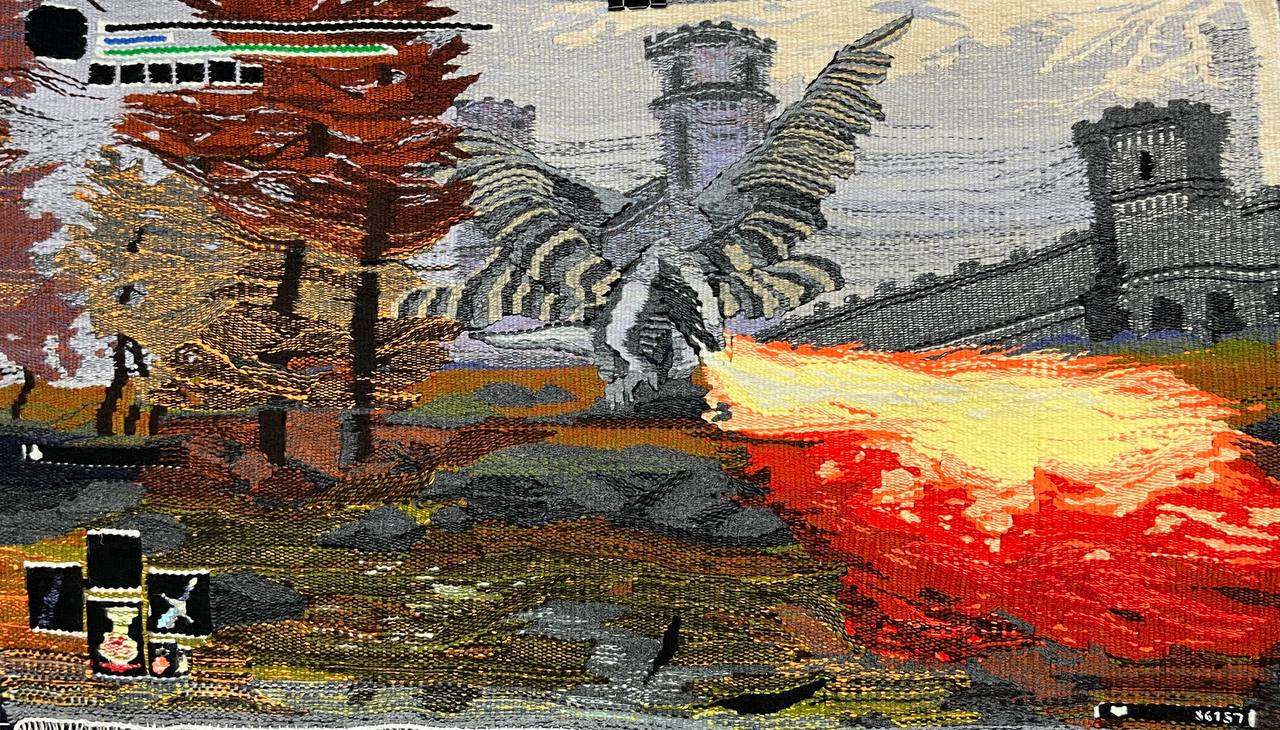
This resonates with the work of textile artist Kristina Pashkova’s Enemy Target, in which game screenshots are hand-woven into textile tapestries and overlaid with projections of in-game code. On Figure 1, one example features the Elden Ring — a so-called souls-like game developed by Japanese studio FromSoftware, which won Game of the Year at The Game Awards in 2022. The game presents a rich and eclectic blend of European cultural motifs: cloud castles, witches, dragons, remixed through a distinctly Japanese aesthetic lens. By selecting such a game, Pashkova highlights the cultural hybridity of contemporary digital myth-making while critically engaging its underlying structures. The project involves lines of video game code that dictate the behaviour of an automated turret system, revealing the entanglement of algorithmic control with militarized vision. By translating militarized visual systems into handwoven fabric and glitch-inspired overlays, Pashkova, like Latypova, exposes the embedded logics of surveillance and control in computational aesthetics. The glitch becomes a critical strategy — both conceptually and materially — that disrupts the smooth interfaces of gaming and automation, revealing their gendered and militarized underpinnings.
Figure 1. Kristina Pashkova Elden Ring 2022. hand weaving, machine embroidery
The glitch’s visual rupture can convert a moment of failure into an act of resistance. This understanding of error conversion adds another layer to feminist critiques of technological determinism by foregrounding how even within tightly programmed environments like video games, space exists for subversive creativity and embodied reappropriation of digital systems.
Feminist theorists such as Donna Haraway and N. Katherine Hayles have argued that cybernetics produces new forms of embodiment, wherein human and machinic processes are inextricably entangled (Haraway, 1991; Hayles, 1999). This perspective is evident in Pashkova’s recent solo exhibition Cycles of Connections — Re:Action (CCI Fabrika, January 31 — March 2, 2025) which examines the mechanization of female labour in digital and industrial systems. Her video works focus on the repetitive, meditative gestures of the weaver, drawing attention to the bodily discipline imposed by both textile manufacturing and computational labour. The repetitive act of weaving becomes a metaphor for digital interaction: a series of embodied movements conditioned by machinic logics. Pashkova’s work asks critical questions: At what point do these movements become mechanical? Where does human agency persist within automated systems?
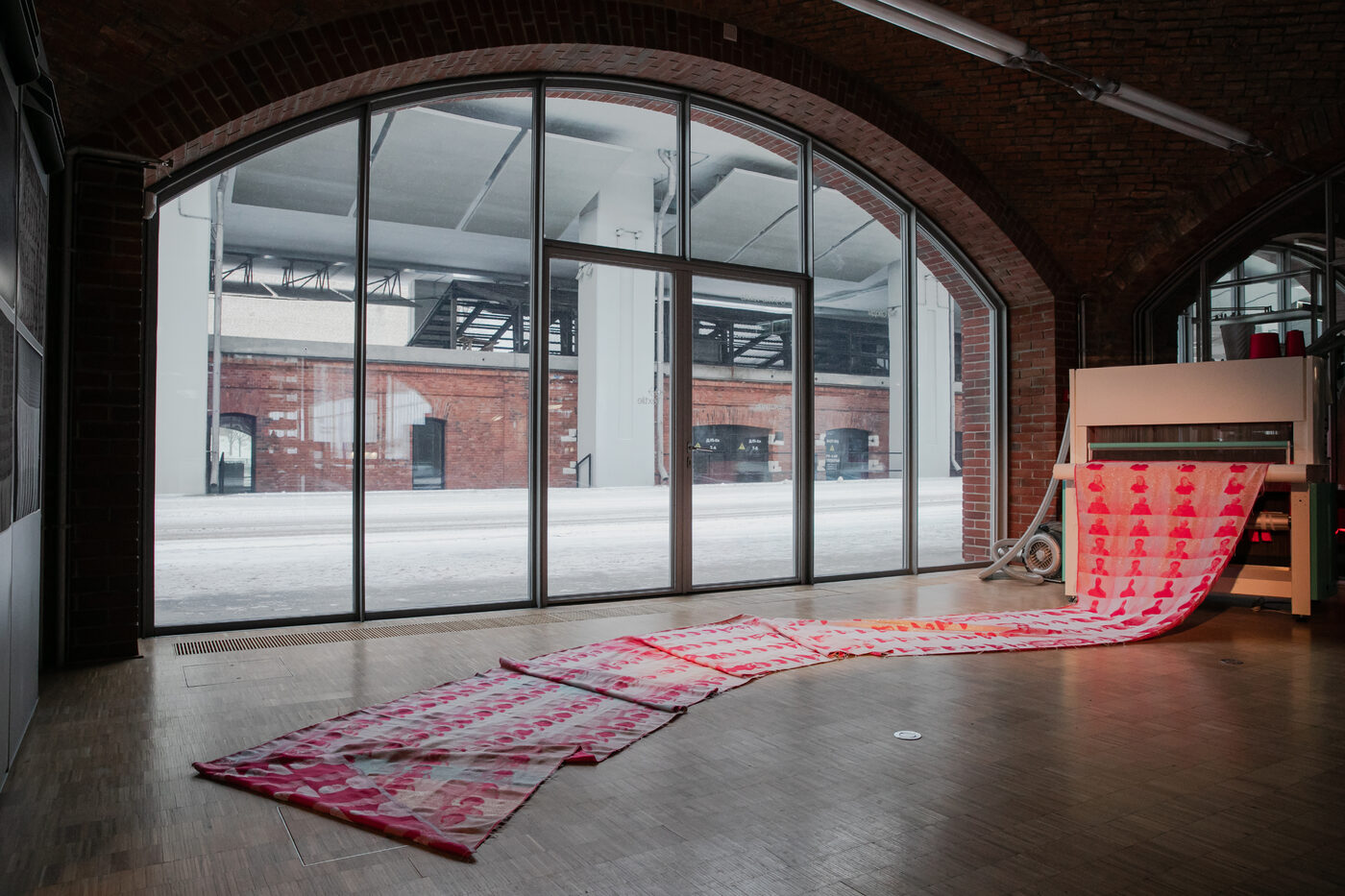
Figure 2. Kristina Pashkova Re-action. Wiping my eyes, 2025 Jacquard woven piece, animated film, collective practices, Vaults, GES-2, Moscow
This critique extends beyond textile-based practices to broader media aesthetics. As Sybille Krämer observes, mediation is often rendered invisible in digital systems, striving toward a frictionless, transparent interface. Yet, as she notes, “only disturbances — noise, glitches — remind us of the presence and operation of media themselves”. Unlike digital screens, which often obscure their own mediation, woven images make their structure visible upon closer inspection. The grid of warp and weft becomes a site of epistemological resistance, disrupting the illusion of seamless representation (Krämer, 1998, p. 74).
This feminist critique of computational determinism extends into contemporary cyberfeminist interventions. The Australian collective VNS Matrix played a foundational role in this discourse, proclaiming themselves “saboteurs of Big Daddy Mainframe”. Their Cyberfeminist Manifesto for the 21st Century (1991) embraced noise, glitch, and digital disruption as strategies for dismantling patriarchal control over technological systems. In doing so, they laid the groundwork for artists who continue to challenge the politics of interface design today. A central question emerging from these inquiries is: How is bodily engagement with textile-making positioned in relation to the mechanization of digital production and algorithmic control?
The tension between the embodied act of weaving and the abstraction of computational systems lies at the heart of many contemporary art practices. A powerful example is a visual artist’s Olena Newkryta Patterns Against Workers (2023), a 34-minute film essay exploring the entanglement of textile labour and digital automation. Tracing the historical shift from handwoven gestures to algorithmic control, the film reveals how labour has been gradually absorbed into capitalist infrastructures of data extraction and mechanization.

Figure 3. Olena Newkryta Patterns Against Workers, 2024. Filmessay, 33:50 min., 2023, English (de/en subs)
Through film, installation, and textile, Olena Newkryta examines the exploitation of marginalized labour, technological infrastructures, and resistance. Using weaving as both method and metaphor, she creates audiovisual ‘hypertexts’ that draw on glitches, techno-feminist theory, and post-work imaginaries — challenging dominant narratives and envisioning alternative futures.
The historical continuity between textiles and computation challenges traditional distinctions between craft and technology (Bryan-Wilson, 2017), art and science. The logic of pattern-making — whether in fabric, code, or digital images — reveals the deep interconnection between material production and abstract reasoning. Weaving, with its structured yet flexible logic, offers a model for thinking about computation not as a rigid system but as a dynamic, reconfigurable process.
As Gottfried Semper argued in Der Stil (1878), textile techniques played a foundational role in shaping artistic and architectural forms, influencing aesthetic and technical principles across disciplines. His concept of “form as matter” highlights how textiles are not merely surfaces but material structures that determine aesthetic and computational logic (Semper, 1878).
Several contemporary artists translate digital imagery into textile forms, making the materiality of mediation explicit. Elaine Reichek’s Sampler (Andy Warhol) (1997) interrogates modernist painting by reinterpreting Pollock’s gestural spontaneity through through detailed hand embroidery. This contrast highlights the tension between traditionally male-coded ideas of artistic freedom and female-coded notions of precision and discipline (Schneider, 2010).
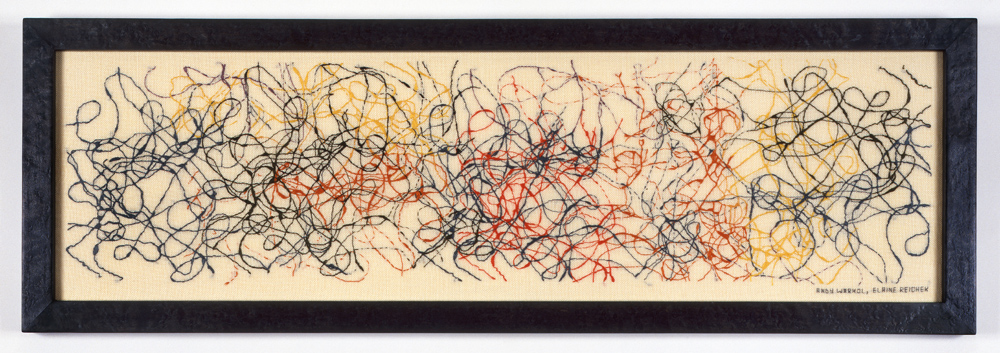
Figure 4. Elaine Reichek, Sampler (Andy Warhol), 1997, Hand embroidery on linen. 26 x 78.1 cm. New York, Susan Unterberg Collection
This contrast highlights the tension between traditionally male-coded ideas of artistic freedom — associated with bold, expressive, and often chaotic gestures in modernist painting and female-coded notions of precision, repetition, and discipline, historically linked to domestic craft practices like embroidery. By translating Pollock’s erratic brushstrokes into carefully stitched patterns, Reichek not only questions the gendered hierarchies of artistic value but also elevates textile work as a form of critical, conceptual art. Her piece reveals how aesthetic practices carry embedded cultural assumptions about gender, labour, and creativity.
The intersection of weaving, cybernetics, and feminist theory finds powerful expression in contemporary art practices that challenge the deterministic narratives of technology. Textiles are not merely passive surfaces but material structures that shape both aesthetic and computational logic, encoding patterns in ways that prefigure digital mediation. Textile artists make the materiality of mediation explicit, revealing the hidden structures behind algorithmic systems. For instance, they transform pixelated video game interfaces into hand-stitched embroidery to disrupt the supposed immateriality of digital.
By revisiting the entanglements of textiles, digital media, and feminist resistance, contemporary artists and theorists challenge computational logic as a neutral, disembodied system. Instead, they expose its deeply material, gendered, and historically contingent nature, opening new possibilities for reimagining digital aesthetics through the politics of weaving, glitch, and embodied agency.
This article has examined the profound yet frequently overlooked connections between weaving, computation, and interface design, demonstrating how the logic of textiles provides a critical framework for rethinking digital systems. The historical lineage of programmed pattern-making, from Jacquard looms to algorithmic interfaces, has been traced to reveal the ways in which textile-based practices have shaped computational logic and continue to inform discussions on digital materiality, embodiment, and agency.
As digital environments evolve, the reimagination of not only physical space but also the fundamental structures of interfaces and interactions becomes increasingly essential. The logic of weaving — its interlacing of threads and flexible structuring of surfaces — has been considered as a powerful model for re-evaluating digital interface architecture, computational logic, and the performative nature of interaction. Just as textiles organize fibers into structured forms that define the material world, digital patterns and interface architectures determine how computational spaces are perceived and navigated.
The interconnectedness of contemporary digital infrastructures has been likened to the woven structures of earlier mechanical systems. Digital machines of the late twentieth century have been observed to form networks from previously isolated elements: words, numbers, images, sounds, and textures, integrating fragmented data into dynamic, interactive environments. The evolution of computation, therefore, cannot be separated from the histories of textile production and the encoded structures that preceded modern digital logic.
A feminist approach to digital translation, one that highlights both the materiality and political dimensions of interfaces, has been shown to challenge conventional narratives of technological determinism. By bringing attention to the historical role of weaving in computation, dominant perceptions of digital culture as abstract, disembodied, and neutral have been critically reassessed. Instead, computation has been positioned within a broader historical framework that acknowledges its deep entanglement with labour, gendered craft, and embodied knowledge.
Such a perspective introduces new possibilities for reconceptualizing interface design — not as a seamless, invisible mediator, but as a contested site of resistance, agency, and creative intervention. Experimental cyberfeminist art practices, including glitch aesthetics and textile-based computation, have been recognized for their role in reclaiming the interface as a performative space where human and machinic processes converge. The case studies in this article were selected based on their explicit engagement with feminist cybernetics, textile-based computation, and critical interface design. The artists featured: Kristina Pashkova, Olena Newkryta, Elaine Reichek, were chosen because their work exemplifies key cyberfeminist strategies, including the reappropriation of historically gendered labour (weaving) in digital contexts, the critique of algorithmic control, and the use of glitch aesthetics as a method of resistance. Each of these artists directly engages with the materiality of computation and challenges the supposed neutrality of digital media, making them particularly relevant to the study’s framework. Each case study is discussed within a wider discourse on feminist media theory, drawing from cyberfeminist manifestos (VNS Matrix, Glitch Feminism manifesto, Cyber Femin Club), media archaeology (Sadie Plant, Sybille Krämer), computational and glitch aesthetics (T’ai Smith, Birgit Schneider, Alina Latypova).
Just as weaving encodes knowledge into material structures, digital practices informed by feminist cybernetics have been explored as methods of unravelling and restructuring the underlying power dynamics of contemporary technology.
By weaving together historical, aesthetic, and political dimensions of computation, this article has advocated for a more inclusive, materially aware, and critically engaged understanding of interfaces — one that foregrounds the entanglement of bodies, systems, and threads in shaping the digital future.
The publication was prepared as part of the project “Visual Ecology in Theory and Practice of Contemporary Media Culture,” supported by a competition for the implementation of promising fundamental research by candidates of sciences at Herzen University.
Albers, A. (1974). On weaving. Wesleyan University Press.
Barad, K. (2007). Meeting the Universe Halfway: Quantum Physics and the Entanglement of Matter and Meaning. Duke University Press. https://doi.org/10.2307/j.ctv12101zq
Bee, J., Gradinari, I., & Köppert, K. (Eds.). (2024). Digital:gender—De:mapping affect. Eine spekulative Kartographie [digital:gender—De:mapping affect. A speculative cartography]. Spector. (In German).
Braidotti, R. (2013). The Posthuman. Polity Press.
Braidotti, R. (2021). Cyberfeminists and Other Bad Girls. In L. G. Nazionale, C. Canziani, & P. Ugolini (Eds.), Io dico Io – I say I: Female Artists and Self-Representation. Silvana. (In Italian).
Bryan-Wilson, J. (2017). Fray: Art and Textile Politics. University of Chicago Press. https://doi.org/10.7208/chicago/9780226369822.001.0001
Chun, W. H. K. (2005). On Software, or the Persistence of Visual Knowledge. Grey Room, 18, 26–51. https://doi.org/10.1162/1526381043320741
Chun, W. H. K. (2011). Programmed Visions: Software and Memory. The MIT Press. https://doi.org/10.7551/mitpress/9780262015424.001.0001
Deleuze, G. (1992). Postscript on the Societies of Control. In Cultural theory: An anthology (pp. 139–142). John Wiley & Sons.
Deleuze, G. (2006). The Fold: Leibniz and the Baroque. A&C Black.
Engell, L., & Siegert, B. (2014). Längengradbestimmung und Simultanität in Philosophie, Physik und Imperien [Longitude determination and simultaneity in philosophy, physics and empires]. Zeitschrift Für Medien- Und Kulturforschung, 5(2). https://doi.org/10.28937/1000106421 (In German)
Galloway, A. R. (2012). The Interface Effect. Polity Press.
Haraway, D. (1991). Simians, Cyborgs, and Women: The Reinvention of Nature. Routledge.
Hayles, N. K. (1999). How We Became Posthuman: Virtual Bodies in Cybernetics, Literature, and Informatics. University of Chicago Press. https://doi.org/10.7208/chicago/9780226321394.001.0001
Irigaray, L. (1985). Speculum of the other woman. Cornell University Press.
Krämer, S. (1998). Das Medium als Spur und als Apparat [The medium as a trace and as an apparatus]. In S. Krämer (Ed.), Medien, Computer, Realität: Wirklichkeitsvorstellungen und Neue Medien [Media, computers, reality: Concepts of reality and new media] (pp. 73–94). Suhrkamp. (In German).
Latypova, A. (2016). Bug Conversion: Glitch Art in Computer Games. In Media Philosophy XII. Game or Reality? (pp. 263–280). Fond razvitiya konfliktologii. (In Russian).
Lenkevich, A., & Latypova, A. (2015). Interface as a subject of reflection. Bulletin of the Pushkin Leningrad State University, 2(2), 181–190. (In Russian).
Lenkevich, A., & Latypova, A. (2024). Interface as a Thorn in the Flesh: Game Controllers and Radical Body Engineering. Logos, 34(6), 157–176. https://doi.org/10.17323/0869-5377-2024-6-157-176 (In Russian).
Mead, M. (1963). Cultural patterns and technical change. Mentor Books.
Mitrofanova, A. (2018). From the history of cyberfeminism of the 1990s: A network journal. Virtual anatomy. Art Journal, 105. https://moscowartmagazine.com/issue/78/article/1697 (In Russian).
Moore, D. L. (1977). Ada, Countess of Lovelace: Byron’s illegitimate daughter. John Murray.
Morrison, P., & Morrison, E. (Eds.). (1961). Charles Babbage and his calculating engines: Selected writings by Charles Babbage and others. Dover.
Ocheretyany, K. (2024). Marquis de Sade—The Inventor of the Interface. Logos, 34(6), 47–64. https://doi.org/10.17323/0869-5377-2024-6-47-64 (In Russian).
Ocheretyany, K., & Pogrebnyak, A. (2024). After Algorithms: From Social Utopias to the Phantasm of Cosiness. Logos, 34(6), 1–7. https://doi.org/10.17323/0869-5377-2024-6-1-7 (In Russian).
Plant, S. (1995). The Future Looms: Weaving Women and Cybernetics. Body & Society, 1(3–4), 45–64. https://doi.org/10.1177/1357034X95001003003
Plant, S. (2012). Zeros+ ones: Digital women and new technoculture. In J. Hemmings (Ed.), The textile reader (pp. 324–336). Bloomsbury.
Russell, L. (2020). Glitch feminism: A manifesto. Verso Books.
Schneider, B. (2007). Textiles Prozessieren: Eine Mediengeschichte der Lochkartenweberei [Textile processing: A media history of punch card weaving]. Diaphanes. (In German).
Schneider, B. (2010). Textile Codierungen: Mediale Übersetzungen von Material und Struktur bei Elaine Reichek, Patricia Waller und Ingrid Wiener [Textile codings: Medial Translations of Material and Structure in the Work of Elaine Reichek, Patricia Waller and Ingrid Wiener]. In T. Weddigen (Ed.), Metatextile: Identity and history of a contemporary art medium (pp. 109‑121). Edition Imorde. (In German).
Semper, G. (1878). Der Stil in den technischen und tektonischen Künsten oder praktische Ästhetik [Style in the technical and tectonic arts or practical aesthetics]: Vol. 1: Die textile Kunst für sich betrachtet und in Beziehung zur Baukunst [Textile art viewed in isolation and in relation to architecture]. F. Bruckmann. (In German).
Smith, T. (2014). Writing on weaving: A Bauhaus craft, a Bauhaus medium. University of Minnesota Press.
Smith, T. (2017). Binding economies: The fabric of the world and the art of modernism. University of Minnesota Press.
Albers, A. (1974). On weaving. Wesleyan University Press.
Barad, K. (2007). Meeting the Universe Halfway: Quantum Physics and the Entanglement of Matter and Meaning. Duke University Press. https://doi.org/10.2307/j.ctv12101zq
Bee, J., Gradinari, I., & Köppert, K. (Eds.). (2024). Digital:gender—De:mapping affect. Eine spekulative Kartographie [digital:gender—De:mapping affect. A speculative cartography]. Spector. (In German).
Braidotti, R. (2013). The Posthuman. Polity Press.
Braidotti, R. (2021). Cyberfeminists and Other Bad Girls. In L. G. Nazionale, C. Canziani, & P. Ugolini (Eds.), Io dico Io – I say I: Female Artists and Self-Representation. Silvana. (In Italian).
Bryan-Wilson, J. (2017). Fray: Art and Textile Politics. University of Chicago Press. https://doi.org/10.7208/chicago/9780226369822.001.0001
Chun, W. H. K. (2005). On Software, or the Persistence of Visual Knowledge. Grey Room, 18, 26–51. https://doi.org/10.1162/1526381043320741
Chun, W. H. K. (2011). Programmed Visions: Software and Memory. The MIT Press. https://doi.org/10.7551/mitpress/9780262015424.001.0001
Deleuze, G. (1992). Postscript on the Societies of Control. In Cultural theory: An anthology (pp. 139–142). John Wiley & Sons.
Deleuze, G. (2006). The Fold: Leibniz and the Baroque. A&C Black.
Engell, L., & Siegert, B. (2014). Längengradbestimmung und Simultanität in Philosophie, Physik und Imperien [Longitude determination and simultaneity in philosophy, physics and empires]. Zeitschrift Für Medien- Und Kulturforschung, 5(2). https://doi.org/10.28937/1000106421 (In German)
Galloway, A. R. (2012). The Interface Effect. Polity Press.
Haraway, D. (1991). Simians, Cyborgs, and Women: The Reinvention of Nature. Routledge.
Hayles, N. K. (1999). How We Became Posthuman: Virtual Bodies in Cybernetics, Literature, and Informatics. University of Chicago Press. https://doi.org/10.7208/chicago/9780226321394.001.0001
Irigaray, L. (1985). Speculum of the other woman. Cornell University Press.
Krämer, S. (1998). Das Medium als Spur und als Apparat [The medium as a trace and as an apparatus]. In S. Krämer (Ed.), Medien, Computer, Realität: Wirklichkeitsvorstellungen und Neue Medien [Media, computers, reality: Concepts of reality and new media] (pp. 73–94). Suhrkamp. (In German).
Mead, M. (1963). Cultural patterns and technical change. Mentor Books.
Moore, D. L. (1977). Ada, Countess of Lovelace: Byron’s illegitimate daughter. John Murray.
Morrison, P., & Morrison, E. (Eds.). (1961). Charles Babbage and his calculating engines: Selected writings by Charles Babbage and others. Dover.
Plant, S. (1995). The Future Looms: Weaving Women and Cybernetics. Body & Society, 1(3–4), 45–64. https://doi.org/10.1177/1357034X95001003003
Plant, S. (2012). Zeros+ ones: Digital women and new technoculture. In J. Hemmings (Ed.), The textile reader (pp. 324–336). Bloomsbury.
Russell, L. (2020). Glitch feminism: A manifesto. Verso Books.
Schneider, B. (2007). Textiles Prozessieren: Eine Mediengeschichte der Lochkartenweberei [Textile processing: A media history of punch card weaving]. Diaphanes. (In German).
Schneider, B. (2010). Textile Codierungen: Mediale Übersetzungen von Material und Struktur bei Elaine Reichek, Patricia Waller und Ingrid Wiener [Textile codings: Medial Translations of Material and Structure in the Work of Elaine Reichek, Patricia Waller and Ingrid Wiener]. In T. Weddigen (Ed.), Metatextile: Identity and history of a contemporary art medium (pp. 109‑121). Edition Imorde. (In German).
Semper, G. (1878). Der Stil in den technischen und tektonischen Künsten oder praktische Ästhetik [Style in the technical and tectonic arts or practical aesthetics]: Vol. 1: Die textile Kunst für sich betrachtet und in Beziehung zur Baukunst [Textile art viewed in isolation and in relation to architecture]. F. Bruckmann. (In German).
Smith, T. (2014). Writing on weaving: A Bauhaus craft, a Bauhaus medium. University of Minnesota Press.
Smith, T. (2017). Binding economies: The fabric of the world and the art of modernism. University of Minnesota Press.
Латыпова, А. Р. (2016). Конверсия ошибки: Глитч-арт в компьютерных играх. В Медиафилософия XII. Игра или реальность? (сс. 263–280). Фонд развития конфликтологии.
Ленкевич, А. С., & Латыпова, А. Р. (2015). Интерфейс как предмет рефлексии. Вестник Ленинградского сосударственного университета им. А.С. Пушкина, 2(2), 181–190.
Ленкевич, А. С., & Латыпова, А. Р. (2024). Интерфейс как жало в плоть Игровые контроллеры и радикальный инжиниринг тела. Логос, 34(6), 157–176. https://doi.org/10.17323/0869-5377-2024-6-157-176
Митрофанова, А. (2018). Из истории киберфеминизма 1990-х: Сетевой журнал. Виртуальная анатомия. Художественный Журнал, 105. https://moscowartmagazine.com/issue/78/article/1697
Очеретяный, К. А. (2024). Маркиз де Сад – изобретатель интерфейса. Логос, 34(6), 47–64. https://doi.org/10.17323/0869-5377-2024-6-47-64
Очеретяный, К. А., & Погребняк, А. А. (2024). После алгоритмов: От социальных утопий—К фантазму уюта. Логос, 34(6), 1–7. https://doi.org/10.17323/0869-5377-2024-6-1-7