Storytelling and Visual Culture in the Digital Age: The Impact of YouTube on Short Filmmaking
Manipal University Jaipur (Jaipur, India).
Email: kadambari1992[at]gmail.com
 0009-0000-2558-766X
Manipal University Jaipur (Jaipur, India).
Email: Journalism.gunjan[at]gmail.com
0009-0008-0969-6055Abstract
As a leading digital platform, YouTube has democratized the filmmaking process, providing filmmakers with exceptional access to global audiences and innovative tools. This study explores current trends in short filmmaking on YouTube, including the use of digital technologies in film production, distribution, and audience engagement. This research paper examines the transformative impact of YouTube, a prominent social media platform, on short filmmaking, with a focus on digital storytelling and visual culture. Through content analysis and an examination of case studies of popular YouTube short films, this study has found that YouTube has reshaped the art of short filmmaking. The study also underscores the significance of YouTube in fostering a vibrant and diverse short film community, ultimately contributing to the broader discourse on digital media and visual culture. The findings highlight the benefits and challenges of using YouTube as a distribution platform, such as increased accessibility, cost-effectiveness, and the potential for viral success, alongside issues of content saturation and quality control.
Keywords
Digital Storytelling, Visual Culture, YouTube, Short Films, Digital Age, Short Filmmaking, Film Production, Audience Engagement, Film Community, Social Media
Сторителлинг и визуальная культура в цифровую эпоху: влияние YouTube на создание короткометражных фильмов
Университет Манипал Джайпур (Джайпур, Индия).
Email: kadambari1992[at]gmail.com
0009-0000-2558-766XУниверситет Манипал Джайпур (Джайпур, Индия).
Email: Journalism.gunjan[at]gmail.com
0009-0008-0969-6055Аннотация
Как ведущая цифровая платформа YouTube демократизировал процесс создания фильмов, предоставив кинематографистам беспрецедентный доступ к глобальной аудитории и инновационным инструментам. В этом исследовании рассматриваются современные тенденции в создании короткометражных фильмов на YouTube, включая использование цифровых технологий в производстве, распространении и взаимодействии с аудиторией. В данной работе анализируется трансформирующее влияние YouTube на создание короткометражных фильмов с особым вниманием к цифровому повествованию и визуальной культуре. Анализ контента и изучение примеров популярных короткометражных фильмов на YouTube показали, что платформа изменила искусство создания продуктов этого кинематографического жанра. Исследование также подчеркивает значение YouTube в формировании динамичного и разнообразного сообщества авторов и зрителей короткометражного кино, что в конечном итоге способствует более широкому обсуждению цифровых медиа и визуальной культуры. Результаты исследования подчеркивают преимущества и ограничения использования YouTube в качестве платформы для распространения, такие как повышенная доступность, экономическая эффективность и потенциал вирусного успеха, наряду с рисками насыщенности контента и контроля качества.
Ключевые слова
цифровой сторителлинг, визуальная культура, YouTube, короткометражные фильмы, цифровая эпоха, создание короткометражных фильмов, кинопроизводство, вовлечение аудитории, кинематографическое сообщество, социальные сети
Introduction
YouTube has revolutionized global media consumption, with a reach of over 2.7 billion monthly active users and 500 hours of video uploaded every minute. It has emerged as the world’s largest digital storytelling platform. In India alone, the platform has 500 million users. Among these users, 70% engage with regional-language content on a daily basis. This trend has disrupted Bollywood’s traditional historical dominance (FICCI-EY, 2025). The democratization of filmmaking has enabled indie creators to compete with established studios and industry giants. This is evident in short films such as The School Bag and Chutney, which have garnered over 15 million and 25 million views, respectively, without any traditional studio backing. The rise of YouTube as a cultural and entrepreneurial force has reshaped short filmmaking by offering creators extraordinary access to global audiences. Unlike traditional gatekeeping ecosystems in media and the film industry, the platform empowers marginalized voices, regional filmmakers, feminist storytellers, and tribal animators, thereby bypassing institutional barriers. However, this democratization coexists with systemic imbalances. Beneath this apparent creative liberation lies a contradiction in the form of algorithmic bias and platform capitalism. Techniques designed to maximize engagement, such as algorithmic recommendation systems, often suppress socio-politically charged narratives while amplifying formulaic content. Meanwhile, YouTube's monetization policies leave vernacular creators at a disadvantage, with only 12% able to meet the platform's stringent Partner Program thresholds (KPMG, 2022). Such underlying forces position YouTube as a contested “Third Space,” in which grassroots innovation competes with the homogenizing forces of platform capitalism. This not only compromises the creativity of storytelling but also privileges viral models over cultural authenticity (Vizcaíno-Verdú et al., 2021).
Problem Statement
While YouTube has indisputably expanded opportunities for independent filmmakers, its algorithmic authority reinforces a digital hierarchy. Tribal films like Gond Tribe1 receive 30% fewer impressions than urban-centric content, while feminist reinterpretations like Ahalya face devaluation for challenging patriarchal norms. This conflict between democratization and sidelining raises critical questions: Does YouTube's attention economy naturally favour homogenized, algorithm-friendly material, or can it sustain diverse storytelling traditions?
Research Objectives & Questions
This study investigates YouTube’s dual role as an enabler and constrainer of short film innovation in India. Specifically, it aims to:
-
To Examine the Evolution of Creative Innovation: to understand how YouTube’s algorithmic framework has enabled filmmakers to explore developments in storytelling, cinematography and production excellence throughout three pivotal eras (2007–2024).
-
To Enhance Opportunities for Underrepresented Voices: Identify strategies to improve visibility, revenue generation, and representation for regional filmmakers, as well as feminist creators within YouTube's digital environment.
-
To Promote Equitable and Inclusive Platform Protocols: Establish practical strategies to align the control of algorithms with cultural diversity, and inclusive growth.
Guiding Research Questions:
-
How have narrative structures, story styling and cinematographic techniques evolved in response to YouTube’s algorithmic demands?
-
What metrics define “success” for short films on YouTube, and how do they differ for mainstream vs. underrepresented groups (regional, tribal, feminist storytellers)?
-
Can hybrid models (e.g., regional content quotas, AI-driven metadata optimization) foster equitable growth without compromising cultural authenticity?
Methodology Overview
The researchers have adopted a mixed-methods approach. In doing so, they combine qualitative analysis of 20 short films using Bordwell’s (2008) Film Art framework with quantitative metrics (e.g., views, watch time, and likes). The films are categorized into three eras: Early (2007–2015), Mid (2016–2019), and Present (2020–2024). Audience engagement data were extracted from YouTube’s publicly available data. In addition, algorithmic bias was assessed through comparative analysis of impression shares and monetization reports (Zimmermann et al., 2022).
Significance of the Study
This study supports broader discussions on cultural fairness and platform governance. Through mapping YouTube's impact on India's short film environment, policymakers and platform designers can better understand how to tackle algorithmic biases. For creators, the study offers guidelines on navigating platform restrictions while preserving narrative integrity. Academically, it bridges the gap between media studies, platform economics, and post-colonial theory, thereby enriching debates on online storytelling (Bee, 2024).
Structure of the Paper
Following this introduction, the next section offers a review of the literature on algorithmic storytelling and platform capitalism. Section 3 details the mixed-methods approach used in this study. Sections 4 and 5 present the findings on narrative progression and engagement metrics. Section 6 investigates the effects of relevant policies; Section 7 concludes by proposing recommendations for more equitable digital environments.
Literature Review
The unprecedented evolution of storytelling in the digital age now establishes storytelling as an enterprise where competition is shaped by algorithmic governance and the economics of attention. Immersive short videos have been likened to entrepreneurial activities that trigger psychological impulses, with fragmented narratives and sensory overload aimed at optimizing engagement, according to Yan et al. (2023). To monetize segmented viewer time, platforms such as YouTube serve as attention markets where creators host audiovisual content. Xiang (2022) broadens that idea with concepts such as “algorithmic presence,” which refers to the effect of recommendation engines curating content according to user biases and creating an illusion of intimacy with the audience. However, such curation often privileges viral templates over local and subaltern narratives. Although such insights are supposedly common to Western contexts, they raise significant questions about India’s digital economy: Will YouTube’s “attention marketplace” be able to accommodate the rasas of Indian storytelling? Does it reduce cultural heritage to commodified clickbait? (Benjamin, 2019)
In arguing that the digital miracle of storytelling in India is enabled and constrained by platform capitalism, Pietrobruno (2016) considers YouTube to be a neo-colonial marketplace through which a developing nation attempts to rearticulate its storytelling traditions in digital form. While urban creators, like those of BB Ki Vines, can amass millions of subscribers through algorithm-friendly content, filmmakers from tribal backgrounds featured in Gond Tribe find it next to impossible to be seen on YouTube because the platform’s ad policies classify their vernacular storytelling as “unmonetizable.” This shows that a form of digital caste has emerged, reproducing inequalities already present offline. This, in turn, is contextualized within the “New Wave” of decentralized digital entrepreneurship in India by Rajadhyaksha (2009), who also compares YouTube's disruptors to the indie pioneers of Satyajit Ray. Nevertheless, he warns against naive techno-optimism: while algorithms amplify feminist retellings such as Ahalya, they simultaneously suppress caste critiques like Gond Tribe, revealing inherent tensions between creative autonomy and platform dependency.
European viewers can access the short film Gond Tribe on YouTube; yet it often becomes a mystical essence of “ethnic art” deprived of its sociopolitical context. This paradox best illustrates the difficulty of sustaining cultural entrepreneurship in digital environments. Such conditions also strip works of their artistic force while leaving behind only a superficial appearance of authenticity. The gut-wrenching emotion of minimalist stories like The School Bag2, with its depiction of rural schooling, becomes less visible when battling for the audience's attention through thumbnails against waves of viral memes. Benjamin's criticism of mechanical reproduction makes sense within YouTube's attention economy, where narrative is sometimes split into highly replicable shorter forms designed to maximize view time (Benjamin, 2019; Bucher & Helmond, 2018).
The storytelling traditions of India have long depended on a balance between innovation and the preservation of cultural forms, including oral epics. These epics once existed alongside temple frescoes, just as Parallel Cinema today shares space with the algorithmic dominance of YouTube.
However, digital platforms command entrepreneurial agility, which requires a shift in narrative techniques:
-
Traditional Narratives: Linear, chronologically bound format stories (e.g.- Satyajit Ray's Pather Panchali).
-
Digital Narratives: Fragmented platform-based narratives, experimental cinematography, and audience-driven engagement strategies.
A further form of expression shaped by YouTube’s specific economy is symbolic compression. In Devi3, a clenched fist represents resistance and critiques algorithmic suppression. Similarly, Chutney4 incorporates a rolling pin into its harrowing narrative as a metonym for domestic tension, a strategy well suited to an age in which creators weigh the integrity of art against the dictates of data. Such approaches, however, risk commodifying cultural rasa, thereby potentially jeopardizing the very existence of authentic storytelling in digital environments.
The promise of the platform lies in its democratization of convergence culture (Jenkins, 2006), where audience members become co-creators themselves. Regional films like Mathi (Tamil) use YouTube as a repository of language and as a means of challenging mainstream monopoly. The opposite, however, is suggested by Nick Srnicek’s Platform Capitalism (2016), which illustrates how systematic inequalities in YouTube’s Partner Program encourage the standardization of content through monetary incentives that discourage innovation in favour of templates such as those imposed by Dice Media, which restructure projects to meet the specifications of the “5-minute drama.” The FICCI-EY (2025) report puts numbers to this trend, estimating that 65 percent of under-30 creators in India opt for trending formats rather than originality in pursuit of monetization. Moreover, for vernacular filmmakers like Chhoti Si Baat (Marathi), visibility alone does not suffice, as they face 30 percent lower impressions than their urban counterparts.
The functioning of digital storytelling as an unfolding process is therefore analyzed in the present study with the help of a dual-method approach. The qualitative analysis emphasizes narrative structure, cinematography, mise-en-scène, and visual semiotics. Drawing upon Bordwell’s (2008) Film Art, this approach examines the technological transition through which storytelling techniques move from raw, independent, experimental forms to highly produced narratives algorithmically determined. The reception of digital storytelling is examined quantitatively through audience engagement metrics, including views, watch time, likes, shares, and sentiment analysis of comments. The interplay of these two paradigms thus enriches the understanding of the processes that impact the evolution of digital storytelling, where both artistic form and measurable audience engagement need to be considered (Hockett, 2019).
The above literature also positions YouTube as a cultural site for sustainability and creative entrepreneurship, raising the question of whether this digital marketplace sustains heterogeneous storytelling or instead promotes homogenization and algorithmic oversight. While these studies question the platform’s effect on short filmmaking in India, they also provide insight into opportunities for innovation and systematic roadblocks within digital media environments.
Theoretical Framework: Platform Studies and Cultural Policy
The study employs a dual theoretical lens to understand how platforms like YouTube affect short filmmaking in India, drawing on platform studies and cultural policy. The study thus provides an account of YouTube, revealing it as a socio-technical system that enables creative expression even as it restricts the production, sharing, and distribution of particular forms of content or narratives.
Platform studies, developed by scholars like van Dijck et al. (2018) and Gillespie (2019), remind us that digital platforms are not neutral infrastructure for sharing content, but socio-technical systems composed of code, algorithms, business models, governance practices, and economic logics. As a result, platforms actively configure the conditions of cultural visibility by giving preferential treatment to some forms of content while marginalizing others. In the case of YouTube, the platform's recommendation algorithms prioritize engagement-driven content, which, at worst, incentivizes hyper-sensationalized and standardized formats at the expense of experimental or politically challenging content. In this view, YouTube acts as a cultural intermediary that curates not only how films are distributed, but also how films, especially short films, are produced and consumed. The advantages of the YouTube platform include real-time analytics, advertising-based monetization, and algorithmic feedback loops that encourage filmmakers to make content that is “platform-ready.” This means that filmmakers are drawn into a feedback loop in which they adjust their narrative styles for example, documentary or experimental modes, cinematography to make it visually appealing and attention-directing, and subject matter such as social justice issues to enhance visibility within an algorithmic ecosystem.
On the one side, YouTube broadens access by lowering barriers to entry; therefore, instead of having to work with developers, investors, or other industry gatekeepers, regional filmmakers, feminist storytellers, and tribal artists can function without these gatekeepers. In contrast, YouTube creates a new hierarchy through its monetization thresholds and algorithmic filtering. Finally, YouTube provides avenues for grassroots creativity while being complicit in the structure of platform capitalism, a contemporary form of capitalism in which the extraction of data and subsequent monetization shape the parameters of cultural production.
Cultural Policy and Political Economy
YouTube functions as a civil agency or regulator in its own right, with the terms of its policies governing cultural expression in ways typically reserved for states or cultural institutions. Hesmondhalgh (2007) suggests that digital media organisations are acting more like cultural policy makers, imposing the rules of the game that determine which voices will be amplified, rewarded, or suppressed. YouTube's Partner Programme establishes criteria for monetisation that only a small proportion of Indian creators can expect to meet. YouTube thus acts as a private regulator of India's cultural economy, promoting creators who strive to produce content consistent with global advertiser-friendly standards. Cultural policy perspectives also focus on how YouTube raises related questions pertaining to equity, representation, and diversity. In India, regional-language films and narrative works critical of caste or gender norms struggle for algorithmic visibility, even though they represent a culturally significant intervention. Thus, YouTube reproduces a version of digital stratification that resembles offline hierarchies in which certain cultural forms are systematically undervalued. The influence of cultural policy therefore illustrates how YouTube's form of governance internally creates conditions for national questions involving inclusivity, diversity, and the commodification and protection of creative heritage.
Integrative Value
Jointly, platform studies and cultural policy provide an understanding of YouTube's dual role in Indian short filmmaking. The platform is not just a location of technological innovation or audience engagement, but a contested cultural field where algorithmic governance operates in relation to wider struggles for creative equity. Using these two approaches in combination, this paper understands YouTube as both a technological infrastructure and a policy actor whose logics of engagement, monetization, and visibility shape what is possible and what is impossible for digital storytelling today.
Research Methodology
The research design combines qualitative and quantitative approaches within a mixed-methods framework, allowing this study to examine the evolution of digital storytelling in YouTube short films.
For the qualitative analysis, the evolution of the medium is analyzed in terms of narrative structure, cinematography, mise-en-scène, and visual semiotics as key storytelling elements. Quantitative analysis measures audience engagement through views, watch time, likes, shares, and comment sentiments, using statistical analyses to identify patterns of engagement. The complementarity of the two approaches enriches the understanding of the trends that digital storytelling assumes, balancing textual depth with measurable audience interaction.
Qualitative Methodology
The qualitative research draws on the following theoretical framework: Bordwell's Film Art, which encompasses elements of filmmaking with a focus on narrative structure, cinematography, mise-en-scène, and genre. It helps to explain the transition from raw, independent storytelling to algorithm-driven, highly produced content on YouTube.
Across the three evolutionary stages on which the study focuses, the analysis examines short films made for YouTube:
Early Era (2007–2015): This period is characterized by amateur storytelling, limited plot development, and attempts at experimental filmmaking.
Mid Era (2016–2019): This phase is marked by increased production value and the introduction of structured narratives to improve platform performance.
Present Era (2020–2024): This stage is characterized by highly produced films shaped by audience analytics and defined by YouTube's recommendation algorithm.
The study analyzes a total of 20 selected short films to represent broader national trends in digital storytelling, although this sample offers only limited generalizability. These films are:
-
Early Years (2007–2015): This phase was characterized by grassroots experimentation and the exploratory use of digital platforms. I Am 205 emerged as a viral short on YouTube, reflecting the rawness and immediacy of early digital circulation. Similarly, OP – Stop Smelling Ur Socks6 represented the low-budget, experimental ethos of the time. By 2015, Ahalya7 demonstrated a significant shift, using mythological motifs within a contemporary cinematic grammar; it exemplified how digital short films began to approach mainstream production standards.
-
Middle Era (2016–2019): The middle phase witnessed a surge in production quality alongside the strategic use of YouTube’s algorithm for visibility. Chutney8 employed a non-linear narrative to heighten its digital appeal, while Khujli9 leaned on humor and trending topics to ensure resonance with audiences. Socially critical shorts such as Juice10 dissected domestic gender relations, while Lakshmi11, a Tamil short film, highlighted gender marginalization within the Indian context. The School Bag gained popularity through emotive storytelling and grassroots promotion, whereas Rogan Josh12 illustrated the rise of alternative funding and digital distribution mechanisms. Films such as Tindey13 took bolder stances, addressing caste structures in ways that conflicted with algorithmic promotion. By 2019, global perspectives also entered the Indian YouTube landscape, as seen in the Academy Award–winning The Neighbors’ Window14.
-
Present Era (2020–2024): The current phase reflects the increasing influence of artificial intelligence, regional storytelling, and cross-genre experimentation. dealt with urgent social concerns, foregrounding issues of patriarchy, trauma, and child labour. Gond Tribe15 represented the algorithmic marginalization of regional voices, while No Reservations – A Pipeline Comedy16 used satire to critique globalization and cultural homogenization. The animated Umbrella17 expanded the field into children’s and affective storytelling, whereas Sci-Fi Short Film – Connected18 reflected how AI technologies cut production costs and transformed cinematic processes. Documentaries such as Murchison Falls: A Wildlife Adventure19 emphasized eco-visual storytelling for a global audience. Finally, The Broken Table20 explored memory and aging, and I’m Not a Robot21 interrogated the human–AI boundary, raising questions about authenticity, identity, and ethical dilemmas in AI-mediated culture.
This evolution illustrates both the democratization and the homogenization of digital storytelling under the pressures of audience engagement and algorithmic influence.
Justification for Film Selection
The study analyzes twenty short films available on YouTube, deliberately chosen to represent the platform’s evolution across three distinct eras: 2007–2010 (the early period, characterized by user-generated works with minimal resources), 2011–2016 (a phase of semi-professional production with improving technical quality), and 2017–2024 (an era of highly polished shorts often supported by brands or streaming platforms). This chronological spread enables an examination of the transformation in narrative style, production techniques, and audience engagement over time. The short films encompass a diverse range of genres, including drama, comedy, experimental film, slice-of-life, and social commentary, thereby capturing the adaptability of storytelling forms within the constraints and opportunities of a digital platform.
Selection criteria emphasized cultural and thematic relevance, ensuring that each film addresses issues, narratives, or aesthetics reflective of its period’s socio-cultural context. The corpus balances viral successes with critically recognized works, allowing for comparative insights into algorithm-driven popularity versus content-driven artistic value. All films are freely accessible in full on YouTube, ensuring transparency and reproducibility in the analysis, and are presented in their original form without editing to preserve authenticity. Priority was given to works by independent creators, highlighting YouTube’s function as a democratizing medium that enables filmmakers to bypass traditional distribution channels and reach global audiences directly. This selection strategy ensures a representative and analytically rich dataset for exploring storytelling and visual culture in the digital age.
Qualitative Analysis: A Bordwellian Analysis of YouTube Short Films
Bordwell's Film Art framework sheds light on the transformations that have occurred across YouTube short films from the Early era (2007–2015) through the Mid era (2016–2019) to the Present era (2020–2024) in terms of narrative, cinematography, mise-en-scène, genre, cultural hybridity, and algorithmic adaptation.
The present analysis is also extended to incorporate genre, cultural hybridity, and algorithmic adaptation, dimensions particularly salient for the study of YouTube as both a site of artistic experimentation and a site of platform capitalism (Burgess & Green, 2013; Cunningham & Craig, 2019).
Narrative Structure
In the Early Era, the narrative form was simple and functional. Shorts such as I Am 20 adopted linear storytelling, often resembling documentary or observational cinema. The story unfolded without twists, focusing on everyday people and their direct experiences. Similarly, OP – Stop Smelling Ur Socks was built around a straightforward comedic idea, with the narrative revolving around a single gag. These films reveal YouTube’s early character: direct, unpolished, and rooted in immediacy.
During the Mid Era, narratives began to grow in complexity. Ahalya transformed a mythological story into a suspense thriller, carefully withholding information to create tension and ambiguity. Chutney employed layered storytelling, combining melodrama with gothic elements that challenged the viewer’s expectations. Juice and The School Bag also moved beyond simplicity, developing subplots and situational tension that reflected social realities.
In the Present Era, films such as Devi pushed narrative design much further. Devi relied on ensemble storytelling, weaving together the voices of several women in one confined setting. Lakshmi adopted allegorical narrative techniques, breaking away from linearity and using symbolism to communicate layered meanings. As shown in Figure 1, Bordwell’s Film Art framework demonstrates that the impact level of narrative structure rises steadily across the three eras, from functional beginnings to sophisticated storytelling in the present.
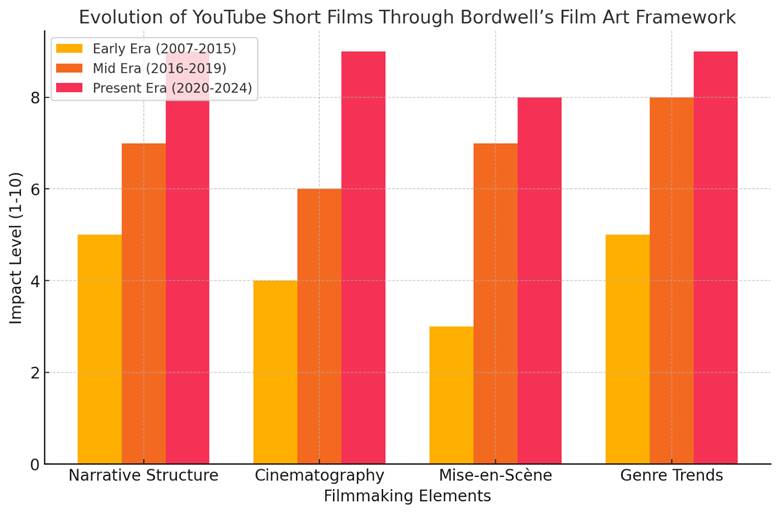
Figure 1. Bordwell’s Film Art Framework
Cinematography
Cinematography in YouTube short films reflects the shift from amateur production to professionalised digital filmmaking. In the Early Era, filmmakers relied on available light, handheld cameras, and static shots. I Am 20 exemplifies this with its straightforward framing, which prioritises content over visual style.
The Mid Era marks the point at which technology, especially affordable DSLR cameras, changed visual aesthetics. Chutney used controlled lighting and precise framing to build atmosphere, while Juice employed careful composition to highlight domestic confinement. The School Bag enhanced emotional storytelling through tracking shots and a cinematic look. These examples show how shorts gradually adopted techniques once associated with mainstream cinema.
In the Present Era, cinematography became central to the films’ identity. Tindey and Rogan Josh used symbolic colour palettes, long takes, and stylised framing to create a mythic and immersive effect. Devi relied on controlled close-ups and spatial framing to emphasise collective presence and silence. Figure 1, based on Bordwell’s Film Art framework, highlights this change clearly, with cinematography showing one of the steepest growth curves, rising from minimal attention in the Early Era to near-professional quality in the Present Era.
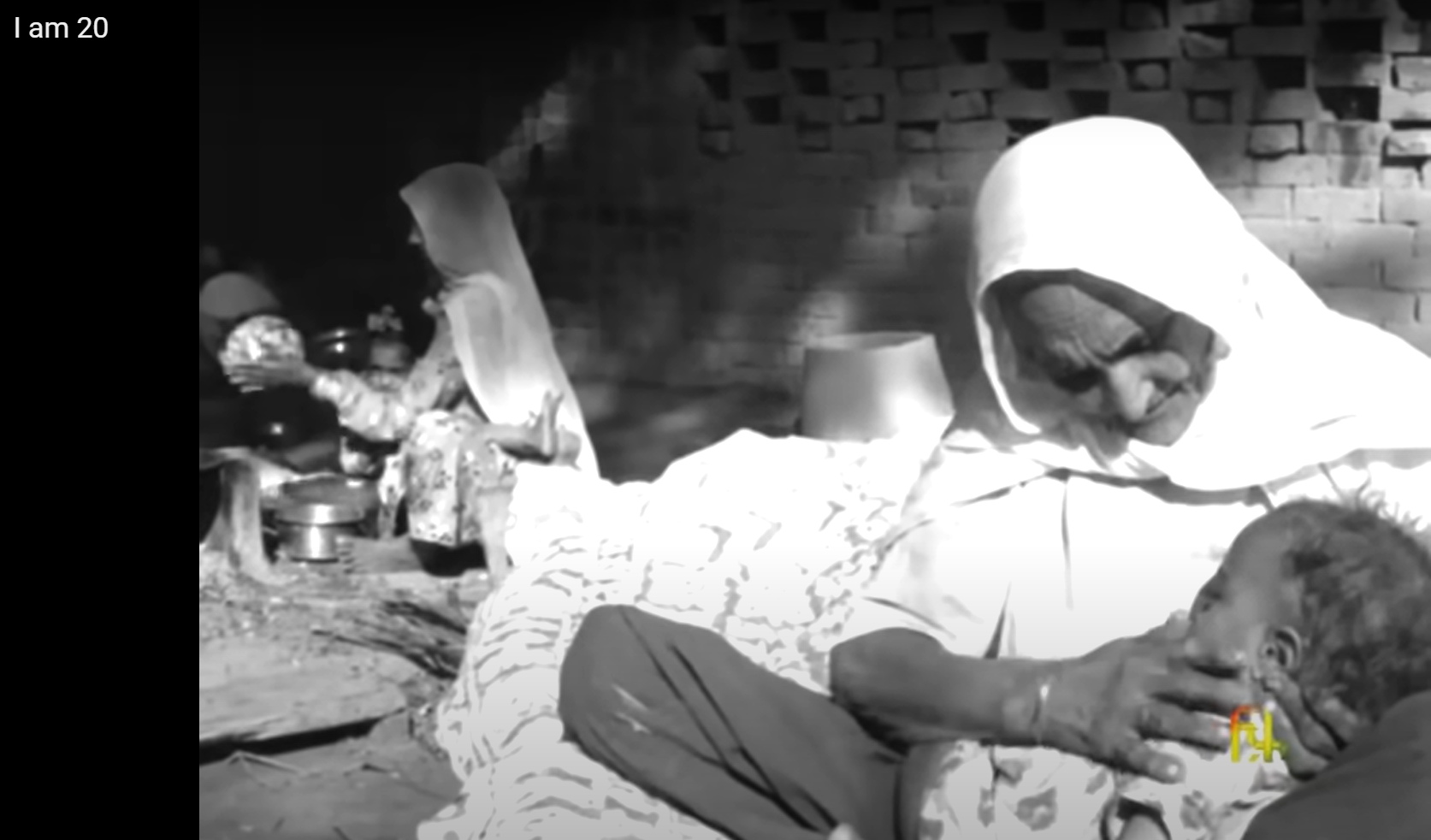
Figure 2. I am 20
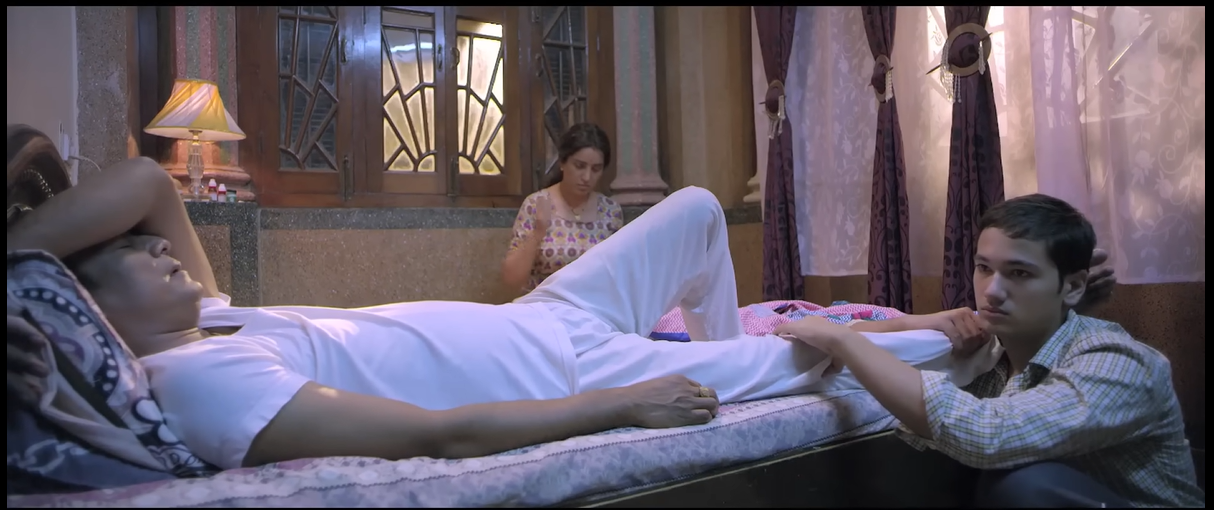
Figure 3. Chutney
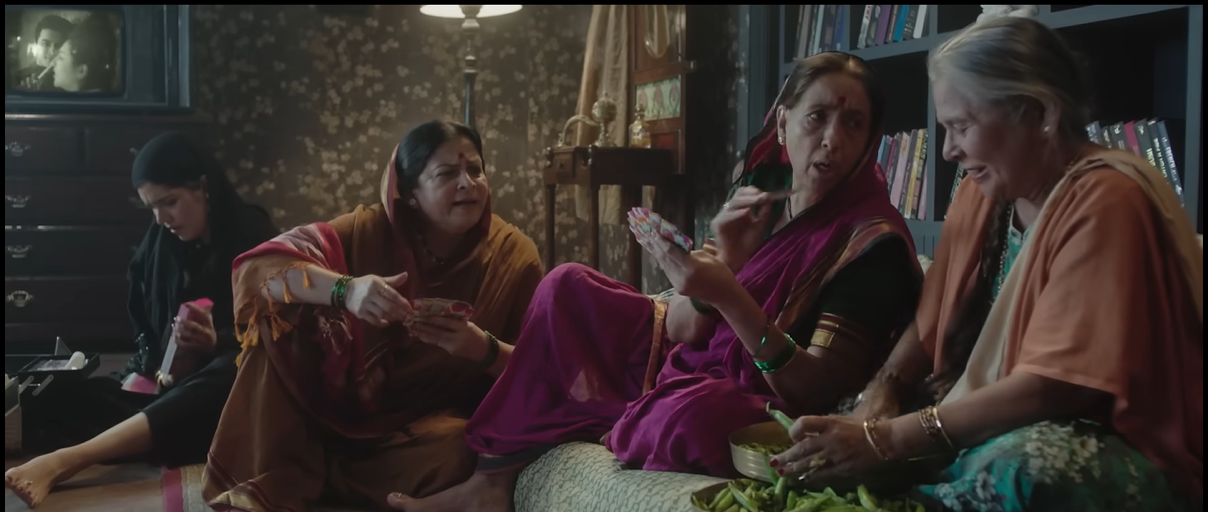
Figure 4. Devi
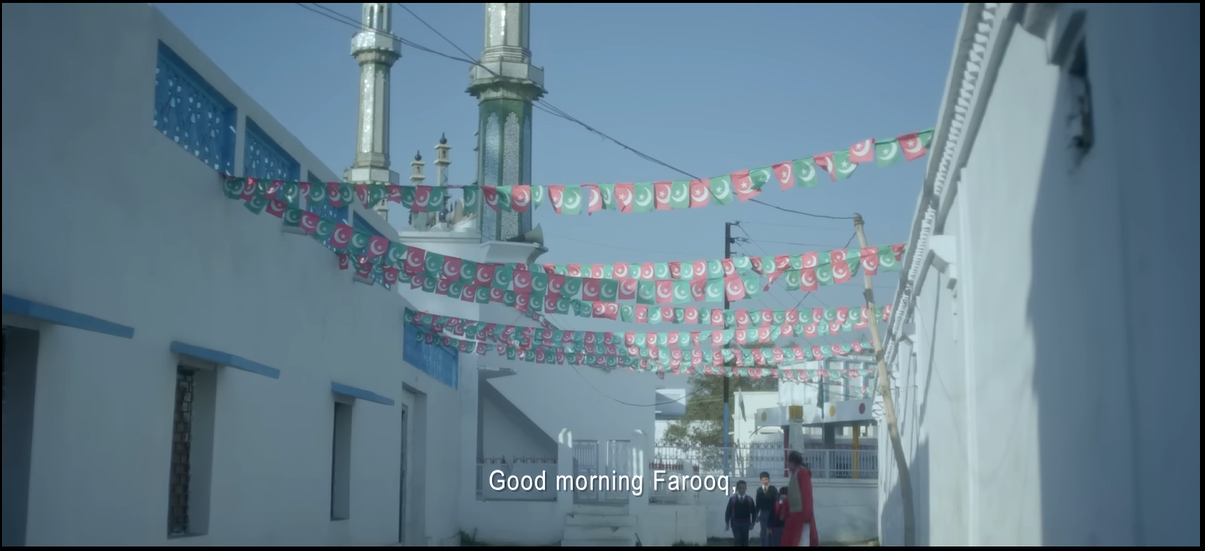
Figure 5. The School Bag
Mise-en-scène
Mise-en-scène including settings, costumes, performances, and staging, shows a clear progression across eras. In the Early Era, mise-en-scène was largely incidental. I Am 20 relied on documentary-style realism, while OP – Stop Smelling Ur Socks used interiors without symbolic layering. Ahalya marked a turning point by integrating costumes, décor, and mythic undertones to construct a stylized atmosphere.
The Mid Era brought deliberate visual design. In Juice, the cramped kitchen symbolized domestic confinement, while Chutney used costume and décor to heighten unease. Khujli relied on comic staging through props, and Rogan Josh employed dining settings to reveal hidden trauma. Regional works like Lakshmi and Tindey used mise-en-scène to embed cultural and caste dynamics, while The School Bag foregrounded sparse spaces as metaphors for loss. The Neighbors’ Window extended this to urban interiors reflecting isolation and desire.
By the Present Era, mise-en-scène became overtly symbolic. In Devi, the crowded room embodied collective resistance, while Kavi highlighted child labour through stark industrial settings. Gond Tribe used rural landscapes to assert marginalized identities, and Umbrella relied on animated palettes to evoke empathy. No Reservations – A Pipeline Comedy satirized consumer spaces, while Sci‑Fi Short Film – Connected merged futuristic staging with minimalist design. Murchison Falls: A Wildlife Adventure used natural backdrops as spectacle, The Broken Table staged memory in domestic interiors, and I’m Not a Robot layered theatrical props with reality motifs. The upward trend shown in Figure 1, based on Bordwell’s Film Art framework, highlights how mise-en-scène evolved from incidental to expressive and deeply layered.
Genre
Genre experimentation has been central to YouTube short films. In the Early Era, films leaned toward slice-of-life realism and comedy. I Am 20 reflected documentary realism, while OP – Stop Smelling Ur Socks used humour and everyday relatability. By Ahalya, mythology was reimagined as a noir thriller, signaling a shift toward hybridisation.
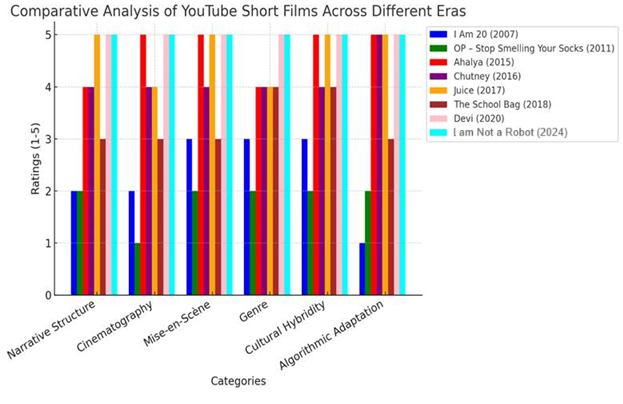
Figure 6. Matplotlib.pyplot Graph: Comparative Analysis of YouTube Short Films Across Different Eras
The Mid Era deepened this blending of forms. Chutney fused melodrama with suspense, Khujli employed comedy for social satire, and Juice mixed realism with a critique of gender roles. Lakshmi added regional melodrama, while The School Bag and Rogan Josh drew on tragedy and psychological tension. Tindey layered romance with caste critique, and The Neighbors’ Window combined urban realism with quiet emotional drama.
In the Present Era, genre intersects with social and technological commentary. Devi functioned as a social drama and chamber piece, while Kavi foregrounded human rights through realist tragedy. Gond Tribe took an ethnographic form, Umbrella used animation to evoke empathy, and No Reservations – A Pipeline Comedy played satire against globalization. Sci‑Fi Short Film – Connected explored futuristic allegory, while Murchison Falls: A Wildlife Adventure employed documentary naturalism. The Broken Table staged memory as domestic drama, and I’m Not a Robot blended allegory, spirituality, and political critique. As shown in Figure 6, generated using Matplotlib, genre innovation steadily increased, with mid- and present-era films consistently rated higher for experimentation.
Cultural Hybridity
Cultural hybridity highlights how these films negotiate between local traditions and global storytelling forms. In the Early Era, shorts such as I Am 20 were grounded in vernacular realism, directly reflecting the social and political conditions of India without global aesthetic overlays.
In the Mid Era, hybridity became more pronounced. Ahalya adapted an Indian myth but staged it through a cinematic grammar drawn from global thriller traditions. Chutney did the same with gothic tropes reinterpreted in an Indian domestic setting. These films combined familiar cultural symbols with globalised forms of storytelling, making them accessible to international audiences while retaining their rootedness.
In the Present Era, hybridity reaches its peak. Devi combined feminist discourse with ensemble storytelling associated with Western dramas, while I’m Not a Robot fused AI iconography with stylised contemporary cinematic technique. Figure 6, generated using Matplotlib, shows the higher cultural hybridity ratings of these present-era films, reflecting their layered negotiation between the local and the global.
Algorithmic Adaptation
Algorithmic adaptation captures how films shape themselves to YouTube’s platform logic. In the Early Era, films like I Am 20 circulated without much thought to thumbnails, metadata, or platform-specific optimisation. The focus was on content rather than visibility.
By the Mid Era, creators began to adapt. The School Bag benefitted from festival recognition and emotional branding, helping it gain algorithmic traction. Similarly, Chutney used promotional posters and paratexts to enhance discoverability.
In the Present Era, adaptation to platform logic is explicit. Devi relied on star power and socially urgent themes to encourage virality. I’m Not a Robot used symbolic titles, eye-catching thumbnails, and high-contrast visuals optimised for YouTube’s algorithmic systems. These examples show how aesthetic and thematic choices are increasingly influenced by the platform’s economic and technological demands. Figure 6, generated using Matplotlib, demonstrates how algorithmic adaptation becomes especially important in the Present Era, marking a sharp contrast with early shorts.
The seismic transformation of short cinema and its ecosystem through YouTube has provided filmmakers with a space in which to develop and interrogate new forms of storytelling within a contemporary media environment. With the continued growth of AI, VR, and algorithmic storytelling, the platform is likely to maintain a critical role in nurturing creativity and redefining how digital cinema engages audiences across the world. At the same time, a major challenge emerges from this evolving configuration: how to preserve legitimate artistic expression amid algorithmic control and the widening tension between technology and human creativity. In this still-emerging digital landscape, YouTube is likely to remain a key experimental space for short films, reshaping contemporary filmmaking in ways that were previously difficult to anticipate.
Quantitative Analysis: Engagement Metrics
The quantitative analysis of audience engagement in this study is based on publicly available YouTube data from the 20 selected short films.
Views and Watch Time
By analyzing data from YouTube videos, the study gains a deeper understanding of the overall reach and audience engagement of the content. The total views and average watch time per video provide valuable insights into how effectively the story and visuals capture viewers' interest. For instance, a higher average viewing duration suggests that a film has successfully held the audience's attention beyond the initial click. This assessment can shed light on the level of audience involvement and the lasting impact of the narrative, offering a more nuanced perspective on the content's performance.
The analysis of engagement data reveals significant trends in viewer behaviour across three eras, Early (2007–2015), Mid (2016–2019), and Present (2020–2024), by focusing on total views and average watch time for all 20 selected videos. These measures shed light on how successfully films from each era attract viewers’ attention and sustain engagement, while also encouraging sharing and emotional response.
During the Early Era (2007–2015), the selected three films achieved approximately 26.8 million views, together with an average watch time of 993 seconds (roughly 16.6 minutes). Although the overall view counts were lower, reflecting the early days of digital film distribution on YouTube, the relatively long viewing times indicate that content creators pursued a deeper, narrative-rich strategy. Even though production resources were more limited during this period, the short films released in it retained features of conventional cinematic storytelling. These short films relied on lengthy formats that allowed viewers to engage with the storyline in a more comprehensive manner.
The Mid Era (2016–2019) saw a notable improvement in viewer involvement. With the average viewing time rising to approximately 1011 seconds (almost 16.9 minutes), the seven short films together attracted about 201.5 million views. This era is characterized by a balance between advanced production quality and compelling narrative form. The longer average watch time and the noteworthy increase in total views demonstrate that directors were able to upgrade their storytelling techniques and production standards, thus capturing and sustaining audience interest with greater precision than in earlier periods.
In contrast, the Present Era (2020–2024) shows a marked shift toward concision and rapid impact. Eight short films from this period gained a total of approximately 76.3 million views, while the average watch time declined to around 833 seconds (roughly 13.9 minutes). Regardless of the overall lower view counts compared to the Mid Era, the reduced watch time reflects modern viewers’ preferences for shorter, more dynamic content that delivers immediate yet still engaging narratives.
A graph-based visualization of these engagement metrics across the three eras vividly illustrates the evolution from traditional, long-form storytelling to the concise, fast-paced style favored by today’s digital viewers.
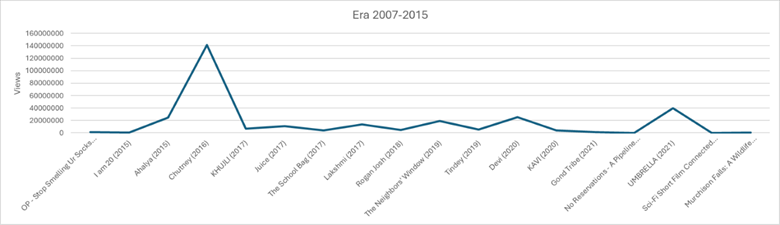
Figure 7. Comparative Analysis of Total Views Across Three Eras of YouTube Short Filmmaking
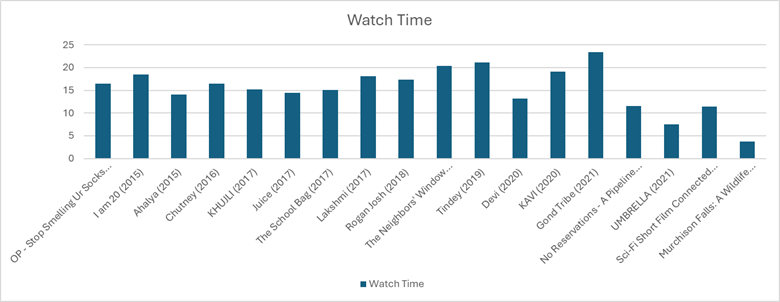
Figure 8. Temporal Trends in Average Watch Time Per Video Across Three Eras
Audience Interactivity Metrics
The study investigates audience interactivity by analyzing the number of likes publicly available on each video’s page. These figures indicate the overall level of audience approval and provide a measure of interactive response.
Within the Early Era, three films, namely OP – Stop Smelling Ur Socks, I Am 20, and Ahalya, received a total of 234,578 likes, averaging roughly 78,000 likes per film. This era reflects the emergent stage of digital film distribution, when audience interactivity was still developing and engagement was modest yet promising.
During the Mid Era, eight films, including Chutney, Juice, and The Neighbors’ Window, amassed approximately 1,581,196 likes, with an average nearing 197,650 likes per film. Enhanced production quality and refined storytelling appear to have contributed to a notable rise in interactive responses during this period.
In the Present Era, seven films, ranging from Devi with 798,192 likes to Umbrella (2021) with 561,925 likes, totaled about 1,415,187 likes, averaging around 202,170 likes per film. Despite higher variability, this era demonstrates an overall uplift in audience engagement, driven by sophisticated content strategies and algorithmic amplification.
The pie chart in Figure 9 presents data on audience preferences for short films based on the number of likes received. The distribution is uneven, with a few films commanding a significant share of likes, while others receive minimal engagement. In particular, Ahalya holds the highest proportion at 25%, followed by The School Bag at 19% and Chutney at 17%. These three films collectively dominate audience preferences, indicating strong narrative appeal or thematic resonance. Conversely, films like I Am 20 and Gond Tribe register 0%, suggesting limited recognition or appeal.
Mid Era films, including Juice and Kavi, maintain moderate engagement at 8%, while others like Lakshmi, Tindey, and Devi remain in the lower range of 3%. The data suggest differences in audience reception, potentially influenced by factors such as storytelling, production quality, or thematic relevance. The dominance of select films implies an audience preference for socially relevant or highly engaging narratives, which may reflect broader cinematic trends.
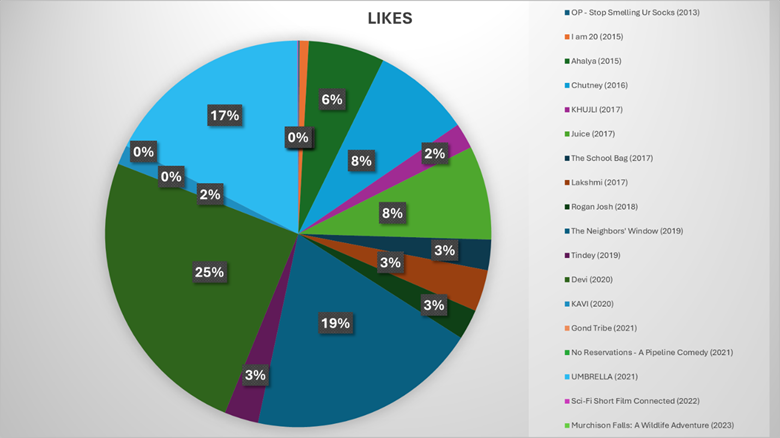
Figure 9. Audience Interactivity Trends Across Three Eras of YouTube Short Filmmaking
Findings & Discussion
YouTube short films underwent a significant evolution from 2007 to 2024, marked by radical changes in narrative structure, cinematography, thematic depth, and audience engagement. While the qualitative analysis traces a shift from experimental and grassroots storytelling to algorithm-driven content, quantitative measures reveal changes in viewership, watch time, and audience engagement. This paper explores how new techniques of digital storytelling and viewer engagement operate, showing how changes brought about by technology and platform algorithms shape trends in content production and consumption.
In the Early Era (2007–2015), YouTube emerged as a space in which raw and experimental storytelling flourished. Works such as I Am 20 and OP – Stop Smelling Ur Socks were defined more by immediacy and experimentation than by tightly structured narratives. Handheld cinematography, low production value, and naturalistic mise-en-scène characterized this period, and the filmmakers engaged audiences through documentary styles and absurd humour. Ahalya introduced a blend of myth and contemporary storytelling. Although the films recorded a total of just over 26.8 million views, the longer average watch time of 16.6 minutes suggests that audiences remained strongly engaged with long-form storytelling. Without algorithmic optimization, virality resulted from organic sharing rather than strategic content placement.
This was followed by the Mid Era (2016–2019), in which content creators gained the capacity to shape their narratives in accordance with platform engagement strategies. It was also the period in which hybrid modes of storytelling developed, combining formal planning, social commentary, and algorithmic adaptation. From the non-linear storytelling and suspense-building techniques of Chutney and Khujli to the minimalist yet powerful narration of Juice and The School Bag, filmmakers increasingly relied on narrative control to draw audiences in. High production value, professional cinematography, and SEO-optimized metadata became critical components of visibility. Total views rose to 201.5 million, while average watch time increased slightly to 16.9 minutes. This combination of social relevance and strategic optimization was reflected in increased likes, shares, and comments, which further reinforced audience engagement.
The Present Era is often framed in terms of technological innovation, AI‑enhanced storytelling, and the future of immersion and interactivity. At the same time, films such as Devi, Lakshmi, and Juice are representative of a broader body of work focused on women’s empowerment and critiques of caste. Meanwhile, Connected and I’m Not a Robot demonstrate an increasing reliance on artificial intelligence in film production, reducing costs while maximizing efficiency and visual appeal. Virtual reality, digital landscapes, and algorithmic optimization further reinforce these tendencies.
In summary, the quantitative analysis establishes significant trends in audience behavior and shows how content optimization affects engagement. Earlier films had lower view counts but higher watch times, while Mid Era films leveraged structured narratives combined with effective algorithmic amplification to reach wider audiences. Even though contemporary films are becoming more technically sophisticated, they also face declining watch time because of viewers’ shifting preferences toward shorter, more engaging content. Overall, the findings indicate that digital storytelling has shifted from depth to accessibility and from sustained viewing to instant impact, reflecting the changing nature of online content consumption.
To further visualize the comparative analysis of short films uploaded on YouTube in different eras, the graphs generated using the pyplot module in Matplotlib represent key trends related to views, watch time, and audience engagement. These graphs provide a clear illustration of how digital storytelling on YouTube has transformed across eras.
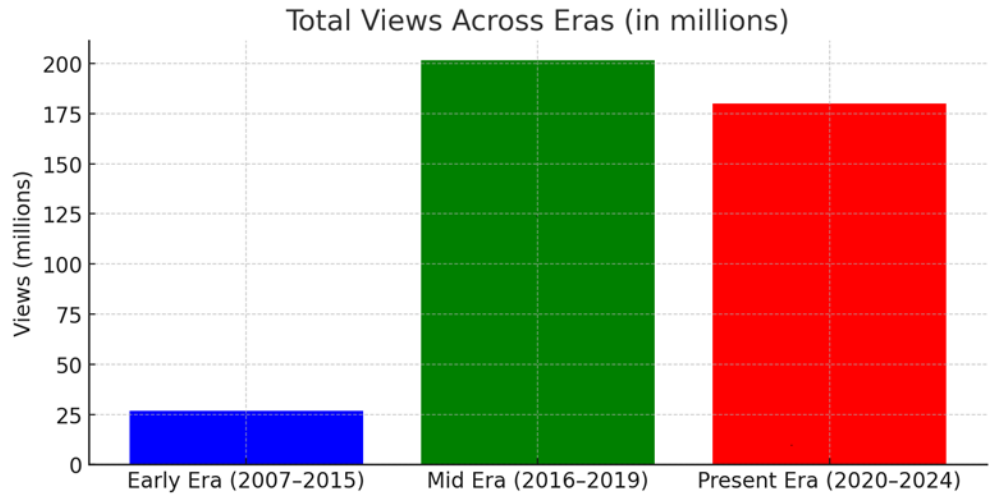
Figure 10. Total Views across Eras
The table gives a picture of the total views garnered by short films across different eras. During the Mid Era (2016–2019), there was an explosion in the number of views as a result of improved production quality, algorithmic promotion, as well as cross-platform circulation. The Present Era (2020–2024) shows a decrease in that regard, which reflects changes in patterns of viewer consumption and competition from other emerging forms of content.
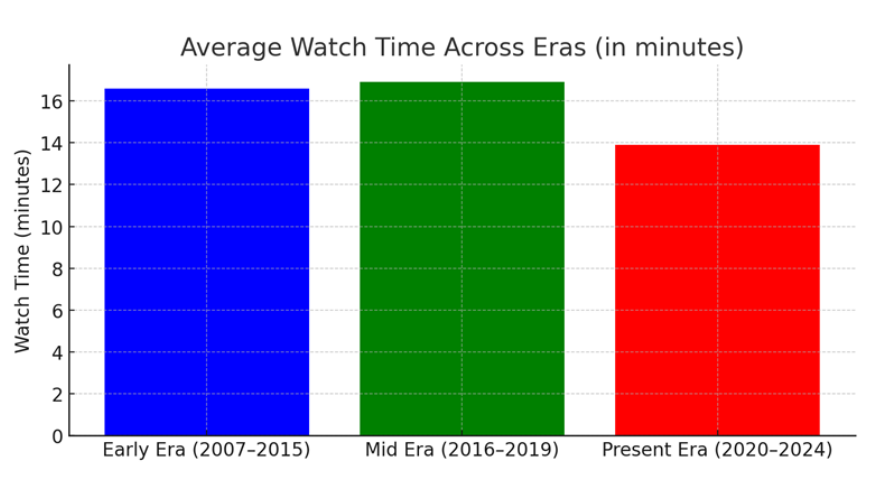
Figure 11. Average Watch Time across Eras
Trend-wise, long narratives were able to hold viewer attention in the Early Era (2007–2015), though Mid Era narratives began to carve out a more engagement-focused structure. Presently, shorter content has led to reduced average watch time despite high viewer engagement.
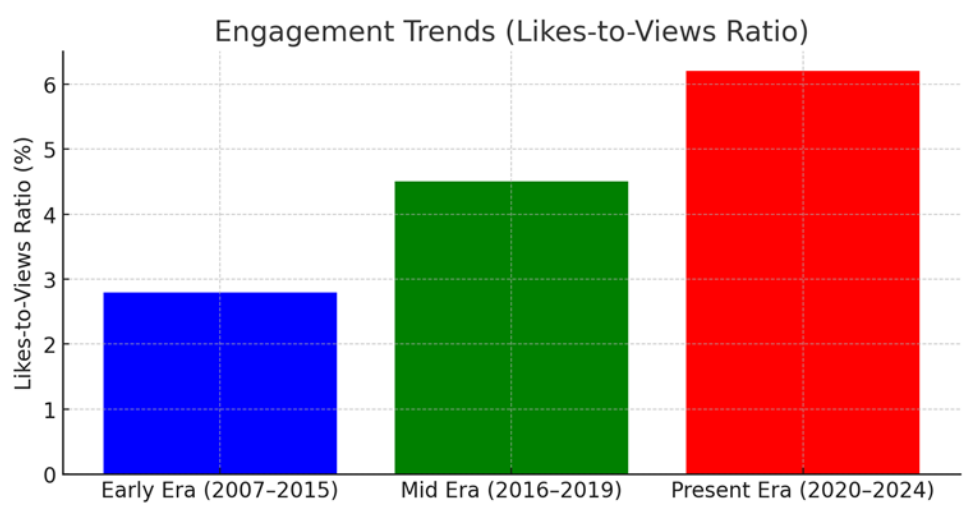
Figure 12. Trends of Engagement (Likes-to-Views Ratio)
This measure captures audience interaction in terms of the likelihood of a film being watched relative to the total number of views over time. The Current Era (2020–2024) records the highest engagement rate, which may imply that while watch time may be lower across the board, audiences are still enjoying fast-paced, immersive, and socially relevant storytelling. They solidify the transition from unfiltered, grassroots storytelling in the Early Age to highly professionalized, algorithm-directed productions in the Present Age.
Conclusion & Future Directions
In today’s digital age, YouTube has developed not only as a medium for creative experimentation but also as a gatekeeper enforcing algorithmic norms, thereby shaping the course of Indian short filmmaking in significant ways. Since the inception of YouTube, the researchers have divided the last 18 years into three distinct periods: 2007–2015, 2016–2019, and 2020–2024. This classification reveals several important developments, including the evolution of narrative structures from raw, simple, linear, documentary-style productions toward intricate, complex, data‑driven storytelling attuned to audience retention. Early releases such as I Am 20 and OP – Stop Smelling Ur Socks highlighted unfiltered authenticity, realism, rawness, and community sharing, whereas mid-era short films like Ahalya and Chutney featured non-linear plots, suspense and thriller elements, and layered symbolism to prolong engagement. In the contemporary era, filmmakers utilize AI‑assisted personalization, ensemble casts, and narrative hooks designed to reinforce the algorithms. This demonstrates how aesthetic decisions now serve dual purposes: as vehicles for artistic expression and as instruments of viral potential.
Cinematography has also reflected this change. Techniques have evolved from handheld cameras to controlled lighting. Filmmakers have advanced from low-resolution footage to DSLR-empowered production values. Today’s short films featured on YouTube not only use symbolic colour palettes but also attractive thumbnails optimized to compel mobile viewers. Mise-en-scène has likewise become strategic. Visual metaphors such as the crowded room in Devi, the confined kitchen in Juice, and the harsh industrial setting in Kavi demonstrate collective resistance and social marginalization. These metaphors function not only as narrative devices but also as visually compelling elements within YouTube’s algorithmic ecosystem.
Significant inequalities are found in the quantitative metrics. Popular productions utilize the influence of famous actors, recognition from film festivals, and detailed platform data to excel in viewership, engagement, and revenue generation. By contrast, regional, tribal, and feminist short filmmakers receive approximately thirty percent fewer impressions. In addition, they encounter systemic barriers even after producing work of considerable cultural importance. This ‘digital caste system’ favors narratives that are appealing to advertisers and centered in urban contexts. As a result, vernacular and socially critical content is pushed to the sidelines. This particular scenario demonstrates the replication of offline hierarchies in online environments as well. Even with these issues and challenges, hybrid techniques and new experiments are pointing towards an equitable future. The richness of themes and narrative is not diluted even after AI-driven metadata optimization. For instance, the short film Devi used the language of the algorithm to achieve virality. In the future, diverse storytelling traditions can gain greater visibility by employing multiple methods, namely improving feed recommendations for regional content, implementing forms of algorithmic affirmative action, and creating decentralized curation platforms. This would also require training filmmakers in best practices for metadata and tuning AI tools for multilingual and culturally specific productions.
New technologies such as AR, VR, blockchain-based distribution, and immersive formats may redefine digital cinema. This process can be promoted through collaboration among policymakers, platform architects, and creative communities. Advocating for innovative forms of narration can balance algorithmic efficiency with cultural sovereignty. YouTube, thus, can fulfill its promise of democratizing film and create an equitable ecosystem in which heterogeneous voices can thrive.
Footnotes
1See https://www.youtube.com/watch?v=nG1lCzCGWkA
2See https://www.youtube.com/watch?v=2oZOOKFTKpE
3See https://www.youtube.com/watch?v=2KP0aDTVtFI
4See https://www.youtube.com/watch?v=0krwKbsQscw
5See https://www.youtube.com/watch?v=fA8h74ZW8Ok
6See https://www.youtube.com/watch?v=VVQP-IpZZaU
7See https://www.youtube.com/watch?v=Ff82XtV78xo
8See https://www.youtube.com/watch?v=0krwKbsQscw
9See https://www.youtube.com/watch?v=KmRzflPuCjE
10See https://www.youtube.com/watch?v=R-Sk7fQGIjE
11See https://www.youtube.com/watch?v=vP5dOY42DKI
12See https://www.youtube.com/watch?v=r06uBlw0zj4
13See https://www.youtube.com/watch?v=EGvHVQHRFG8
14See https://www.youtube.com/watch?v=k1vCrsZ80M4
15See https://www.youtube.com/watch?v=nG1lCzCGWkA
16See https://www.youtube.com/watch?v=DDXx9lEwST8
17See https://www.youtube.com/watch?v=Bl1FOKpFY2Q
18See https://www.youtube.com/watch?v=fTukNLREXxg
19See https://www.youtube.com/watch?v=uEOAFherIzY
References
Bee, J. (2024). Ethnographic Film, Fourth Cinema and Situated Knowledge Practices—From Colonial Film to Collaborative Research. NTM Zeitschrift Für Geschichte Der Wissenschaften, Technik Und Medizin, 32(3), 213–250. https://doi.org/10.1007/s00048-024-00399-w
Benjamin, R. (2019). Race after technology: Abolitionist tools for the new Jim code. Polity.
Berry, D. M. (2025). Synthetic media and computational capitalism: Towards a critical theory of artificial intelligence. AI & Society, 40(7), 5257–5269. https://doi.org/10.1007/s00146-025-02265-2
Bordwell, D., & Thompson, K. (2008). Film art: An introduction. McGraw-Hill.
Bucher, T., & Helmond, A. (2018). The Affordances of Social Media Platforms. In J. Burgess, A. Marwick, & T. Poell, The SAGE Handbook of Social Media (pp. 233–253). SAGE Publications Ltd. https://doi.org/10.4135/9781473984066.n14
Burgess, J., & Green, J. (2013). YouTube: Online Video and Participatory Culture. John Wiley & Sons.
Cunningham, S., & Craig, D. (2019). Social Media Entertainment: The New Intersection of Hollywood and Silicon Valley. NYU Press. https://doi.org/10.18574/nyu/9781479838554.001.0001
FICCI-EY. (2025). Shape the future: Indian media and entertainment is scripting a new story. Ernst & Young LLP & Federation of Indian Chambers of Commerce and Industry. https://www.ey.com/content/dam/ey-unified-site/ey-com/en-in/insights/media-entertainment/images/ey-shape-the-future-indian-media-and-entertainment-is-scripting-a-new-story.pdf
Gagrčin, E., Naab, T. K., & Grub, M. F. (2024). Algorithmic media use and algorithm literacy: An integrative literature review. New Media & Society, 14614448241291137. https://doi.org/10.1177/14614448241291137
Gillespie, T. (2019). Custodians of the Internet: Platforms, Content Moderation, and the Hidden Decisions That Shape Social Media. Yale University Press. https://doi.org/10.12987/9780300235029
Gillespie, T. (2020). Content moderation, AI, and the question of scale. Big Data & Society, 7(2), 2053951720943234. https://doi.org/10.1177/2053951720943234
Gillespie, T. (2023). The Fact of Content Moderation; Or, Let’s Not Solve the Platforms’ Problems for Them. Media and Communication, 11(2). https://doi.org/10.17645/mac.v11i2.6610
Hesmondhalgh, D. (2007). The Cultural Industries. SAGE.
Hockett, M. A. (2019). Get one million views overnight!: How YouTube influences the creation and reception of documentary film [Master’s Thesis, Montana State University - Bozeman, College of Arts & Architecture]. https://scholarworks.montana.edu/handle/1/15573
Jenkins, H. (2006). Convergence Culture: Where Old and New Media Collide. NYU Press.
KPMG. (2022). Media and entertainment budget 2022–23. KPMG International. https://assets.kpmg.com/content/dam/kpmg/in/pdf/2022/02/media-and-entertainment-budget-2022-23.pdf
Mhlambi, S., & Tiribelli, S. (2023). Decolonizing AI Ethics: Relational Autonomy as a Means to Counter AI Harms. Topoi, 42(3), 867–880. https://doi.org/10.1007/s11245-022-09874-2
Pietrobruno, S. (2018). YouTube flow and the transmission of heritage: The interplay of users, content, and algorithms. Convergence: The International Journal of Research into New Media Technologies, 24(6), 523–537. https://doi.org/10.1177/1354856516680339
Rajadhyaksha, A. (2009). Indian cinema in the time of celluloid: From Bollywood to the emergency. Tulika Books. https://doi.org/10.2979/5466.0
Sekarnegara, Z. S. Y., & Handriyotopo, H. (2022). Youtube as an Alternative Medium for Appreciating Independent Short Films. Capture : Jurnal Seni Media Rekam, 14(1), 17–29. https://doi.org/10.33153/capture.v14i1.4056
Srnicek, N. (2016). Platform Capitalism. John Wiley & Sons.
Suwarto, D. H., Annisa, F., & Kulau, F. (2023). Utilizing YouTube for The Local Film Culture Expansion. Komunikator, 15(2), 156–166. https://doi.org/10.18196/jkm.19229
Tong, Y., Zhang, Z., & Wang, Y. (2025). “Making” Rural Elites: Empowerment of Chinese Rural “Public Affairs Live Streamers” on Short Video Platforms. Journalism and Media, 6(2), 58. https://doi.org/10.3390/journalmedia6020058
van Dijck, J., & Poell, T. (2018). Social media platforms and education. LondonSAGE reference. https://dare.uva.nl/search?identifier=f9922723-96c4-414c-a0d9-903fd28f2a02
Van Dijck, J., Poell, T., & De Waal, M. (2018). The Platform Society (1st ed.). Oxford University PressNew York. https://doi.org/10.1093/oso/9780190889760.001.0001
Vizcaíno-Verdú, A., Aguaded, I., & Contreras-Pulido, P. (2021). Understanding Transmedia Music on YouTube through Disney Storytelling. Sustainability, 13(7), 3667. https://doi.org/10.3390/su13073667
Xiang, Y. (2022). YouTube and the protocological control of platform organisations. Qualitative Research in Accounting & Management, 19(3), 348–372. https://doi.org/10.1108/QRAM-04-2021-0060
Yan, Y., He, Y., & Li, L. (2023). Why time flies? The role of immersion in short video usage behavior. Frontiers in Psychology, 14, 1127210. https://doi.org/10.3389/fpsyg.2023.1127210
Zimmermann, D., Noll, C., Gräßer, L., Hugger, K.-U., Braun, L. M., Nowak, T., & Kaspar, K. (2022). Influencers on YouTube: A quantitative study on young people’s use and perception of videos about political and societal topics. Current Psychology, 41(10), 6808–6824. https://doi.org/10.1007/s12144-020-01164-7