A Content Analysis of Mission and Vision Statements: Mapping the Strategic Focus of Nigerian Universities
University of Port Harcourt (Port Harcourt, Nigeria).
Email: becoolholly[at]gmail.com
 0000-0003-4163-7756
Abstract
Universities are regarded as citadels of learning in which education and research stand as the foundation of their activities. Among all these activities, universities prioritize being public-oriented, giving opportunities to those who cannot afford their services to participate in learning, research, and economic development. Nigerian universities have contributed to the development of the nation through the training of students who have graduated into important positions all over the world. One of the ways universities communicate their intentions and values is through mission and vision statements. This study attempts to understand how Nigerian universities prioritize their activities and future aspirations by analyzing the content of their vision and mission statements. Using content frames that investigate teaching and training, scientific research, and public interest, this study analyzes the mission and vision statements to understand the prevalent categories in Nigeria. The research was limited to federal universities in Nigeria. The results showed that the Northwest region had the highest number of federal universities (16) and the Southeast region the least (7). The findings revealed that most federal universities prioritized public interest in their mission statements (40.74%), while scientific research received the least attention (22.22%). In their vision statements, the focus was primarily on teaching and training (41.51%), with public interest receiving the lowest priority (26.42%) among federal universities. The study confirms that Nigerian universities, similar to their global counterparts, prioritize scientific research and teaching and training students. However, they should also focus on enhancing their public interest activities, as reflected in their mission and vision statements.
Keywords
Mission and Vision Statement, Mission Statement, Vision Statement, Education, Nigeria, Universities, Research, Public Service, Teaching and Training, Content Analysis
Контент-анализ заявлений о миссии и видении: картирование стратегических приоритетов нигерийских университетов
Университет Порт-Харкорта (Порт-Харкорт, Нигерия).
Email: becoolholly[at]gmail.com
0000-0003-4163-7756Аннотация
Университеты традиционно рассматриваются как «цитадели знания», в деятельности которых образование и научные исследования выступают базовыми основаниями. Среди многообразия функций они также декларируют ориентацию на общественные потребности, предоставляя возможности участия в обучении, исследованиях и экономическом развитии тем группам населения, которые не могут в полной мере оплатить соответствующие услуги. Нигерийские университеты внесли существенный вклад в развитие страны, осуществляя подготовку специалистов, многие из которых впоследствии заняли значимые позиции в различных странах мира. Одним из ключевых инструментов, посредством которых университеты артикулируют свои намерения и ценностные установки, являются заявления о миссии и видении. Настоящее исследование направлено на выявление того, каким образом нигерийские университеты расставляют приоритеты в своей деятельности и формулируют представления о будущем, на основе контент-анализа их миссий и видений. Используя аналитические рамки, ориентированные на три аспекта — «преподавание и подготовка кадров» (Teaching-Training), «научные исследования» (Scientific Research) и «общественный интерес» (Public Interest), — авторы анализируют соответствующие тексты с целью определить доминирующие категории в нигерийском контексте. Эмпирическая база исследования ограничена федеральными университетами Нигерии. Полученные результаты показывают, что наибольшее число федеральных университетов сосредоточено в Северо-Западном регионе (16), тогда как наименьшее — в Юго-Восточном (7). Анализ миссий выявил, что большинство федеральных университетов в наибольшей степени акцентируют общественный интерес (40,74%), тогда как научным исследованиям уделяется наименьшее внимание (22,22%). В заявлениях о видении, напротив, преобладает фокус на преподавании и подготовке кадров (41,51%), а общественный интерес получает минимальный приоритет (26,42%) среди федеральных университетов. В целом исследование подтверждает, что нигерийские университеты, подобно университетам в других странах, выделяют в качестве приоритетов научные исследования, а также обучение и подготовку студентов. Вместе с тем им целесообразно усиливать общественно ориентированную компоненту деятельности, более последовательно отражая её в формулировках миссии и видения.
Ключевые слова
заявление о миссии и видении, заявление о миссии, заявление о видении, образование, Нигерия, университеты, научные исследования, общественное служение, преподавание и подготовка кадров, контент-анализ
Introduction
Scholars envision universities as important actors in socio-economic development, mainly through the generation of skilled labor and research that responds to market and societal demands (Hailu, 2024; Vergani, 2024; Zaidan & Momani, 2024). Yet within this premise, responsibilities may include instituting new institutions, nurturing and moulding new cultural values, and educating and socializing members of newly emerging social elites, especially during periods of significant transformation. This was highly evident during the COVID-19 pandemic, when the world turned to universities and research institutions in the quest to find vaccines and cures to combat the virus (Ling, 2020; Ndinojuo, 2020). Historically, universities have been associated with social development and are acknowledged to fulfill three principal functions: education and training, research, and public service, usually encapsulated in their mission and vision statements (Abo-Khalil, 2024; Bamiro, 2024; Huang, 2024). The functions of universities extend to advocacy within educational, scholarly, and technological domains (Huang, 2024); their instructional practices are designed to develop managerial competencies and disseminate knowledge that facilitates personal and professional development (Enstroem & Schmaltz, 2024; Wang et al., 2024). The role of universities has implications for all sectors from both social and legal viewpoints. Their main role is to produce highly skilled individuals who use research findings to attain specified goals. Universities may also facilitate the creation of creative community groups, foster new societal ideals, and academically and culturally prepare people for a new socioeconomic future (Enstroem & Schmaltz, 2024; Wang et al., 2024). The establishment of mission and vision statements is a strategic action within the highly competitive environment of higher education institutions that precisely clarifies the objectives to be pursued in alignment with all major stakeholders, including students, faculty members, and donors (Kosmützky & Krücken, 2015; Kotler & Murphy, 1981).
Thus, these statements are among the most critical tools for strategic communication, being extremely market-oriented and thus also widely disseminated in higher education institutions beyond mere planning documents. Rather, they are primary media texts by which universities construct their public identity (Kosmützky & Krücken, 2015; Kuenssberg, 2011). This study also frames mission and vision statements within the purview of media studies and examin es them as objectified narrative artifacts from university websites that are intended to enhance public perception. The texts are situated as the foundational promise for a university's brand impact, geared towards platform logic (van Dijck et al., 2018), where visibility, distinctiveness, and legitimacy are paramount. They also function as instruments of media strategy and digital identity, gaining their fullest expression through publication on institutional websites and in official documents. Therefore, this study can be understood as an examination of how Nigerian federal universities negotiate their role and image in the public space of citizenship from within multiple sites in the national and international academic environments.
Universities have traditionally functioned as educational institutions that conduct scientific research, address national concerns, cultivate qualified professionals in critical fields, and significantly contribute to the advancement of democratic principles and independent thinking. In this view, universities are considered institutions that lead efforts for social reform. Universities, as they transform society, are at the forefront of change since they are required to be agents of transformation (Gasset, 1998; Karakütük, 2006; Kavak, 1990; Sönmez, 2003; Türel, 2004). Gürüz et al. (1994) propose categorizing the functions of contemporary universities into teaching, original scientific research, community service, and the development of a skilled workforce. Alternatively, they argue that we might categorize universities based on their societal functions, such as research institutions or mass instruction providers. Mission and vision statements are strategic documents that articulate an institution's core purpose and aspirational future direction (Cowley & Domb, 2012; Dinçer, 2006). They emphasize the image the institution aims to cultivate, predicated on its societal role via partnerships with the sector. Etzkowitz and Leydesdorff (2000) emphasize the important role of university-industry collaboration in fostering innovation and knowledge exchange, which is crucial for socioeconomic development. The study primarily examines the mission and vision statements of Nigerian federal universities to ascertain their prioritization of educational and research initiatives in conjunction with public-oriented agendas. The objective of this research is to conduct a content analysis of such statements and to determine the dominant themes and modalities of relationship within teaching and training, scientific research, and public interest in terms of how these institutions frame their strategies vis-à-vis their priorities and possible aspirations.
Many Nigerian federal universities operate under extraordinarily difficult circumstances. It is at least one of the most important determining factors of an institution's strategic priorities. Two critical constraints shape these institutions: the massification pressure propelling exponentially increasing student populations on one hand, and chronic underfunding on the other, thereby creating tension between the pursuit of excellence in research and teaching mandates (Gambo & Fasanmi, 2019; Wahab, 2022). An additional pressure on research capacity facing institutions is the acute and continuous “brain drain.” Competent academic personnel are drawn away by the promise of greener pastures far removed from where such personnel would be most useful in the production of knowledge (Ajoseh et al., 2024; Akinwale et al., 2023). The local conditions that determine this operating environment are characterized by severe local challenges such as poverty, insufficient infrastructure, and security problems (Fagbemi et al., 2022; Ndinojuo, 2024). In that environment, certain fundamental questions arise with respect to how universities view and implement their roles in the “public good,” as opposed to universities in the Global North. Added to such catastrophes are tremendous policy pressures from national regulatory bodies like the National Universities Commission (NUC), which wield vast power over the institutional agenda. The study thus posits that the mission and vision statements of these universities cannot be generic but must instead be strategic statements directing how institutions conduct themselves in relation to their contexts, which are marked by severe constraints and high social demand. The discourse of this paper is that an analysis of such statements can bring to the fore negotiated priorities and inherent tensions that Nigerian federal universities contend with in defining their roles between global academic models and immediate local imperatives.
The originality of this study rests in its attempt to go beyond mere generic categorization and interrogate how the mission and vision statements of Nigerian federal universities reflect a strategic negotiation between the idealized tripartite mission of universities (viz. teaching, research, and service) and the stark realities of the Nigerian socio-economic and educational landscape. It details the contradictions in how they frame their public service versus knowledge generation roles. The study distinctly highlights inconsistencies between mission and vision statements with regard to prioritizing public interest versus scientific research, offering a clearer appreciation of strategic communication in Nigerian higher education. The study has three key objectives:
-
To examine if Nigerian universities have mission and vision statements.
-
To categorize the mission and vision statements of Nigerian universities in connection with teaching and training, scientific research, and public interest.
-
To determine if there is a statistically significant difference in how Nigerian federal universities prioritize teaching and training, scientific research, and public interest in their mission statements as compared with their vision statements.
Mission and Vision Statements in Universities
The mission and vision statements of educational institutions have long been considered both sacrosanct and strategic to planning, research, and development in the fields of study covered by the institutions (Kotler & Murphy, 1981; Cortés Sanchez, 2018). Cochran and David (1986) conducted some of the earliest studies to understand the content of mission and vision statements as well as their effect on corporate communication in schools. Other scholars added their voices to the growing field: Orwig and Finney (2007) evaluated the mission and vision statements of various types of academic units, such as AACSB-accredited business schools; Fitzgerald and Cunningham (2016) investigated technology transfer offices; while Wedrich et al. (2012) surveyed ophthalmology departments.
The purpose of mission statements is to guide the process of strategic planning and positioning an institution to make it stand out from others. The mission statement describes what the organization aspires to be and who it serves. Mission statements describe an organization's purpose and strive to unite disparate components of the organization behind a common agenda, give strategic orientation to the organization, and ensure that resources are employed within this framework (Erkan, 2008). According to DPT's (State Planning Organization) (2006) Guide for Preparing a Strategic Plan, mission statements must include the rationale for an organization's existence, whom the organization serves, the field in which it works, the needs it addresses, and the legal requirements of the organization (DPT, 2006). Mission statements should be concise, precise, and passionate. They should explain the organization's goal, identify the persons and organizations served, indicate the organization's scope of operation, specify the needs met by the organization, and express the organization's legal obligations (DPT, 2006; Erçetin, 2000; Özdem, 2011).
Vision is the institution's forward-looking view of the future. It represents a clear understanding of actual and future positions. It suggests a purpose for an institution, having influence on all aspects of institutional life, and is more recently recognized as a vital element of strategic management for today's society. Dinçer (2006) defines a vision as an institution's desire and habit of behavior. A vision is the result of a rational and logical mind's search for solutions to create an ideal future. The vision of an institution should be pragmatic, cost-effective, technologically based, ambitious, and managerial, taking into account possible social challenges and being founded on its capacity and resources (Mazzucato, 2018). While developing their ideas, institutions should not follow a fanciful goal or dream. A strategic vision should push the institution to design its actions and provide energy for its plan (Thompson & Strickland, 1999). According to Thompson and Strickland (1999), the best vision statements are those that provide clear guidance for the institution's operational orientation. A vision statement, according to Cowley and Domb (2012), provides inspiration and authority to everyone working in the company. In summary, a vision statement is a mechanism for a business to reflect on its future and foresee its goals, transforming it into a brand promise. Furthermore, Kotter (2012) defined vision as an organization's prognosis of its future position, and a vision statement as an open or implicit articulation of the reasons for pursuing such a future to the members of that institution.
A university's mission and vision statement delineate its objectives and serve as a framework for all personnel associated with the institution of higher learning. A mission and vision statement establish the significant objectives to be achieved by the university's management. The mission and vision articulate the institution's purpose and clarify its intended course of action for staff members and various stakeholders. It is the ultimate expression of the institution's commitment to itself and to its publics. The need for a vision and mission statement to be reviewed during the process of accreditation just underscores how significant they are. In most cases, these are evaluated at the beginning of the evaluation, along with the policies, procedures, and guidelines implemented in the institution, because they are the fundamental first step in the governance and administration of the institution itself. Although universities' mission statements and visions often compartmentalize the role of the university under the categories of teaching, research, and service, a substantial literature argues that this really needs to be seen as an interconnected whole, particularly with reference to the deep commitment to the community.
This notion, sometimes referred to as the “scholarship of engagement” (Assié-Lumumba, 2017; Boyer, 1996), posits that teaching and research are not opposed to public service; rather, they are the foremost instruments of public service. Community engaged learning pedagogies embed service into the curriculum, thus converting teaching into an immediate public good (Bringle & Hatcher, 1995; Tijsma et al., 2023). Applied and action research, along similar lines, attend to local problems, thus making research a primary means for community development (Checkoway & Richards-Schuster, 2004; Ozer et al., 2010). Thus, the present study employs a categorical framework strictly for analytical expediency, with the awareness that ideally, these domains should be acting synergistically, though in much of the literature, they are viewed as separate. The present analysis seeks to explore how Nigerian universities rhetorically frame these priorities within a particular national context in which resource limitations may impinge upon the effective operationalization of such integration.
Velcoff and Ferrari (2006) surveyed 35 management staff at universities to ascertain how their universities’ mission statements aligned with university operations. They discovered a link between mission statements and university activity. Morphew and Hartley (2006) did a comparative analysis of the mission and vision statements of public and private institutions. They found that few elements appear more frequently than others and that there was a predominance of components that were explicitly tied to service delivery. According to Atkinson (2008), universities' mission and vision statements function as cultural-cognitive indicators, or conceptual identifiers of social unity, shared views, and human cooperation. While Adams and Zanzi (2006) see other goals, including technical infrastructure and national development, as the basis for research progression, Paul and Elder (2008) underline the need for critical thinking for scientific growth. According to the findings of research conducted by James and Huisman (2009), the mission statements of institutions of higher learning were not compatible with regional strategies and were not in line with market goals. Özdem (2011) investigated the mission and vision statements of public universities in Turkey and discovered that the most common mission statement centered on the education of a skilled workforce, whilst the vision statements most frequently focused on the research role.
Firmin and Gilson (2009) examined 107 university/college mission statements and discovered that the most prevalent subjects were educational concerns, religion, culture, lifestyle, and institutional identity, and confirmed that universities expressed their reason for existing through mission statements. Kosmützky and Krücken (2015) restate that mission and vision statements enable universities to position themselves in specific niches and competing contexts with institutions offering similar functions. As a result, are these cultural-cognitive factors present in different institutions? Are universities, on the other hand, utilizing their mission and vision statements to distinguish themselves from other similar institutions? Conversely, this drive for niche positioning can result in homogenization. Kuenssberg (2011) contends that many statements project a generic image of similarity and overlook critical institutional specificities.
Through the examination of vision and mission statements, Olusola and colleagues critically appraised strategic intention with reference to the top ten universities in Nigeria ranked by Times Higher Education in Olusola et al. (2022). They found that vision statements tended to focus on global influence with an emphasis on research, while mission statements were usually longer than vision statements and provided more information about the universities' purposes and goals. Their research provides insight into how leading African universities position themselves strategically and communicate their long-term objectives through their vision and mission statements. Asiru and Oludare (2015) discussed the rhetorical and stylistic features of vision and mission statements from selected universities in Northwest Nigeria. Their study aimed to understand how these features impact the perception, acceptance, and patronage of the Northwest institutions locally and internationally. The study employs a combined approach of linguistics and literary studies, utilizing a relevance-theoretical framework to analyze rhetoric and style in the collected data; the statements were found to include many rhetorical devices: compounding, heading up, backgrounding, and phrases, with a purposeful deployment of these devices to promote the institutions and gain patronage domestically and internationally. Rhetorical and stylistic features are of fundamental importance in shaping the perception of and attraction toward higher education institutions as expressed in their vision and mission statements.
Bakare (2021) delves into the relevance of mission and vision statements to Nigerian universities and their impact on the future of higher education. The researcher argued that vision and mission statements would serve as essential strategic planning tools for organizations because they articulate their purpose and long-term objectives. These declarations guide and focus on the activities and development of universities. The study, therefore, identifies the problems confronting Nigerian universities in the 21st century with respect to how appropriately framed mission and vision statements could assist institutions in negotiating some of these complexities. For instance, in analyzing a study involving several Nigerian universities, the research stresses that Nigerian universities must evolve clear, concise, and inspiring vision and mission statements appropriate for the demands of the 21st century, with these serving as a guiding path for strategic planning, resource allocation, and decision-making processes within the institutions.
Idowu-Faith (2023) offers an exposition of what are described as linguistic and stylistic features found in first-generation private universities in Nigeria. Such examination was done using Systemic Functional Linguistics as a theoretical framework with which to profile the peculiarities of language in the vision and mission statements of Nigeria's first-generation private universities. The scope of analysis was wide, including lexical choices, grammatical structures, rhetorical devices, and thematic organization. This research contributes to understanding how language is strategically used by the selected private universities to position themselves and communicate their unique identities. The study findings reveal that the configuration of linguistic resources in these vision and mission statements revolves around five main themes: high self-ranking, which suggests that the universities use language that positions them as top-tier institutions. They likely employ words and phrases that emphasize their excellence, leadership, and superiority in the field of education; a commitment to quality research indicates that these universities prioritize and highlight their commitment to producing high-quality research outputs; teaching and learning, which reflects the institutions' emphasis on their core educational mission.
Most likely, language indicates commitment to quality education and conducive learning environments; community service indicates that such universities regard their role as extending beyond their campuses; with many of these universities being religious-affiliated, the emphasis on spiritual development in their vision and mission statements is therefore highly pronounced, with this theme signifying the institutions' construed commitment to developing students not only intellectually, but also spiritually. Notably, the study results indicate that these universities carefully elaborate their vision and mission statements in order to portray a clear image beyond excellence in academics, research, and community service by also including spiritual growth, reflecting the important nature of this role played by the universities in Nigeria. As Bakare (2021) spoke about how statements are implicated in the 21st-century challenges, and Idowu-Faith (2023) analyzed linguistic features in the universities of private studies, this research, for the first time, directs attention to a comprehensive and comparative analysis of the content based on the priorities of the federal institutions themselves, the very backbone of national higher education policy.
Mission and Vision Statements as Mediated Communication
Mission and vision statements belong to an important subset of institutional documents that serve a managerial and administrative purpose. In relation to global competitiveness, these statements enable universities to manage their own reputations and expectations (Kraaijenbrink, 2021; Sakellarios & Gann, 2024). This perspective takes its cue from theories of “mediatization” (Hjarvard, 2013; Jansson, 2018; Kermanshahi et al., 2024), according to which media logic increasingly shapes how institutions communicate with one another and what they have to say about each other. The presentation of these statements on university websites further supports them in different ways, while also affording and constraining what can be said, how it can be said, and whether it is presented as HTML text or embedded in a PDF brochure.
The linguistic features of these statements have also been analyzed, and existing studies have established their rhetorical character, while showing that their intent is largely persuasive. Asiru and Oludare (2015), for instance, reported the use of rhetorical devices in the statements of Nigerian universities in terms of “promoting the institutions and gaining patronage.” Idowu-Faith (2023) further showed how private universities used language to position their institutions as elite. The present study extends this line of inquiry by moving from what is prioritized in these statements to how such priorities are rhetorically constructed for key audiences—prospective students, government agencies, international partners, and the public. The current study builds on this foundation by content analyzing such prevalent themes and, thus, providing the quantitative groundwork for deeper future discursive and platform-specific analysis of how Nigerian federal universities' strategic narratives are mediatized.
Methodology
The research used a content analysis methodology to investigate the mission and vision statements obtained from the websites of Nigerian universities. This study was limited to all the federal universities in Nigeria as listed by the Nigerian Universities Commission (NUC), the agency tasked with regulating the operations of universities in Nigeria. Federal universities are those under the regulation and supervision of the Federal Government of Nigeria through the Ministry of Education and other federal agencies like the NUC. Other types of universities in Nigeria are state universities, those controlled by state governments, and private universities, those owned by private individuals and religious institutions. The study adopted a census design that included all the federal universities in Nigeria for the content analysis. Data about the number of federal universities in Nigeria were collected from the NUC website between January 2024 and August 2024.
The unit of analysis for this study was the full text of each university's official mission and/or vision statement as published on its website. Where statements were combined (e.g., FULAFIA, MAUTECH, NAU), the entire text was analyzed. Data were collected between January 2024 and August 2024. For universities with missing statements, three separate attempts were made to access the website over this period before classifying them as unavailable. Photographs, audio and video recordings, reports, press releases, and other forms of communication on the universities’ websites were ignored. Semantic content analysis was used to analyze the mission and vision statements. The universities' official websites were searched for mission and vision statements.
The analysis followed a directed content analysis approach (Hsieh & Shannon, 2005), using the pre-defined framework of Gözükara (2015), which categorizes university roles into: (1) teaching-training, (2) scientific research, and (3) public interest. A preliminary codebook was developed (see Table 8) with operational definitions and key indicator terms for each category. For example, statements were coded as “teaching-training” if they contained terms related to pedagogy, curriculum, knowledge transmission, student development, or skilled human capital (e.g., “provide quality education,” “train leaders,” “develop skilled graduates”). Statements were coded as “scientific research” if they emphasized discovery, innovation, knowledge production, or publication (e.g., “advance knowledge through research,” “foster innovation,” “contribute to scientific discovery”). Statements were coded as “public interest” if they highlighted community service, societal development, addressing national challenges, or engagement (e.g., “serve the community,” “solve societal problems,” “contribute to national development”). Crucially, each statement was allowed to be coded for multiple categories if its content addressed more than one core function.
The primary categorization for Table 3 was assigned based on the dominant theme of the statement. A detailed codebook with operational definitions and example phrases was developed to ensure consistent application of the three core categories (see Table 8). The quantity of messages in each sub-category represented by the universities in their mission and vision statements was calculated and shown in both frequency and percentage.
Statements were multi-coded to account for the full semantic content; however, for purposes of summary classification in Table 3 and the subsequent chi-square test, each statement was attributed in condensed form to a single dominant theme according to the major point of emphasis in its rhetoric. This condensation necessarily simplifies data that are inherently multilinear and multifaceted. A sensitivity analysis or multi-dimensional scaling could be a valuable focus for future research to account for this complexity.
A representative selection of statements from the data, consisting of 20% of the data set (n = 11), underwent co-coding by another trained researcher applying the codebook independently. Intercoder reliability was calculated using Cohen's Kappa (κ), which accounts for agreement by chance. The resulting Kappa score of κ = 0.81 indicates a high level of agreement according to Landis and Koch's (1977) benchmark. Examining further, the category reliability scores were also strong (teaching-training κ = 0.85; scientific research κ = 0.78; and public interest κ = 0.80). Any discrepancies in coding were discussed and resolved by the two researchers, leading to a refinement of the codebook definitions before proceeding with the full analysis.
To assess the robustness of our dominant theme classification, we conducted a sensitivity analysis comparing the condensed classification (single dominant theme per statement) against the full multi-coded data. When considering all present themes rather than just the dominant one, the relative emphasis shifts: public interest appears in 78% of mission statements (vs. 40.74% as dominant), teaching-training in 72% (vs. 38.89%), and scientific research in 56% (vs. 20.37%). This pattern confirms that while Nigerian universities frequently mention all three functions, they strategically emphasize one as primary in their rhetorical framing. The dominant theme approach therefore captures intentional prioritization rather than mere presence, strengthening our interpretation of strategic emphasis.
After the first classification, the textual data within each of the three major categories underwent a thematic analysis to establish finer sub-themes. The process included an iterative reading and re-reading of the statements in search of recurrent phrases and concepts. From this close reading, along with a fine-grained understanding of the specific emphases within each broad functional category, the sub-categories presented in Tables 5, 6, and 7 (e.g., “international standard education,” “contribution to national development”) were derived inductively.
We conducted a focused interface audit of mission/vision statement presentation across a diverse subset of six Nigerian federal university websites (UI - South West, UNIMAID - North East, FUTO – South East, FUTMINNA – North Central, FUPRE – South South, NDA – Specialized Military), selected to represent variation in geographical zone, institution type, and technological sophistication. The parameters investigated were the format (HTML vs. PDF), metadata/completeness, and navigational accessibility.
Finally, a chi-square test for independence was conducted using SPSS v26 to test whether the distribution of classification categories significantly differs between mission and vision statements of Nigerian federal universities. This analysis examined the association between statement type (mission vs. vision) and their dominant alignment categories (teaching-training, scientific research, and public interest). This was supplemented by a multinomial logistic regression analysis to understand the relationship between the universities' dominant mission-vision alignment category (dependent variable) and their institutional characteristics (independent variables): founding year, geopolitical zone, and university type. For the analysis, university type was classified as follows: Regular, Specialized Technology, Specialized Education, Specialized Profession, and Specialized Military. Geopolitical zones were classified as follows: North Central, North East, North West, South East, South South, and South West. Founding year was categorized as follows: old: <1980; middle: 1980–1999; new: ≥2000. The multinomial logistic regression used teaching-training as the reference category for the dependent variable, with regular universities, the North Central region, and the old founding era serving as reference categories for the independent variables. Statistical significance was set at p < 0.05, and analyses were conducted using SPSS v26.
Results and Discussion
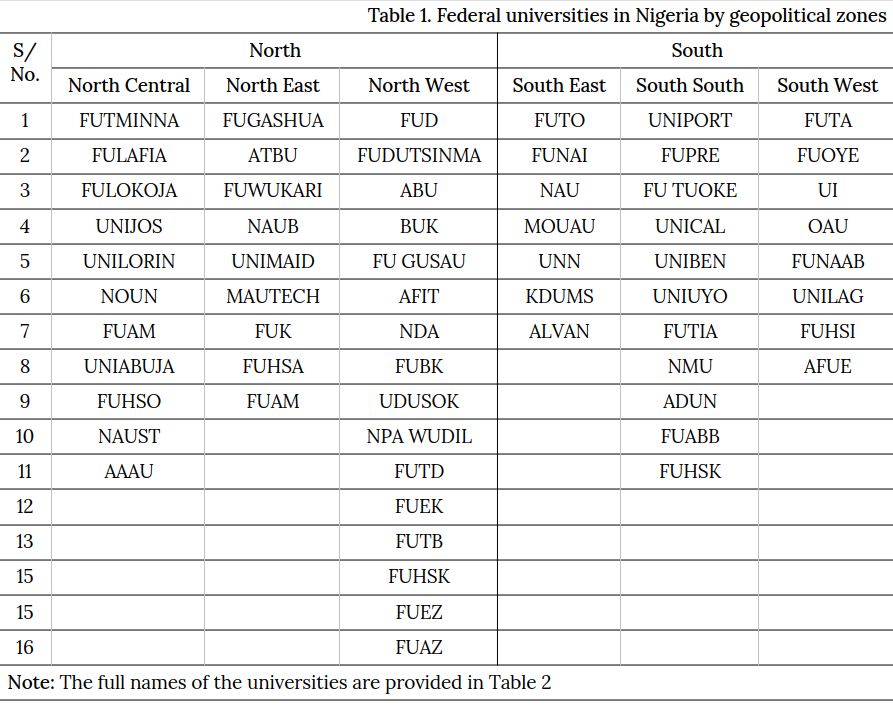
A preliminary investigation was conducted on the website of the Nigerian Universities Commission (NUC1) to extract the list of federal universities in Nigeria. The findings showed that there were 62 federal universities across the six geopolitical zones in Nigeria. The North West geopolitical zone had the highest number of universities, with 16 (25.81%), while the South East had the fewest, with 7 (11.29%) universities. A summary of the distribution of universities across the zones is provided in Table 1.
The first research question about the federal universities in Nigeria that have a mission and/or vision statement is presented in Table 2. The results show that 55 (88.71%) of the 62 universities had a vision and/or mission statement. The 7 (11.29%) universities without mission and/or vision statements include the following: Federal University of Technology, Babura, Jigawa State (FUTB) (North West), for which the webpages for the vision2 and mission3 statements were blank; no website was found for Federal University of Agriculture, Bassam-Biri, Bayelsa (FUABB) (South South), Federal University of Health Sciences, Kwale, Delta State (FUHSK) (South South), Federal University of Health Sciences, Katsina (FUHSK) (North West), Federal University of Agriculture, Mubi (FUAM) (North Central), and Federal University of Education, Zaria, Kaduna State (FUEZ) (North West); while for Federal University of Agriculture, Zuru, Kebbi State (FUAZ4) (North West), the webpage was not accessible during the period of data collection and analysis in June 2024.
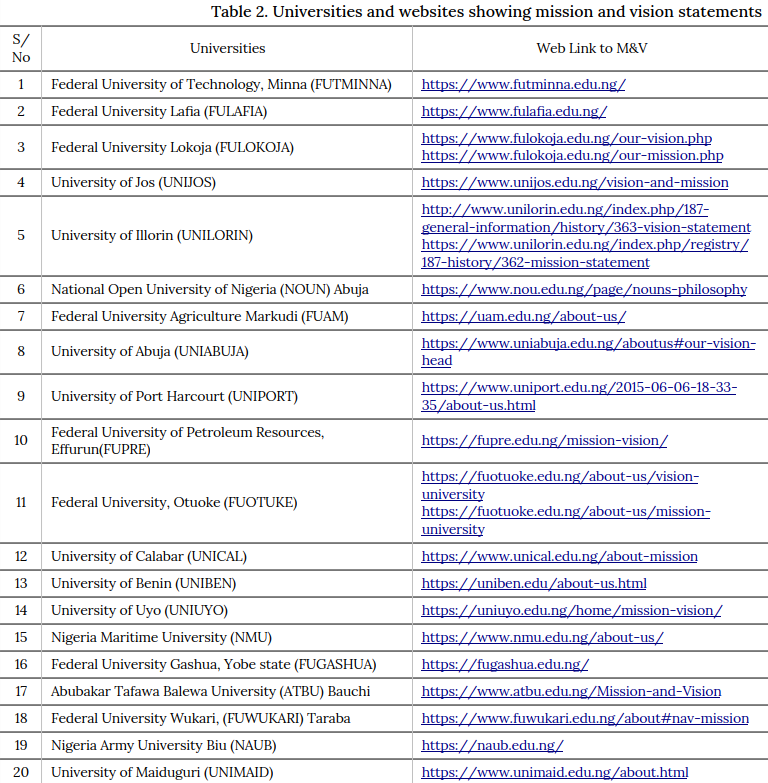
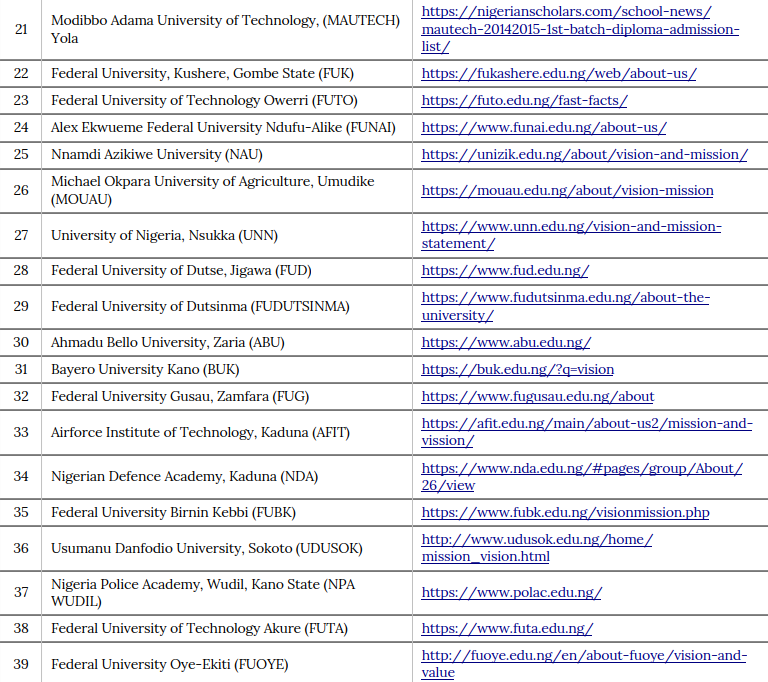
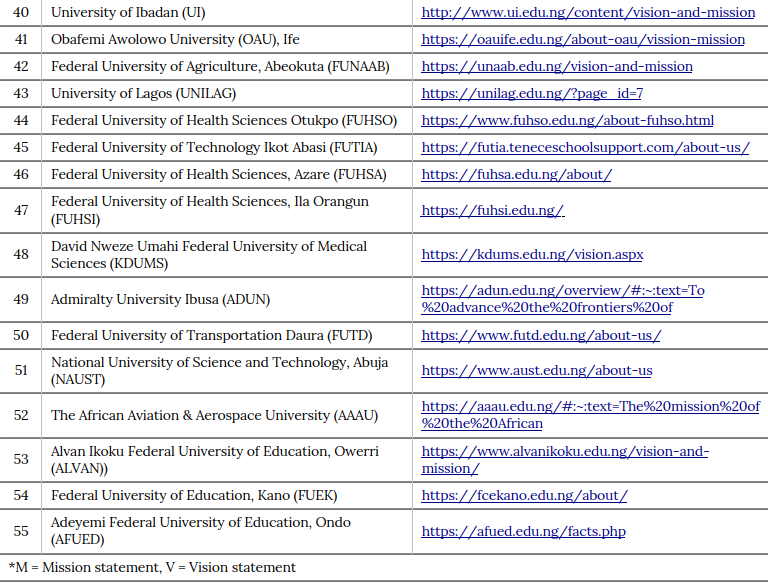

Figure 1. Screen Grab of NAUST homepage showing its old name (August 15, 2024)
The researchers observed that 52 of the 55 universities had both mission and vision statements. Three universities were the exceptions; two universities, ADUN and NAUST (3.23%), had only mission statements, while ABU Zaria (1.61%) had only a vision statement. It is pertinent to note that NAUST, formerly known as the African University of Science and Technology (AUST) (NUC, 2023), still displays the old name on its website without mention of the current name. Unlike most universities, NAUST does not have a separate heading for mission statement. Instead, the mission statement is included as part of the “About Us” section. A screenshot of the NAUST website as of August 15, 2024, is shown in Figure 1. Three universities (4.84%) presented their mission and vision statements in combined form without using separate headings; they are FULAFIA, MAUTECH, and NAU. An analysis of a combined statement, such as that of the Federal University Lafia (FULAFIA), reveals how these priorities are rhetorically woven together. The text integrates a commitment to “providing quality education” (teaching-training) with the goal of being “a centre of advanced research and technological development” (scientific research), demonstrating the potential for these statements to present an integrated, rather than segmented, institutional identity.
The second research question addressed the classification of the universities based on the content analysis of their mission and vision statements as teaching-training, scientific research, or public interest universities. The result is presented in Table 3.
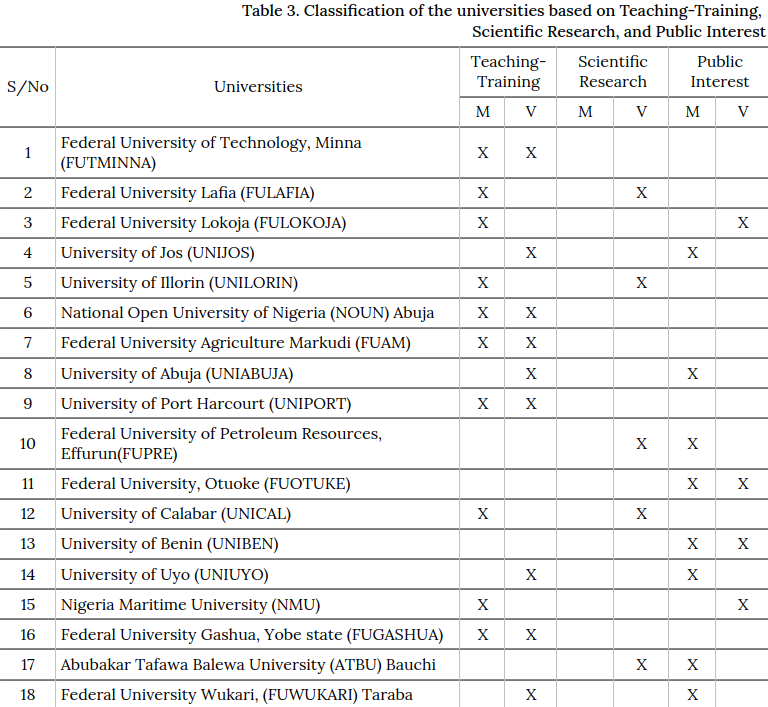
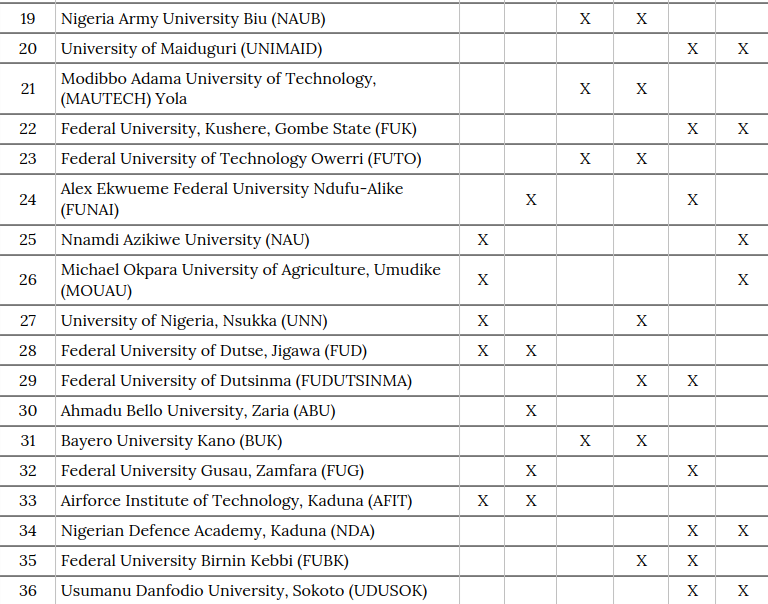
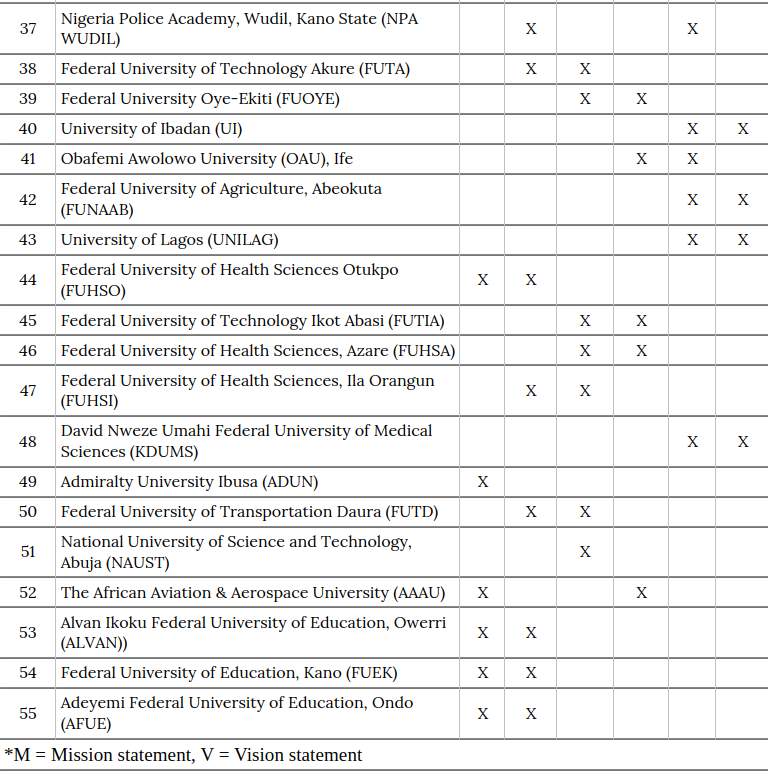
The research data in Table 3 categorizes the mission and vision statements of Nigerian universities based on three key themes: teaching-training, scientific research, and public interest. These themes reflect the core areas often emphasized in university mission and vision statements, aligning with frameworks from studies on higher education's role in society (Cochran & David, 1986; Kotler & Murphy, 1981; Özdem, 2011). Universities that emphasize teaching-training in their mission or vision statements normally prioritize educational excellence, student development, and preparing graduates for professional and personal success. These institutions often focus on curriculum development, pedagogical innovation, and providing a supportive learning environment (Gürüz et al., 1994; Karakütük, 2006), and this is reflected in how they frame their mission and vision statements. The institutions that marked an “X” under the teaching-training (M) column have mission statements targeted at quality education and training for students from different fields. As a case in point, the Federal University of Technology, Minna, marked under both teaching-training (M) and (V), shows a strategic focus on present educational standards and future innovations, which aligns with what Gürüz et al. (1994) and Firmin and Gilson (2009) described as the dual role of universities in education and training.
The dominant mission and vision statements concerning research are usually found in research-intensive universities. Some mission statements deal with advancing knowledge via research, fostering innovation, and contributing to scientific discovery. Some vision statements may pertain to becoming leading producers of research output and impact. An “X” under scientific research (M) denotes that the mission has a strong inclination towards research, likely to involve faculty, students, and industry partnerships. An “X” under scientific research (V) implies a far-sighted strategy to become a future leader in research and innovation. The fact that the University of Ilorin has been marked in both categories of scientific research (M) and (V) may point to a very strong commitment toward research, with aspirations to develop research impact and leadership in the future; Özdem (2011) states that research-oriented mission statements often reflect commitment to the advancement of knowledge and the generation of innovation.
Universities that include ideals of public interest in their mission and vision statements take into account social responsibility, involvement with the community, and also contributions to the greater social good. Such institutions engage societal problems and urge social justice while working in communities to better the quality of life. Under public interest (M), an “X” marks that the mission of the university actively engages societal issues with the aim of serving the public interest. In public interest (V), an “X” promises a future commitment to become a significant actor in addressing public and public needs as well as contributing to societal development. The University of Jos, marked under public interest (M), likely has a strong mission centered on community engagement and societal impact, echoing the role of universities in societal transformation (Gasset, 1998; Karakütük, 2006).
Federal University Lafia and the University of Nigeria, Nsukka, give equal consideration to teaching-training, scientific research, and public interest. This is evidence of a broadly tailored mission and vision directed toward excellence in teaching and social service. On the other hand, others such as the Nigerian Army University Biu have shown specialized attention to scientific research and technology with little or no regard for the public interest; this might imply that their missions are more oriented toward technical and professional education with no serious engagement with wider societal concerns. Institutions like NAUB, NDA, NPA Wudil, and AFIT are military- and police-based universities. Universities that emphasize a particular theme in their vision (e.g., scientific research, such as FUTD, MAUTECH, and NAUST) may be positioning themselves to evolve into leaders in that area in the future, which corresponds with the strategic intent of universities to differentiate themselves based on their unique strengths (Kosmützky & Krücken, 2015) and reflects a strategic intent to grow their influence and capabilities in specific domains relevant to society. The data indicate that aligning academic work with societal needs is becoming increasingly difficult due to global challenges that are becoming more complex and among other things, differ from country to country and thus magnify the strategic differences that exist between institutions when comparing their mission and vision statements.
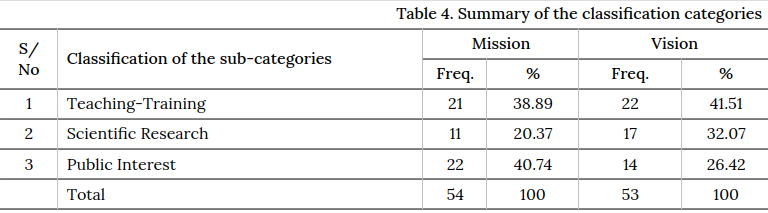
Table 4 provides a summary of the category data. It shows that teaching and training consistently holds a significant position in both mission and vision statements of Nigerian universities, underscoring the institutions’ commitment to societal contributions through education. This reflects the universities' enduring role in producing skilled workers and professionals, which remains a key part of their mission (Cochran & David, 1986; Gürüz et al., 1994). The content categories of these vision statements were further examined with respect to the three themes, highlighting how Nigerian universities strive to balance their immediate public service roles with long-term goals of teaching and research (Atkinson, 2008).
To calculate for the Chi Square frequencies of the data distribution (see Table 9), the following formular was applied:

Where,
-
Chi-Square statistic (χ²) = 3.08
-
Degrees of Freedom (df) = 2
-
p-value = 0.214
-
Significance level (α) = 0.05
A chi-square test of independence was conducted to determine whether there was a statistically significant difference in how Nigerian federal universities prioritize teaching-training, scientific research, and public interest in their mission statements compared to their vision statements. The test revealed no significant association between the type of statement (mission or vision) and the classification category, χ²(2, N = 107) = 3.08, p = .214. This suggests that the distribution of institutional priorities is not significantly different between mission and vision statements. The chi-square result supports the conclusion that these variations are statistically insignificant, despite observable differences in raw frequencies (e.g., public interest being more represented in mission than in vision statements). This implies that Nigerian federal universities have maintained a similar institutional emphasis in their mission and vision statements concerning teaching, research, and public interest, albeit in slightly different proportions. The alignment of mission and vision reflects a semblance of institutional identity. Differences in frequencies may be due more to stylistic or narrative emphasis than to any actual shift in prioritization.
The multinomial logistic regression analysis revealed several significant patterns in how Nigerian federal universities' mission and vision statements align across the three dominant categories of teaching-training, scientific research, and public interest (see Tables 10–12). The overall model demonstrated strong predictive power with 89.1% classification accuracy, indicating that institutional characteristics substantially influence mission-vision alignment. The most significant finding from the multinomial logistic regression was the predominant role of university type in predicting mission-vision alignment. Specialized Technology universities showed an 18-fold increased likelihood of aligning with scientific research compared to teaching-training (p = 0.008). This strong association reflects the inherent research orientation of technology-focused institutions, where innovation and scientific advancement are central to their institutional identity. Conversely, Specialized Education universities demonstrated a significant avoidance of public interest alignment, being 92% less likely to emphasize this category compared to teaching-training (p = 0.028). This pattern suggests that education-focused institutions prioritize pedagogical excellence and teacher training over broader societal engagement in their institutional statements.
The analysis revealed a notable trend among Specialized Military universities, which showed a 7-fold increased tendency toward scientific research alignment (p = 0.086). While this finding approaches but does not reach conventional statistical significance, it aligns with the increasing technological sophistication of modern military education and the growing emphasis on research-driven defense solutions in contemporary security discourse. Interestingly, neither geopolitical zone nor founding era emerged as significant predictors of mission-vision alignment. The absence of regional variation suggests that institutional mission statements extend beyond regional cultural and developmental differences within Nigeria. They instead reflect broader national educational priorities. Similarly, the non-significance of founding era indicates that mission-vision priorities have remained relatively consistent across different generations of university establishment, from older institutions founded before 1980 to newer ones established in the 21st century.
Table 4 provides a summary of classification categories for mission and vision statements across three sub-categories: teaching-training, scientific research, and public interest. For mission statements, the majority focus on public interest (40.74%), followed by teaching-training (38.89%) and scientific research (20.37%). This conforms to the traditional view that universities serve as critical institutions for societal transformation, which includes public service and community engagement (Kavak, 1990; Gasset, 1998; Karakütük, 2006). The higher percentage of public interest in mission statements reflects universities’ recognition of their role in addressing societal needs and challenges, which has been a central theme in academic scholarship (Velcoff & Ferrari, 2006; Morphew & Hartley, 2006). For instance, the mission statement of the Federal University Dutsinma explicitly frames its purpose around societal benefit: “The mission ... is ‘to create knowledge, impart it to transform the human being, deploy it to grow the economy and solve local and global challenges, and do so in partnership and with integrity.’” This statement directly encapsulates the public interest category by linking knowledge creation and teaching directly to human transformation, economic growth, and problem-solving. Vision statements, on the other hand, prioritize teaching-training (41.51%), with scientific research (32.07%) and public interest (26.42%) following behind. This indicates that while mission statements emphasize immediate educational goals in the public interest, vision statements tend to look toward future teaching and training aspirations.
Teaching and training consistently holds a significant position in both mission and vision statements of Nigerian universities, reflecting an ongoing commitment to societal contributions. The content categories of these vision statements were further examined with respect to the three themes. The predominance of teaching-training in vision statements mirrors the findings of previous studies, which have noted that universities often frame their visions around student development and preparing future professionals (Firmin & Gilson, 2009; Erkan, 2008). Moreover, this aligns with the idea that vision statements project an institution’s future direction, guiding its strategic positioning (Kotter, 2012; Dinçer, 2006). This is in line with previous studies conducted in other national contexts, which observed that universities typically frame their visions on “teaching-training” around the development of students and in preparing future professionals (Firmin & Gilson, 2009; Erkan, 2008; Cortés Sanchez, 2018).
The fact that there is relatively less emphasis on scientific research in both mission and vision statements—for example, in mission statements (22.22%) usually indicates that even though research is a critical function of universities, they mostly consider it part of larger societal contributions rather than in isolation (Kosmützky & Krücken, 2015). This finding resonates with Özdem's (2011) investigation, since many universities place greater emphasis on research in their vision statements as a future aspiration rather than as an immediate goal.
The finding that public interest is the most prevalent theme in mission statements (40.74%) does not suggest that teaching and research are neglected. Rather, it indicates that Nigerian federal universities rhetorically position their core purpose, their “reason for being,” within the framework of direct societal contribution. This is a highly strategic communication choice within the Nigerian context, where universities are under significant pressure to demonstrate their relevance to national development challenges (Gambo & Fasanmi, 2019). This framing likely presents public service as the overarching goal, which is achieved through the mechanisms of teaching (e.g., producing graduates who solve national problems) and research (e.g., generating solutions to local issues). The lower explicit emphasis on scientific research (22.22% in missions) may not reflect a de-prioritization of knowledge creation per se, but perhaps a focus on a specific type of research—applied and developmental research aimed at public benefit—which is itself captured by the public interest category.
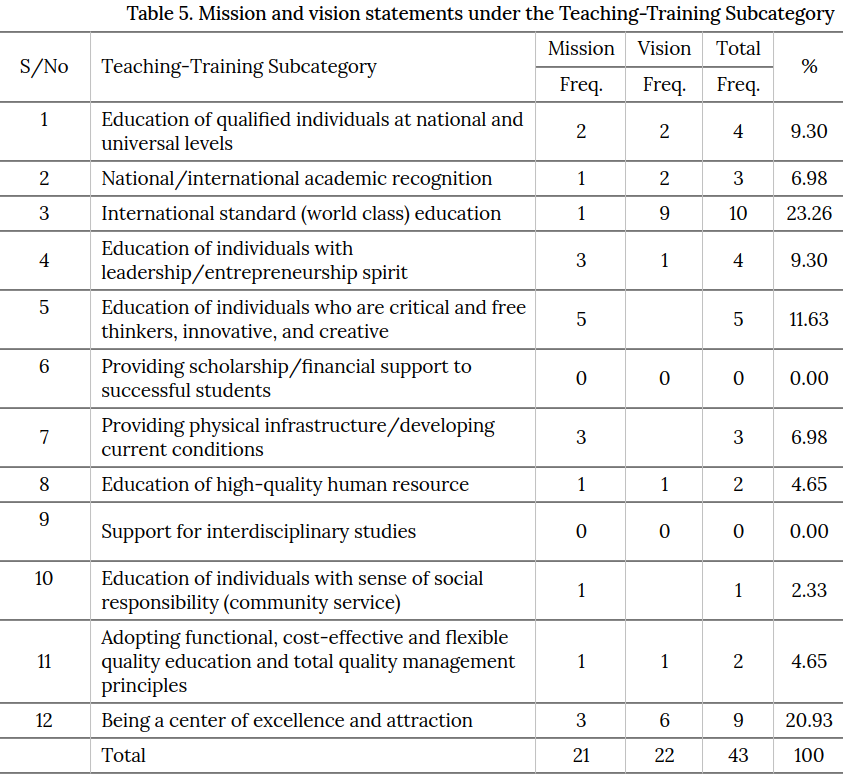
Table 5 provides insights into the strategic priorities of various educational institutions, focusing on the teaching-training component of their mission and vision statements. It breaks down these priorities into specific categories and presents the frequency with which these themes appear in mission and vision statements. The mission and vision statements emphasize the commitment to providing international standards or world-class education 10 times, accounting for 23.26% of the total frequency. An example is seen in the mission statement of the University of Ilorin, whose mission statement is “To provide world-class environment for learning, research and community service.” The primary clause focuses on the “environment for learning,” placing the teaching-training function first, while simultaneously elevating it through the “world-class” modifier, demonstrating the dual emphasis on educational core function and global competitiveness. This implies that numerous institutions strive for global recognition for their educational quality, striving to either meet or surpass international benchmarks. Such emphasis aligns with research that highlights universities’ strategic use of mission and vision statements to position themselves in competitive global educational markets (Kotler & Murphy, 1981; Kosmützky & Krücken, 2015). This finding implies that Nigerian universities are increasingly integrating global perspectives into their strategic priorities to enhance their international recognition and competitiveness (Cochran & David, 1986). Similarly, six vision statements and three mission statements, accounting for 20.93% of the total, highlight the goal of being a center of excellence and attraction; this demonstrates the ambition of these institutions to become leading educational hubs that attract collaborations with students, faculty, and researchers from around the world.
Kuenssberg (2011) noted that universities are embracing competitive distinctions with statements of excellence and positioning themselves as places of attraction. In fact, the statements are used by institutions to communicate distinct institutional goals and values. The education being provided to develop critical thinking, innovation, and creativity in students reflects this theme, as it appears five times in mission statements and accounts for 11.63% of its total frequency. This emphasis on producing students who can think independently and contribute creatively to society indicates a clear strategic concern. This is in line with what Morphew and Hartley (2006) say: most mission statements incline towards skills and competencies for the development of social and economic advancement. The presence of the theme suggests that Nigerian universities are also keeping pace with the emerging trends in innovation and critical thinking because they contribute to achieving the wider educational mission revealed by Gürüz et al. (1994). The findings in Table 5 thus confirm that Nigerian universities are not just interested in high learning and teaching standards but are also strategically positioning themselves to compete on a global scale. Their mission and vision statements demonstrate their dedication to producing graduates with the necessary skills and knowledge to prosper in a globalized world, while also enhancing their institutional reputation as centers of excellence and innovation (Bamiro, 2024; Cortés Sanchez, 2018; Firmin & Gilson, 2009).
It mentions the education of persons who have leadership and entrepreneurial characteristics four times through references to educating future leaders and innovators capable of driving economic and social transformation, an echo of the comment made by Firmin and Gilson (2009), who said that most mission statements usually emphasize the preparation of individuals for leadership in society. Conversely, specific categories garnered diminished attention. The mission and vision statements of the institutions listed in Table 5 do not emphasize the provision of scholarships or financial assistance to accomplished students, nor do they foster multidisciplinary studies. This absence may indicate a possible limitation, since the authors argue that financial assistance and collaborative interdisciplinary approaches are, in fact, crucial vehicles for promoting diversity within educational experiences (Morphew & Hartley, 2006). Areas of lesser concern, like student financial aid and multidisciplinary study, may therefore indicate areas of emphasis or areas for improvement going forward. The different emphases may thus be seen as an outstanding example of divergent goals and strategies of academic institutions as far as meeting their educational mission is concerned (Cochran & David, 1986). This fluctuation demonstrates the fluidity of institutional priorities within changing educational contexts (Kuenssberg, 2011). The funding of education has been largely shifted to the students, and this is supported by the mission and vision statements of Nigerian universities (Gambo & Fasanmi, 2019; Hile, 2023; Wahab, 2022).
Similarly, there is rarely any reference to the education of high-quality human resources and the implementation of functional, cost-effective, and flexible quality education concepts, as each category receives only two citations, accounting for 4.76% of the overall frequency. The comparatively low prevalence of these themes may suggest that, although these goals are significant, they are subordinate to the overarching aims of leadership and global competitiveness. National and worldwide academic recognition constitutes a significant category, appearing three times in the goal and vision statements (7.14%). This indicates that although global standards are a major goal, gaining a reputation in national and worldwide academic communities is an essential aim for Nigerian universities, consistent with Kotler and Murphy's (1981) findings on institutional status goals.
Table 6 presents a summary of the strategic areas of emphasis for scientific research as outlined in the mission and vision statements of different Nigerian universities. The universities place a strong focus on possessing advanced technological infrastructure and equipment. This is mentioned five times in mission statements and twice in vision statements, accounting for 25% of the overall frequency. This emphasis reflects the significance that institutions attribute to equipping themselves with the requisite tools and facilities to carry out state-of-the-art research (Kosmützky & Krücken, 2015). Another key area of focus is contributing to national development through scientific research and publications. This category occurs three times in each of the mission and vision statements, accounting for about 21.43% of the total. This shows a strong commitment to the notion that research not only generates scientific knowledge but should also be geared toward making a difference in national development (Gürüz et al., 1994). Institutions wish that their research activities would be in harmony with the broader aims of national progress, within which areas like economic growth, technological advancement, or public good would fit. Abubakar Tafawa Balewa University is a good example; their vision statement highlights this: “To become a centre of excellence for the creation, transfer and application of scientific knowledge for the advancement of mankind in a friendly, interactive and multi-cultural environment.” The focus here is squarely on the generation and application of new knowledge for the advancement of mankind in a sustainable and pluralistic society.
Being a pioneer in research at the national and international level and achieving national/international recognition in research are also significant themes, each appearing four times in the vision statements. They represent 14.29% of the total frequency, emphasizing the aspiration of institutions to lead in the research domain and gain recognition for their contributions (Nnadozie et al., 2023; Özdem, 2011; Firmin & Gilson, 2009). The focus on pioneering research highlights the ambition to be at the forefront of scientific discoveries, while the desire for recognition recognizes the importance of establishing a reputation in the academic and research communities (Kosmützky & Krücken, 2015). This is evident in the vision of Abubakar Tafawa Balewa University, which aims “To become a centre of excellence for the creation, transfer and application of scientific knowledge for the advancement of mankind...” The emphasis on the entire research cycle—“creation, transfer and application”—and its intended goal of the “advancement of mankind” perfectly illustrates a strategic, research-centric vision with a clear public-oriented outcome.
In contrast, some categories received little to no attention. For instance, the concept of being a research university is not mentioned at all, suggesting that this specific designation may not be a primary focus for the institutions represented in Table 6 (Morphew & Hartley, 2006). This aligns with the structure from Özdem (2011), who states that, in Turkey, research was also given greater importance in vision statements as an aspiration for the future, not the present.
In a similar vein, there is an absence of university-industry collaboration supporting entrepreneurship, knowledge generation, and implementation in the mission and vision statements. Such absences indicate that these areas are neither well-developed nor prioritized in these institutions' present strategic directions. Invoking the literature, university-industry collaboration is instrumental in fostering innovation and transferring knowledge, which are necessary for national growth (Etzkowitz and Leydesdorff, 2000). The mention, though once, of education in exploring and questioning scientists emphasizes an effort that is less pronounced in instilling a culture of inquiry and critical thinking among researchers. Although Paul and Elder (2008) consider critical thinking vital to scientific advancement, other priorities such as technological infrastructure and national development are the bases for research advancement, according to Adams and Zanzi (2006).
Table 7 reveals in detailed terms what educational institutions regard as their priorities for the public in their mission statements and visions. One of the focuses that stands out is conducting studies for human benefit, which appears seven times in mission statements and twice in vision statements, adding up to 25.00% of the total frequency. This emphasizes that these institutions direct research and initiatives to benefit society. These institutions hence tend toward human welfare and commitment to bettering life through their academic and research activities. Professional competency within the national/international arena is another prominent issue, appearing three times in mission and vision statements each, counting for 16.67% of the total. This shows that these institutions really take seriously the importance of preparing students well for competent work in the national and international arenas. Each institution prepares students to be able to add value to their discipline and represent the country and institution in the global arena through professional competence. Contribution to the economic, cultural, social, and technological development of society constitutes yet another significant priority as evidenced by four mentions in mission statements and one in a vision statement, accounting for 13.89%. The mission statements of this category illustrate the value of educational institutions in social development through dimensions of economic growth, cultural enrichment, social cohesion, and technological innovation. Universities shape the future of communities and nations as they make significant contributions in these areas. A good illustration is the Federal University Dutsinma, whose mission statement says “The mission ... is 'to create knowledge, impart it to transform the human being, deploy it to grow the economy and solve local and global challenges, and do so in partnership and with integrity'.” This is a direct articulation of a service-oriented, publicly minded mission.
The rather sweeping “public interest” emphasis in statements under this category begs to be filled with a little more precise articulation about what that commitment means in a university setting. Public service here does not mean the broad charity or welfare provision that is usually associated with social service agencies. Rather, it implies the bringing to bear on societal problems the university's unique and precious academic capital—its knowledge, expertise, and critical capacities. This distinction is the institution's key comparative advantage. The data suggests that Nigerian universities frame this advantage in several ways:
-
Knowledge-Based Problem Solving: The emphasis on “Conducting studies for human benefit” (25.00% of public interest codes, Table 7) positions the university as a generator of evidence-based solutions, not just an implementer of programs. This is a function beyond the typical mandate of a social service agency.
-
Developing Human Capital for Development: The focus on “Professional competence” and “Enhancing the qualified workforce” frames public service indirectly through the output of highly skilled, ethically minded graduates (e.g., “education of individuals with a sense of social responsibility”) who drive long-term national development from within various sectors.
-
Critical Engagement and Advocacy: The role of “Pioneering social advancement” implies a function of critical inquiry, social critique, and advocacy, akin to holding a mirror to society and proposing forward-thinking models for progress that are grounded in research and scholarship.
Another key area receiving attention deals with fostering pioneering social advancement and social development, having appeared four times in mission statements and once in a vision statement, giving it 13.89% of total frequency. The notion reflects the ambition of institutions to pioneer societal changes and developments and hence to be fairly considered catalysts of advancement in various social sectors. A more pronounced distinction of such organizations as pioneering connotes a proactive outlook whereby institutions are involved not only in social development existing under certain frameworks but also in driving new initiatives with output objectives geared towards social development. Two mentions of the training of socially responsible graduates in both mission and vision statements account for 11.11% of the total. In effect, priority seems to be given to nurturing graduates who are skilled professionals as well as socially responsible citizens. The construction of socially responsible citizens with career-oriented skills goes a long way in ensuring that the institutions produce graduates with a firm commitment to giving back positively to their communities and the world. Enhancing and promoting the qualified workforce of the country appears twice in mission and vision statements, making up 11.11% of the total frequency. This concern reflects the role of universities in facilitating national development through activities that ensure the workforce is well-educated, skilled, and capable of responding to the exigencies of the modern-day economy. Curiously, the formal education of environment-conscious youth appears only in vision statements, three times, constituting 8.33% of the total. Such a trend reveals that environmental consciousness has not yet emerged as a prime mission for these institutions but is being envisaged as one in the future, thus confirming that environmental sustainability is becoming a very pertinent matter in education.
The novelty of applying the aforementioned categorical structure (teaching-training, research, public interest) to the entire census of Nigerian federal universities lies in the fact that this area remains underexplored in the literature. This provides a unique baseline of the strategic narrative within a specific, under-researched media ecology. The findings suggest a distinct communicative strategy: a strong, consistent emphasis on public service as an immediate mission, potentially reflecting a need to assert relevance to national stakeholders. In contrast, the usual narratives found in the mission statements of universities from the global North (Morphew & Hartley, 2006) dominate the picture. This demonstrates how local context shapes mediatized institutional identity. In this area, systematic comparisons can be made with lexicographical and rhetorical intensity compared with universities from other parts of the globe (Kenya, South Africa, China, the UK, and the US, for example) so that greater distinctions could then be drawn regarding the specific features of Nigerian strategic discourse.
Digital presentation and accessibility of statements
Beyond the semantic content already analyzed, we conducted a compact interface audit of how these strategic documents are presented digitally (see Appendix, Table 13). The audit of six diverse university websites revealed significant variability in the digital mediation of mission and vision statements that may impact their communicative effectiveness. Three key patterns emerged: First, format fragmentation was substantial, with statements presented as native HTML (most accessible), embedded PDFs (creating accessibility barriers), or buried within lengthy “About Us” pages. Second, navigational inconsistency was pronounced, with the path to locate statements ranging from 1 to 4+ clicks from the homepage, suggesting that these documents are not uniformly treated as priority content. Third, several institutions showed metadata issues, including outdated names (e.g., NAUST displaying its previous designation) and broken links, raising questions about content currency and maintenance. This variability in digital presentation constitutes a form of “platform rhetoric” that complements the textual analysis. The choice to present a mission statement as a downloadable PDF versus integrated HTML signals different assumptions about its audience and purpose. Easy access (1–2 clicks) suggests that the statements are considered core branding materials, while deeper burial may indicate that they function more as compliance documents for accreditation purposes. These presentational differences represent an important dimension of how Nigerian universities' strategic priorities are mediatized to their publics.
International Benchmarking and Nigerian Specificity
To contextualize the Nigerian findings, we conducted a brief comparative analysis of mission/vision statements from four international universities representing different higher education models (see Appendix, Table 14). We randomly selected the University of Oxford in the UK, which has the status of an elite, research-intensive university (Times Higher Education, 2025); Michigan State University in the USA, considered for its land-grant and public service model (Collins, 2012); the University of Cape Town in South Africa, a leading African research university (Times Higher Education, 2024); and the University of Nairobi in Kenya, a comprehensive public university in East Africa (Scientia Educare, 2025). This benchmarking reveals distinctive characteristics of Nigerian federal universities' strategic communication. The University of Oxford's vision emphasizes its “world-leading research” and “global impact,” with research dominance (75% emphasis) reflecting its elite, global orientation. Similarly, the University of Cape Town prioritizes “research-led excellence” and “African global scholarship,” balancing international standing with continental leadership. Both institutions frame their excellence in global competitive terms. In contrast, Michigan State University, as a land-grant institution, demonstrates strong public service alignment (60%) with phrases like “advancing the common good” and “community engagement,” yet maintains substantial research emphasis. The University of Nairobi shows a balanced triad but emphasizes “national development” and “leadership for Africa,” positioning itself as an engine for regional progress. The Nigerian specificity emerges in comparison: while similarly emphasizing public service (40.74% in missions), Nigerian universities do so within a context of more explicit developmental rhetoric and resource constraints. Unlike Oxford's global research ambition or Michigan State's established public service model, Nigerian statements often reflect a pragmatic negotiation between immediate national needs and aspirational educational goals. The relatively lower explicit research emphasis (22.22% in missions) compared to the benchmark institutions may reflect not disinterest but the documented challenges of research capacity in the Nigerian context. This comparative perspective highlights that Nigerian universities' strategic narratives are shaped by their unique position: aspiring to global relevance while addressing pressing local developmental obligations, resulting in a distinctive communicative strategy that emphasizes service as both mission and justification.
Theoretical and Practical Implications
These findings have important implications for higher education policy and institutional strategy. The strong typological patterns suggest that mission-vision statements are not merely rhetorical exercises but reflect genuine institutional specializations and priorities. For policymakers, this emphasizes the importance of maintaining differentiated institutional missions within the national higher education system. For university administrators, the results highlight the need for mission-vision statements that authentically communicate and represent institutional strengths and strategic directions.
Conclusions
This study employed a content analysis of the mission and vision statements of Nigerian federal universities to explore how these institutions articulate their strategic priorities within the context of the national higher education landscape. The chi-square test of independence revealed no statistically significant association between statement type and thematic emphasis (χ²(2, N = 107) = 3.08, p = .214), indicating that the distribution of priorities across mission and vision statements is broadly consistent. The multinomial logistic regression further clarified that this alignment is strongly influenced by institutional type, with specialized universities—particularly technology-focused institutions—showing distinct strategic orientations, while geopolitical zone and founding era showed no significant effect. The lack of a statistically significant difference suggests a coherent strategic narrative across mission and vision statements. Nigerian federal universities present a consistent mediated identity, one that balances the immediate, practical mandate of public service (emphasized in missions) with aspirational goals of educational excellence (emphasized in visions). This consistency can be interpreted as a communication strategy aimed at projecting institutional stability and a clear, unwavering purpose to their publics, despite the internal resource tensions they face.
Therefore, while public interest appears more frequently in mission statements (40.74%) compared to vision statements (26.42%), and teaching-training appears more in visions (41.51%) than in missions (37.04%), these variations are not statistically significant. The core implication is that Nigerian federal universities, as a whole, maintain a consistent institutional identity across their strategic declarations. These slight variations in proportion might be part of a strategic decision regarding the style or narrative drafting of such statements; for example, phrasing a mission in practical, service-oriented terms and aligning a vision through more aspirational, educational language rather than signaling a radical strategic shift in priorities. Moreover, the presentation of mission and vision shows a fairly stable but certainly limited understanding of the complexity of the university role.
These analyses show that the mission and vision statements of Nigerian federal universities are more than mere internal strategic plans; they are also fundamental tools for external communication and identity building. The strong emphasis on public interest rhetoric is a powerful media message targeting stakeholders in both statement types and, evidenced by its high frequency, likely reflects a direct response to Nigeria's pressing socio-economic challenges, positioning the university as an active agent in national development and fitting into the international model of an “engaged university,” in which community relevance is a basic pillar. The strategic nature of this communication is seen in statements that subordinate other functions to the overarching goal of public service. For example, a university might frame its research not as an end in itself, but as a means to “generate solutions to local issues,” a phrasing that would be coded for both scientific research and public interest, showcasing the primacy of the latter in the rhetorical structure.
Conversely, the relatively lower emphasis on scientific research in both missions (22.22%) and visions (32.07%) may not reflect deliberate de-prioritization but rather a pragmatic reflection of the well-documented challenges to research capacity, such as funding limitations and brain drain. The data do not support a conclusion that Nigerian universities prioritize different core functions in their missions versus their visions; instead, the findings point to a consistent, integrated strategic focus across both statements. Also, the consistent narrative observed across the statement types points to a sophisticated, if perhaps implicit, understanding of branding and reputation management within a challenging media environment. Future research should now investigate more fully the discursive mechanics and digital presentation of these narratives to fully unpack the mediatization of Nigerian higher education.
This study contributes to the literature by demonstrating that within the unique Nigerian context, the communicative function of mission and vision statements may be less about distinguishing between operational and aspirational goals, and more about reinforcing a consistent, multifaceted institutional identity. Therefore, the interpretation of the rhetorical emphasis should definitely not lead to the conclusion that Nigerian universities regard teaching, researching, and service as conflicting priorities. The point at issue, then, is not to choose among these functions, but to make it clear and credible how teaching and research strengths could best be deployed as part of public service missions. Future research should move beyond textual analysis to investigate the implementation of these stated priorities, explore whether the consistent emphasis found in official rhetoric translates into congruent resource allocation and strategic decision-making, and look into the actual institutional policies and resource allocations that enable the integration of all three crucial synergistic functions within these institutions.
Limitations and Future Research
The study's novelty is anchored in its comprehensive census of the Nigerian federal university system. To enhance its media-theoretical contribution, future research should incorporate cross-national benchmarking (e.g., with universities beyond Nigeria, including institutions in Kenya, South Africa, and the UK). Based on the applied methodology, another fundamental constraint of the study is that the reduction of multi-coded statements to one dominant category oversimplifies the data, although this simplification was methodologically necessary for the statistical procedures used in this study. Future research can include more advanced analyses, such as logistic regression using the original multi-coded data as predictors to model the effects of variables such as university age, geographic zone, and specialized versus conventional status on the probability of a theme being present in a statement. Other elements that could be incorporated include lexical variety, modality, or rhetorical devices to better understand the constructed communication. Another limitation of the research is that the study analyzed the text of the statements in isolation. However, to develop a complete media studies approach, an analysis of their platform-specific presentation is required. This refers to their findability and accessibility on university web pages, as well as the ways in which layout, typography, and imagery shape their visual presentation. It could also investigate how these statements are integrated into the broader digital narrative of the institution (i.e., through hyperlinks to “Research” or “Community Service” sections). Thus, interface-level and multimodal analysis is essential for understanding how these statements function in the bigger picture of university digital media strategy.
Footnotes
1See https://www.nuc.edu.ng/nigerian-univerisities/federal-univeristies/
2See https://futb.edu.ng/vision/
Authors’ Statements
Agreement with the Journal's Policies
All authors of this manuscript have been notified and agree to the journal's current policies as described on the publication's website.
Originality and Exclusivity of the Manuscript
All authors confirm that the manuscript is original, has not been published previously in whole or in part, and is not under consideration for publication elsewhere.
Authorship and Contribution (CRediT)
Ben-Collins Emeka Ndinojuo conceptualized the paper and the methodology, collected data, analyzed the data, drafted the paper and was responsible for funding acquisition. Otikor Njanubok Samuel helped in designing and writing the introduction and literature review, reviewing and editing the draft and approved the final version of the manuscript.
Policy on Preprints and Previous Versions
All authors confirm the availability of a preprint/working version. I confirm that there is no violation of the journal's policy.
Conflict of Interest
No conflicts.
Funding
The work was supported by the TETFund Research Grant administered through the University of Port Harcourt with the reference number TETF/UPH/IBR/2024/020.
Use of Generative AI and Supporting Tools
AI tools are not listed as authors; any contributions (text editing, translation, illustrations, code) are described in the “Methods” section; accuracy, originality, and compliance with rights have been verified.
Permissions for Use (Texts, Images, Maps, Illustrations)
All copyrighted materials are reproduced with the permission of the copyright holder; license terms (including CC) are observed.
Acknowledgments and Contributions without Authorship
The authors would like to express their heartfelt gratitude to TETFund and the University of Port Harcourt's management, led by Prof. Owunari Georgewill, for their generous support through the TETFund grant. Special thanks are also due to Prof. W.C. Ihejirika, Dean of the Faculty of Communication and Media Studies, and Prof. C.I. Ochonogor, pioneer Head of the Department of Journalism and Media Studies, for approving the project. Our gratitude extends to Prof. C.U. Omego, current HoD, for her continued support.
References
Abo-Khalil, A. G. (2024). Integrating sustainability into higher education challenges and opportunities for universities worldwide. Heliyon, 10(9), e29946. https://doi.org/10.1016/j.heliyon.2024.e29946
Acting ES Receives New Mgt. Of Renamed AUST. (2023). National Universities Commision. https://www.nuc.edu.ng/acting-es-receives-new-mgt-of-renamed-aust/
Adams, S. M., & Zanzi, A. (2006). Developing political intelligence for making feasible decisions. Journal of Management Development, 25(4), 350–367. https://doi.org/10.1108/02621710610655828
Ajoseh, S., Langer, A., Amoniyan, O., & Uyah, U.-A. (2024). Navigating brain drain: Understanding public discourse on legislation to retain medical professionals in Nigeria. Globalization and Health, 20(1), 80. https://doi.org/10.1186/s12992-024-01077-1
Akinwale, O. E., Kuye, O. L., & Akinwale, O. E. (2023). Trajectory of brain-drain and quality of work-life amongst Nigeria’s university lecturers: Academic staff union of universities (ASUU) incessant strike in retrospect. International Trade, Politics and Development, 7(2), 115–137. https://doi.org/10.1108/ITPD-10-2022-0021
Asiru, H. T., & Oludare, A. A. (2015). Stylo-rhetorical Analysis of the Vision and Mission Statements of Higher Institutions in the North-West Geopolitical Zone of Nigeria. IJDA, 1(2), 1–9.
Assié-Lumumba, N. T. (2017). The Ubuntu Paradigm and Comparative and International Education: Epistemological Challenges and Opportunities in Our Field. Comparative Education Review, 61(1), 1–21. https://doi.org/10.1086/689922
Atkinson, T. N. (2008). Textual mapping of imitation and intertextuality in college and university mission statements: A new institutional perspective. Semiotica, 2008(172), 361–387. https://doi.org/10.1515/SEMI.2008.104
Bakare, K. A. (2021). Vision, Mission and the 21st Century Nigerian Universities. European Journal of Management and Marketing Studies, 6(2), 1–15. https://doi.org/10.46827/ejmms.v6i2.1053
Bamiro, O. A. (2024, April 3). Enhancing the quality of institutional leadership and governance of Nigerian universities towards sustainable management and optimal performance. Paper presented at the Retreat for Principal Officers, Deans, Directors, Heads of Departments, and Senior Staff of Elizade University, Faculty of Law Complex, Elizade University.
Boyer, E. L. (1996). The Scholarship of Engagement. Bulletin of the American Academy of Arts and Sciences, 49(7), 18–33. https://doi.org/10.2307/3824459
Bringle, R. G., & Hatcher, J. A. (1995). A Service-Learning Curriculum for Faculty. Michigan Journal of Community Service Learning, 2, 112–122.
Checkoway, B., & Richards-Schuster, K. (2004). Youth Participation in Evaluation and Research as a Way of Lifting New Voices. Children, Youth and Environments, 14(2), 84–98. https://doi.org/10.1353/cye.2004.0075
Cochran, D. S., & David, F. R. (1986). Communication effectiveness of organizational mission statements. Journal of Applied Communication Research, 14(2), 108–118. https://doi.org/10.1080/00909888609360308
Collins, C. S. (2012). Land-Grant Extension as a Global Endeavor: Connecting Knowledge and International Development. The Review of Higher Education, 36(1), 91–124. https://doi.org/10.1353/rhe.2012.0065
Cortés Sánchez, J. D. (2018). Mission statements of universities worldwide: Text mining and visualization. Intangible Capital, 14(4), 584–603. https://doi.org/10.3926/ic.1258
Cowley, M., & Domb, E. (2012). Beyond Strategic Vision. Routledge. https://doi.org/10.4324/9780080500058
Dinçer, Ö. (2006). Strategic management and management policy (8th ed.). Alfa Yayım Dağıtım.
Enstroem, R., & Schmaltz, R. (2024). Striking gold: Navigating the education massification maze for work readiness. Journal of Work-Applied Management, 16(2), 184–199. https://doi.org/10.1108/JWAM-10-2023-0100
Erçetin, C. C. (2000). Vision in the leader spiral. Nobel Prize Publications.
Erkan, V. (2008). Strategic planning in public institutions. Turkey application and factors affecting success in organizations. DPT Publications.
Fagbemi, F., Osinubi, T. T., & Adeosun, O. A. (2022). Enhancing sustainable infrastructure development: A boon to poverty reduction in Nigeria. World Development Sustainability, 1, 100006. https://doi.org/10.1016/j.wds.2022.100006
Firmin, M. W., & Gilson, K. M. (2009). Mission Statement Analysis of CCCU Member Institutions. Christian Higher Education, 9(1), 60–70. https://doi.org/10.1080/15363750903181922
Fitzgerald, C., & Cunningham, J. A. (2016). Inside the university technology transfer office: Mission statement analysis. The Journal of Technology Transfer, 41(5), 1235–1246. https://doi.org/10.1007/s10961-015-9419-6
Gambo, O. O., & Fasanmi, S. A. (2019). Funding university education in Nigeria: The challenges and way forward. Bulgarian Journal of Science and Education Policy (BJSEP), 13(1), 80–91.
Gasset, O. Y. (1998). Mission of the University. Yapi Kredi Publications.
Gözükara, İ. (2015). Mission and Vision Statements of Foundation Universities in the Context of University Roles: A Content Analysis. China-USA Business Review, 14(9), 464–476. https://doi.org/10.17265/1537-1514/2015.09.005
Gürüz, K., Çuhubi, E. A. M., Çengor, C., Türker, K., & Yurtsever, E. (1994). Higher education, science and technology in Turkey and in the world. Turkish Association of Industrialists and Officials.
Hailu, A. T. (2024). The role of university–industry linkages in promoting technology transfer: Implementation of triple helix model relations. Journal of Innovation and Entrepreneurship, 13(1), 1‑17. https://doi.org/10.1186/s13731-024-00370-y
Hile, M. (2023). The burden of university funding shifts to students. Financial Nigeria International Limited. https://www.financialnigeria.com/the-burden-of-university-funding-shifts-to-students-blog-821.html
Hjarvard, S. (2013). The Mediatization of Culture and Society. Routledge. https://doi.org/10.4324/9780203155363
Huang, J. (2024). Research on the Social Service Function of Open Universities: Reflection Based on the Concept of Socially Engaged Universities. Open Access Library Journal, 11(5), 1–12. https://doi.org/10.4236/oalib.1111636
Idowu-Faith, B. (2023). Style and Distinctive Uses of Language in Nigeria’s First-Generation Private Universities’ Vision and Mission Statements: In R. Taiwo, B. Idowu-Faith, & S. Ajiboye (Eds.), Advances in Higher Education and Professional Development (pp. 179–205). IGI Global. https://doi.org/10.4018/978-1-6684-8122-6.ch011
James, H., & Huisman, J. (2009). Missions statements in Wales: The impact of markets and policy on congruence between institutions. Journal of Higher Education Policy and Management, 31(1), 23–35. https://doi.org/10.1080/13600800802559229
Jansson, A. (2018). Mediatization as a Framework for Social Design: For a Better Life with Media. Design and Culture, 10(3), 233–252. https://doi.org/10.1080/17547075.2018.1511140
Karakütük, K. (2006). Financing of higher education. National Education Journal, 171, 219–242.
Kavak, Y. (1990). Higher education in development priority regions environmental activities of my institutions. TOBB Publish.
Kermanshahi, S. N., Van Der Tuin, I., Dirks, S., Overkempe, T., Hardman, L., & Pieters, T. (2024). Re-Mediatization as a New Digital Approach Towards Local Political Deliberation: Using Real-Time Participatory Media Production to Bring Nuance to Public Debates on Religion, Sexuality, and Migration. Digital Society, 3(3), 66. https://doi.org/10.1007/s44206-024-00154-7
Kosmützky, A., & Krücken, G. (2015). Sameness and Difference: Analyzing Institutional and Organizational Specificities of Universities through Mission Statements. International Studies of Management & Organization, 45(2), 137–149. https://doi.org/10.1080/00208825.2015.1006013
Kotler, P., & Murphy, P. E. (1981). Strategic Planning for Higher Education. The Journal of Higher Education, 52(5), 470–489. https://doi.org/10.1080/00221546.1981.11778119
Kotter, J. P. (2012). Leading Change. Harvard Business Press. https://doi.org/10.15358/9783800646159
Kraaijenbrink, J. (2021, April 13). Why Your Mission And Vision Statements Don’t Work (And What To Do About It). Forbes. https://www.forbes.com/sites/jeroenkraaijenbrink/2021/04/13/why-your-mission-and-vision-statements-dont-work-and-what-to-do-about-it/
Kuenssberg, S. (2011). The discourse of self-presentation in Scottish university mission statements. Quality in Higher Education, 17(3), 279–298. https://doi.org/10.1080/13538322.2011.625205
Landis, J. R., & Koch, G. G. (1977). The Measurement of Observer Agreement for Categorical Data. Biometrics, 33(1), 159. https://doi.org/10.2307/2529310
Ling, L. (2020). Universities and research in times of crisis: The getting of wisdom. Qualitative Research Journal, 20(4), 361–371. https://doi.org/10.1108/QRJ-06-2020-0055
List of Federal Universities. (2024). National Universities Commision. https://www.nuc.edu.ng/nigerian-univerisities/federal-univeristies/
Mazzucato, M. (2018). Mission-oriented innovation policies: Challenges and opportunities. Industrial and Corporate Change, 27(5), 803–815. https://doi.org/10.1093/icc/dty034
Morphew, C. C., & Hartley, M. (2006). Mission Statements: A Thematic Analysis of Rhetoric across Institutional Type. The Journal of Higher Education, 77(3), 456–471. https://doi.org/10.1080/00221546.2006.11778934
Ndinojuo, B.-C. E. (2020). 5G, Religion, and Misconceptions in Communication during Covid-19 in Nigeria. Jurnal The Messenger, 12(2), 97–110. https://doi.org/10.26623/themessenger.v12i2.2282
Ndinojuo, B.-C. E. (2024). Narratives in reporting poverty in Nigerian newspapers. African Identities, 22(4), 1011–1031. https://doi.org/10.1080/14725843.2023.2170324
Olusola, S. A., Oluseye, O. O., Saviour, U. M., Iember, K. J., & Ayomiposi, D. O. (2022). A Content analysis of the vision and mission statements of top ten leading Universities in Africa. Cogent Education, 9(1), 2143648. https://doi.org/10.1080/2331186X.2022.2143648
Orwig, B., & Zachary Finney, R. (2007). Analysis of the mission statements of AACSB‐accredited schools. Competitiveness Review: An International Business Journal, 17(4), 261–273. https://doi.org/10.1108/10595420710844343
Özdem, G. (2011). An analysis of the mission and vision statements on the strategic plans of higher education institutions. Educational Sciences: Theory & Practice, 11(4), 1887–1894.
Ozer, E. J., Ritterman, M. L., & Wanis, M. G. (2010). Participatory Action Research (PAR) in Middle School: Opportunities, Constraints, and Key Processes. American Journal of Community Psychology, 46(1–2), 152–166. https://doi.org/10.1007/s10464-010-9335-8
Paul, R., & Elder, L. (2008). The Miniature Guide to Critical Thinking Concepts and Tools. Foundation for Critical Thinking Press.
Sakellarios, M. D., & Gann, D. (2024). Critically evaluating university mission and vision statements. International Journal of Evaluation and Research in Education (IJERE), 13(6), 3906–3913. https://doi.org/10.11591/ijere.v13i6.29277
Scientia Educare. (2025, June 8). University of Nairobi Kenya: Education and Research in East Africa. Online Learning Platform. https://scientiaeducare.com/university-of-nairobi-kenya-a-pillar-of-academic-excellence-and-innovation-in-east-africa/
Sönmez, V. (2003). An essay on the restructuring of higher education. Educational Researches, 12, 4–12.
State Planning Organization (DPT). (2006). Strategic planning guide for public administrations. DPT.
The top 50 universities by reputation 2025. (2025, February 18). Times Higher Education (THE). https://www.timeshighereducation.com/student/best-universities/top-50-universities-reputation
Thompson, A. A., & Strickland, A. J. (1999). Strategic Management: Concepts and Cases (11th ed.). Irwin Mc Graw Hill.
Tijsma, G., Urias, E., & Zweekhorst, M. (2023). Embedding engaged education through community service learning in HEI: A review. Educational Research, 65(2), 143–169. https://doi.org/10.1080/00131881.2023.2181202
Türel, O. (2004). Reflections on the (re)institutionalization of higher education in Turkey. Property Journal, 28(242), 151–180.
University of Cape Town. (2024, March 29). Times Higher Education (THE). https://www.timeshighereducation.com/world-university-rankings/university-cape-town
Velcoff, J., & Ferrari, J. R. (2006). Perceptions of University Mission Statement by Senior Administrators: Relating to Faculty Engagement. Christian Higher Education, 5(4), 329–339. https://doi.org/10.1080/15363750500408090
Vergani, F. (2024). Higher education institutions as a microcosm of the circular economy. Journal of Cleaner Production, 435, 140592. https://doi.org/10.1016/j.jclepro.2024.140592
Wahab, A. (2022, July 28). Nigerian universities suffer from poor funding. Vanguard News. https://www.vanguardngr.com/2022/07/nigerian-universities-suffer-from-poor-funding/
Wang, C., Chen, X., Yu, T., Liu, Y., & Jing, Y. (2024). Education reform and change driven by digital technology: A bibliometric study from a global perspective. Humanities and Social Sciences Communications, 11(1), 256. https://doi.org/10.1057/s41599-024-02717-y
Wedrich, A., Langmann, G., Klug, U., Langmann, A., Faschinger, C., Wohlfart, C., Weger, M., Granitz, E., Kohlhofer, A., & Hödl, R. (2012). Entwicklung und Implementierung eines Leitbildes an der Universitäts-Augenklinik Graz [Development and Implementation of a Mission Statement at the University Eye Clinic in Graz]. Spektrum der Augenheilkunde, 26(4), 212–220.
https://doi.org/10.1007/s00717-012-0111-z (In German).
Zaidan, E., Momani, R., & Al-Saidi, M. (2024). Entrepreneurial universities and integrated sustainability for the knowledge-based economy: Self-perception and some structural challenges in the Gulf region. Humanities and Social Sciences Communications, 11(1), 585. https://doi.org/10.1057/s41599-024-03032-2