
Keywords
Family Memory
The Great Patriotic War
Digital Memory
Mediatization of Memory
Collective Memory
Cultural Memory
Digital Platforms
Commemoration
Digital Humanities
How to Cite
Abstract
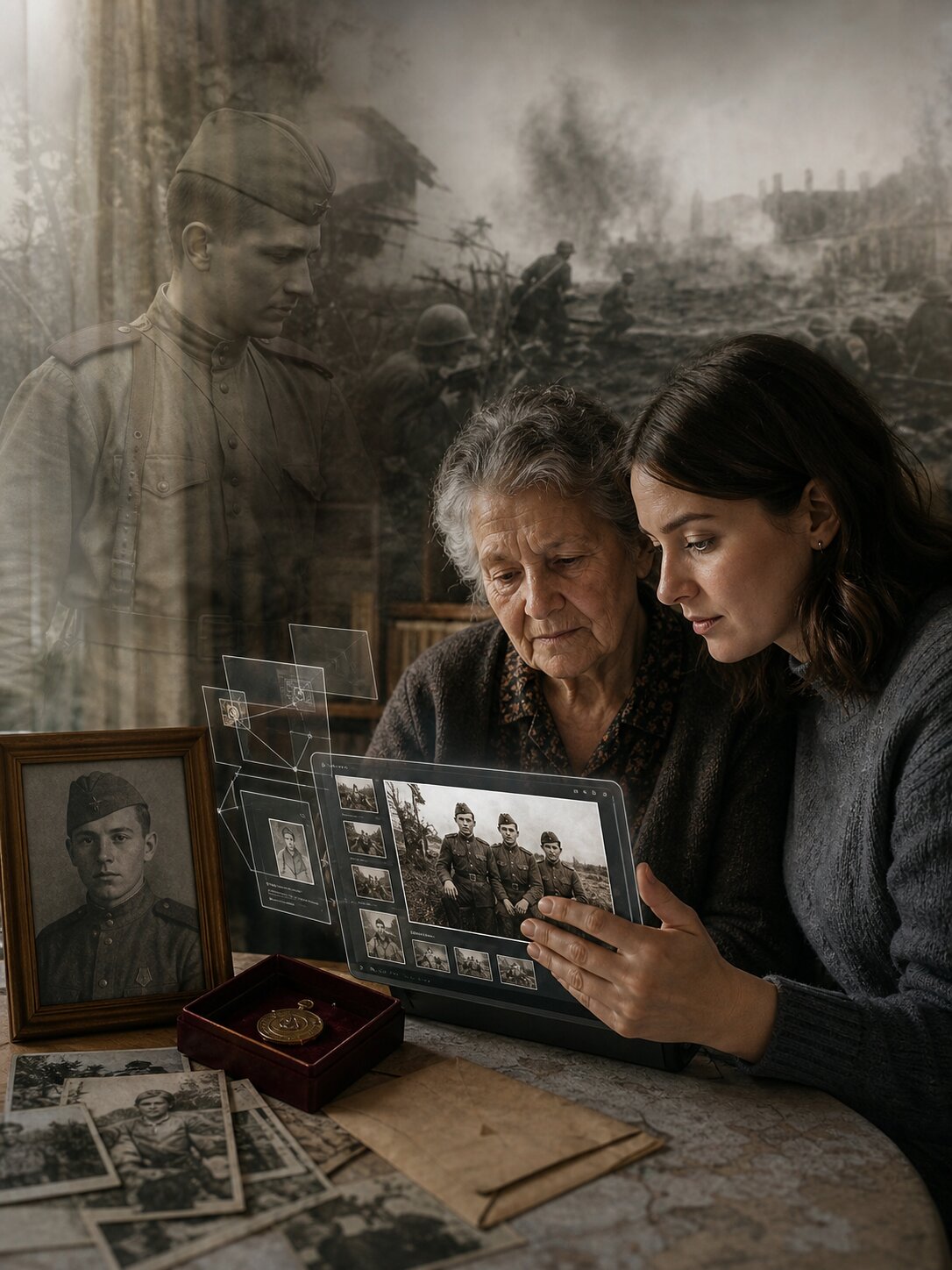
The article is devoted to the problem of transformation of family memory in the context of digitalization of society, when the processes of preservation, transmission, and interpretation of the past are increasingly transferred to the environment of digital platforms, social media services and online archives. Under these conditions, family memory ceases to be an exclusively private and intergenerational form of communication, but is included into the broader context of public representation, mediatization, and standardization of historical experience. This problem is of particular importance in relation to the memory of the Great Patriotic War, which remains one of the central foundations of cultural identity and collective self-understanding in modern Russia. The purpose of the study is to identify how digitalization is changing the forms of family memory and how these changes manifest themselves at the level of user-friendly commemorative practices, the platform organization of texts of memories and stories, as well as ways of public representation of the past. The paper shows that the digital environment not only expands the possibilities of preserving and distributing family narratives, but also significantly rebuilds the very structure of memory, transferring it from a live narrative mode to a platform-based, partially standardized and publicly accessible form. Based on the material of the platforms “Zhivaya istoriya” and “Bessmertny polk”, it has been established that digital family memory develops in the logic of transition from narrativization to formalization. The proportion of extended family stories is decreasing, the role of short biographical notes is increasing, and the language of the texts is becoming more formulaic and less lexically diverse. It is concluded that the digitalization of family memory represents not only a technical change in the channels of storing the past, but also a profound transformation of its social and communicative forms. The article is addressed to specialists in the field of social philosophy, collective memory research, digital humanities, media studies, as well as to anyone who studies modern forms of representation of the past in digital culture.
References
Artamonov, D. S. (2022). Socio-Epistemic Arenas of Historical Cognition. Izvestiya of Saratov University. Philosophy. Psychology. Pedagogy, 22(3), 238–242. https://doi.org/10.18500/1819-7671-2022-22-3-238-242 (In Russian).
Assmann, J. (2004). Cultural Memory and Early Civilization: Writing, Remembrance, and Political Imagination. Languages of Slavic Culture. (In Russian).
Barash, R. E. (2021). Family Memory of the Russia’s Citizens in the Context of Actual Social Challenges. Sociopolitical Sciences, 11(5), 13–26. https://doi.org/10.33693/2223-0092-2021-11-5-13-26 (In Russian).
Barnwell, A., Neves, B. B., & Ravn, S. (2023). Captured and Captioned: Representing Family Life on Instagram**. New Media & Society, 25(5), 921–942. https://doi.org/10.1177/14614448211012791
Beer, D. (2017). The Social Power of Algorithms. Information, Communication & Society, 20(1), 1–13. https://doi.org/10.1080/1369118X.2016.1216147
Couldry, N., & Hepp, A. (2017). The Mediated Construction of Reality. John Wiley & Sons.
Covington, P., Adams, J., & Sargin, E. (2016). Deep Neural Networks for YouTube Recommendations. Proceedings of the 10th ACM Conference on Recommender Systems, 191–198. https://doi.org/10.1145/2959100.2959190
DaCosta, B. (2025). Speaking with the Past: Constructing AI-Generated Historical Characters for Cultural Heritage and Learning. Heritage, 8(9), 387. https://doi.org/10.3390/heritage8090387
Dijck, J. van, Poell, T., & de Waal, M. (2018). The Platform Society: Public Values in a Connective World. Oxford University Press.
Erll, A. (2011). Memory in Culture. Palgrave Macmillan. https://doi.org/10.1057/9780230321670
Fricker, M. (2007). Epistemic Injustice: Power and the Ethics of Knowing. Oxford University Press. https://doi.org/10.1093/acprof:oso/9780198237907.001.0001
Fuller, S. (2002). Social Epistemology. Indiana University Press.
Goldman, A. I. (1999). Knowledge in a Social World. Clarendon Press. https://doi.org/10.1093/0198238207.001.0001
Grishechkina, N. V., & Tikhonova, S. V. (2018). Civil Expertise of Scientific Knowledge in the Digital Era. Epistemology & Philosophy of Science, 55(2), 123–138. https://doi.org/10.5840/eps201855233 (In Russian).
Grønning, A. (2021). Micro-Memories: Digital Modes of Communication Across Three Generations. Memory Studies, 14(4), 733–746. https://doi.org/10.1177/1750698020959810
Halbwachs, M. (2007). The Social Frameworks of Memory. New Publishing House. (In Russian).
Helmond, A., & Van Der Vlist, F. N. (2019). Social Media and Platform Historiography: Challenges and Opportunities. TMG Journal for Media History, 22(1), 6. https://doi.org/10.18146/tmg.434
Holloway, D., & Green, L. (2017). Mediated Memory Making: The Virtual Family Photograph Album. Communications, 42(3). https://doi.org/10.1515/commun-2017-0033
Hoskins, A. (2024). AI and Memory. Memory, Mind & Media, 3, e18. https://doi.org/10.1017/mem.2024.16
Hoskins, A. (Ed.). (2018). Digital Memory Studies: Media Pasts in Transition. Routledge. https://doi.org/10.4324/9781315637235
Hutchins, E. (1995). Cognition in the Wild. MIT Press. https://doi.org/10.7551/mitpress/1881.001.0001
Ivkin, V. I. (2020). Open-Access Information Resources Devoted to the Great Patriotic War and Historical Research. Humanitarian Bulletin of the Military Academy of the Strategic Missile Forces, (4), 21–28. (In Russian).
Jacobsen, B., & Beer, D. (2021). Social Media and the Automatic Production of Memory: Classification, Ranking and the Sorting of the Past (1st ed.). Bristol University Press. https://doi.org/10.46692/9781529218176
Jakubowicz, A. (2009). Remembering and Recovering Shanghai: Seven Jewish Families [Re]-connect in Cyberspace. In J. Garde-Hansen, A. Hoskins, & A. Reading (Eds.), Save As … Digital Memories (pp. 96–114). Palgrave Macmillan UK. https://doi.org/10.1057/9780230239418_6
Jones, J., & Ackerman, M. S. (2018). Co-constructing Family Memory: Understanding the Intergenerational Practices of Passing on Family Stories. Proceedings of the 2018 CHI Conference on Human Factors in Computing Systems, 1–13. https://doi.org/10.1145/3173574.3173998
Kitchin, R. (2017). Thinking Critically About and Researching Algorithms. Information, Communication & Society, 20(1), 14–29. https://doi.org/10.1080/1369118X.2016.1154087
Korobitsyna, L. V. (2022). Memory of the Great Patriotic War in the Internet Space of Russian Social Networks. History: Facts and Symbols, (2), 108–114. https://doi.org/10.24888/2410-4205-2022-31-2-108-114 (In Russian).
Marselis, R. (2024). Colourising the Past: Digital Visual Repatriation of Colourised Sámi Photography. Memory, Mind & Media, 3, e16. https://doi.org/10.1017/mem.2024.9
O’Connor, C., & Weatherall, J. O. (2019). The Misinformation Age: How False Beliefs Spread. Yale University Press. https://doi.org/10.2307/j.ctv8jp0hk
Origgi, G. (2012). Epistemic Injustice and Epistemic Trust. Social Epistemology, 26(2), 221–235. https://doi.org/10.1080/02691728.2011.652213
Otrokova, O. Yu. (2020). Archival Sources on the History of the Great Patriotic War in Digital Format: Structure and Features. International Journal of Humanities and Natural Sciences, (11–1), 43–46. https://doi.org/10.24411/2500-1000-2020-11337 (In Russian).
Petrelli, D., & Whittaker, S. (2010). Family Memories in the Home: Contrasting Physical and Digital Mementos. Personal and Ubiquitous Computing, 14(2), 153–169. https://doi.org/10.1007/s00779-009-0279-7
Reading, A. (2016). Gender and Memory in the Globital Age. Palgrave Macmillan UK. https://doi.org/10.1057/978-1-137-35263-7
Richardson-Walden, V. G., & Marrison, K. (2024). An Entangled Memoryscape: Holocaust Memory on Social Media. Memory, Mind & Media, 3, e23. https://doi.org/10.1017/mem.2024.15
Rodin, P., Ghersetti, M., & Odén, T. (2019). Disentangling Rhetorical Subarenas of Public Health Crisis Communication: A Study of the 2014–2015 Ebola Outbreak in the News Media and Social Media in Sweden. Journal of Contingencies and Crisis Management, 27(3), 237–246. https://doi.org/10.1111/1468-5973.12254
Roued, H., Castenbrandt, H., & Revuelta-Eugercios, B. A. (2023). Search, Save and Share: Family Historians’ Engagement Practices with Digital Platforms. Archival Science, 23(2), 187–206. https://doi.org/10.1007/s10502-022-09404-4
Shchipko, V. R. (2025). Social Networks and Platforms for Popularization of Events of the Great Patriotic War Among the Youth Audience. Education and Science Without Borders: Fundamental and Applied Research, (21), 182–186. https://doi.org/10.36683/FP-21/182-186 (In Russian).
Shipovalova, L. V. (2019). Distributed Cognition and its Boundaries in the Context of Public Science Communication. Sociology of Science and Technology, 10(3), 56–71. https://doi.org/10.24411/2079-0910-2019-13003 (In Russian).
Tikhonova, S. V., & Frolova, S. M. (2020). Historical Memory and the Medial Turn: Digitalization of the Past. Bulletin of the Volga Region Institute of Administration, 20(4), 78–85. https://doi.org/10.22394/1682-2358-2020-4-78-85 (In Russian).
Toshchenko, Zh. T. (2020). What is Happening to Historical Memory of the Great Patriotic War? Sociological Studies, (5), 18–22. (In Russian).
** — owned by Meta, an organization recognized as extremist and banned in the Russian Federation

This work is licensed under a Creative Commons Attribution 4.0 International License.
Copyright (c) 2026 Denis S. Artamonov, Svetlana A. Shilova