
Ключевые слова
семейная память
Великая Отечественная война
цифровая память
медиатизация памяти
коллективная память
культурная память
цифровые платформы
коммеморация
цифровая гуманитаристика
Как цитировать
Аннотация
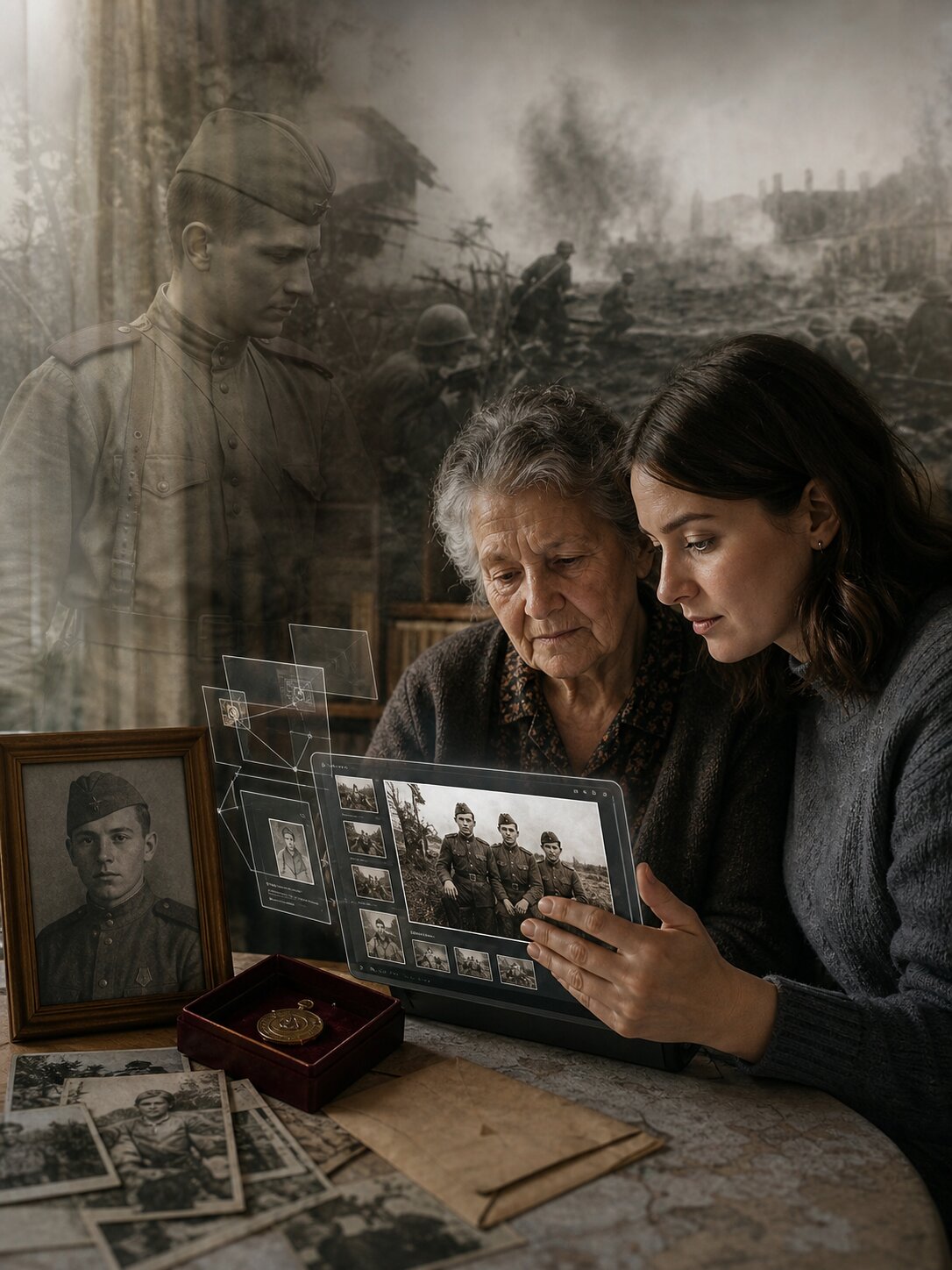
Статья посвящена проблеме трансформации семейной памяти в условиях цифровизации общества, когда процессы сохранения, передачи и интерпретации прошлого все в большей степени переносятся в среду цифровых платформ, сервисов социальных сетей и онлайн-архивов. В этих условиях семейная память перестает быть исключительно приватной и межпоколенческой формой коммуникации, включаясь в более широкий контекст публичной репрезентации, медиатизации и стандартизации исторического опыта. Особое значение данная проблема приобретает применительно к памяти о Великой Отечественной войне, которая в современной России остается одной из центральных основ культурной идентичности и коллективного самопонимания. Цель исследования состоит в выявлении того, каким образом цифровизация изменяет формы существования семейной памяти и как эти изменения проявляются на уровне пользовательских коммеморативных практик, платформенной организации текстов воспоминаний и историй, а также способов публичной репрезентации прошлого. В работе показано, что цифровая среда расширяет возможности сохранения и распространения семейных нарративов, а также существенно перестраивает саму структуру памяти, переводя ее из режима живого повествования в режим платформенно организованной, частично стандартизированной и публично доступной формы. На материале платформ «Живая история» и «Бессмертный полк» установлено, что цифровая семейная память развивается в логике перехода от нарративизации к формализации: снижается доля развернутых семейных рассказов, усиливается роль кратких биографических записей, а язык текстов становится более шаблонным и менее лексически разнообразным. Делается вывод о том, что цифровизация семейной памяти представляет собой не только техническое изменение каналов хранения прошлого, но и глубокую трансформацию его социальных и коммуникативных форм. Статья адресована специалистам в области социальной философии, исследований коллективной памяти, цифровой гуманитаристики, медиаисследований, а также всем, кто изучает современные формы репрезентации прошлого в цифровой культуре.
Библиографические ссылки
Artamonov, D. S. (2022). Socio-Epistemic Arenas of Historical Cognition. Izvestiya of Saratov University. Philosophy. Psychology. Pedagogy, 22(3), 238–242. https://doi.org/10.18500/1819-7671-2022-22-3-238-242 (In Russian).
Assmann, J. (2004). Cultural Memory and Early Civilization: Writing, Remembrance, and Political Imagination. Languages of Slavic Culture. (In Russian).
Barash, R. E. (2021). Family Memory of the Russia’s Citizens in the Context of Actual Social Challenges. Sociopolitical Sciences, 11(5), 13–26. https://doi.org/10.33693/2223-0092-2021-11-5-13-26 (In Russian).
Barnwell, A., Neves, B. B., & Ravn, S. (2023). Captured and Captioned: Representing Family Life on Instagram**. New Media & Society, 25(5), 921–942. https://doi.org/10.1177/14614448211012791
Beer, D. (2017). The Social Power of Algorithms. Information, Communication & Society, 20(1), 1–13. https://doi.org/10.1080/1369118X.2016.1216147
Couldry, N., & Hepp, A. (2017). The Mediated Construction of Reality. John Wiley & Sons.
Covington, P., Adams, J., & Sargin, E. (2016). Deep Neural Networks for YouTube Recommendations. Proceedings of the 10th ACM Conference on Recommender Systems, 191–198. https://doi.org/10.1145/2959100.2959190
DaCosta, B. (2025). Speaking with the Past: Constructing AI-Generated Historical Characters for Cultural Heritage and Learning. Heritage, 8(9), 387. https://doi.org/10.3390/heritage8090387
Dijck, J. van, Poell, T., & de Waal, M. (2018). The Platform Society: Public Values in a Connective World. Oxford University Press.
Erll, A. (2011). Memory in Culture. Palgrave Macmillan. https://doi.org/10.1057/9780230321670
Fricker, M. (2007). Epistemic Injustice: Power and the Ethics of Knowing. Oxford University Press. https://doi.org/10.1093/acprof:oso/9780198237907.001.0001
Fuller, S. (2002). Social Epistemology. Indiana University Press.
Goldman, A. I. (1999). Knowledge in a Social World. Clarendon Press. https://doi.org/10.1093/0198238207.001.0001
Grishechkina, N. V., & Tikhonova, S. V. (2018). Civil Expertise of Scientific Knowledge in the Digital Era. Epistemology & Philosophy of Science, 55(2), 123–138. https://doi.org/10.5840/eps201855233 (In Russian).
Grønning, A. (2021). Micro-Memories: Digital Modes of Communication Across Three Generations. Memory Studies, 14(4), 733–746. https://doi.org/10.1177/1750698020959810
Halbwachs, M. (2007). The Social Frameworks of Memory. New Publishing House. (In Russian).
Helmond, A., & Van Der Vlist, F. N. (2019). Social Media and Platform Historiography: Challenges and Opportunities. TMG Journal for Media History, 22(1), 6. https://doi.org/10.18146/tmg.434
Holloway, D., & Green, L. (2017). Mediated Memory Making: The Virtual Family Photograph Album. Communications, 42(3). https://doi.org/10.1515/commun-2017-0033
Hoskins, A. (2024). AI and Memory. Memory, Mind & Media, 3, e18. https://doi.org/10.1017/mem.2024.16
Hoskins, A. (Ed.). (2018). Digital Memory Studies: Media Pasts in Transition. Routledge. https://doi.org/10.4324/9781315637235
Hutchins, E. (1995). Cognition in the Wild. MIT Press. https://doi.org/10.7551/mitpress/1881.001.0001
Ivkin, V. I. (2020). Open-Access Information Resources Devoted to the Great Patriotic War and Historical Research. Humanitarian Bulletin of the Military Academy of the Strategic Missile Forces, (4), 21–28. (In Russian).
Jacobsen, B., & Beer, D. (2021). Social Media and the Automatic Production of Memory: Classification, Ranking and the Sorting of the Past (1st ed.). Bristol University Press. https://doi.org/10.46692/9781529218176
Jakubowicz, A. (2009). Remembering and Recovering Shanghai: Seven Jewish Families [Re]-connect in Cyberspace. In J. Garde-Hansen, A. Hoskins, & A. Reading (Eds.), Save As … Digital Memories (pp. 96–114). Palgrave Macmillan UK. https://doi.org/10.1057/9780230239418_6
Jones, J., & Ackerman, M. S. (2018). Co-constructing Family Memory: Understanding the Intergenerational Practices of Passing on Family Stories. Proceedings of the 2018 CHI Conference on Human Factors in Computing Systems, 1–13. https://doi.org/10.1145/3173574.3173998
Kitchin, R. (2017). Thinking Critically About and Researching Algorithms. Information, Communication & Society, 20(1), 14–29. https://doi.org/10.1080/1369118X.2016.1154087
Korobitsyna, L. V. (2022). Memory of the Great Patriotic War in the Internet Space of Russian Social Networks. History: Facts and Symbols, (2), 108–114. https://doi.org/10.24888/2410-4205-2022-31-2-108-114 (In Russian).
Marselis, R. (2024). Colourising the Past: Digital Visual Repatriation of Colourised Sámi Photography. Memory, Mind & Media, 3, e16. https://doi.org/10.1017/mem.2024.9
O’Connor, C., & Weatherall, J. O. (2019). The Misinformation Age: How False Beliefs Spread. Yale University Press. https://doi.org/10.2307/j.ctv8jp0hk
Origgi, G. (2012). Epistemic Injustice and Epistemic Trust. Social Epistemology, 26(2), 221–235. https://doi.org/10.1080/02691728.2011.652213
Otrokova, O. Yu. (2020). Archival Sources on the History of the Great Patriotic War in Digital Format: Structure and Features. International Journal of Humanities and Natural Sciences, (11–1), 43–46. https://doi.org/10.24411/2500-1000-2020-11337 (In Russian).
Petrelli, D., & Whittaker, S. (2010). Family Memories in the Home: Contrasting Physical and Digital Mementos. Personal and Ubiquitous Computing, 14(2), 153–169. https://doi.org/10.1007/s00779-009-0279-7
Reading, A. (2016). Gender and Memory in the Globital Age. Palgrave Macmillan UK. https://doi.org/10.1057/978-1-137-35263-7
Richardson-Walden, V. G., & Marrison, K. (2024). An Entangled Memoryscape: Holocaust Memory on Social Media. Memory, Mind & Media, 3, e23. https://doi.org/10.1017/mem.2024.15
Rodin, P., Ghersetti, M., & Odén, T. (2019). Disentangling Rhetorical Subarenas of Public Health Crisis Communication: A Study of the 2014–2015 Ebola Outbreak in the News Media and Social Media in Sweden. Journal of Contingencies and Crisis Management, 27(3), 237–246. https://doi.org/10.1111/1468-5973.12254
Roued, H., Castenbrandt, H., & Revuelta-Eugercios, B. A. (2023). Search, Save and Share: Family Historians’ Engagement Practices with Digital Platforms. Archival Science, 23(2), 187–206. https://doi.org/10.1007/s10502-022-09404-4
Shchipko, V. R. (2025). Social Networks and Platforms for Popularization of Events of the Great Patriotic War Among the Youth Audience. Education and Science Without Borders: Fundamental and Applied Research, (21), 182–186. https://doi.org/10.36683/FP-21/182-186 (In Russian).
Shipovalova, L. V. (2019). Distributed Cognition and its Boundaries in the Context of Public Science Communication. Sociology of Science and Technology, 10(3), 56–71. https://doi.org/10.24411/2079-0910-2019-13003 (In Russian).
Tikhonova, S. V., & Frolova, S. M. (2020). Historical Memory and the Medial Turn: Digitalization of the Past. Bulletin of the Volga Region Institute of Administration, 20(4), 78–85. https://doi.org/10.22394/1682-2358-2020-4-78-85 (In Russian).
Toshchenko, Zh. T. (2020). What is Happening to Historical Memory of the Great Patriotic War? Sociological Studies, (5), 18–22. (In Russian).
** — owned by Meta, an organization recognized as extremist and banned in the Russian Federation

Это произведение доступно по лицензии Creative Commons «Attribution» («Атрибуция») 4.0 Всемирная.
Copyright (c) 2026 Артамонов Денис Сергеевич, Шилова Светлана Алексеевна